MiCA Market Growth
ESMA MiCA Register Expands to 294 Firms, Authorizing Ripple and More Banks Post-Deadline
Anonymous
Key Points
1
BitPay became the latest company to secure a MiCA license from the Netherlands regulator, signaling continued post-deadline licensure activity across the EU.
2
OSL EU GmbH in Austria was added to the MiCA register, expanding post-deadline representation of digital-asset services among Central European players.
3
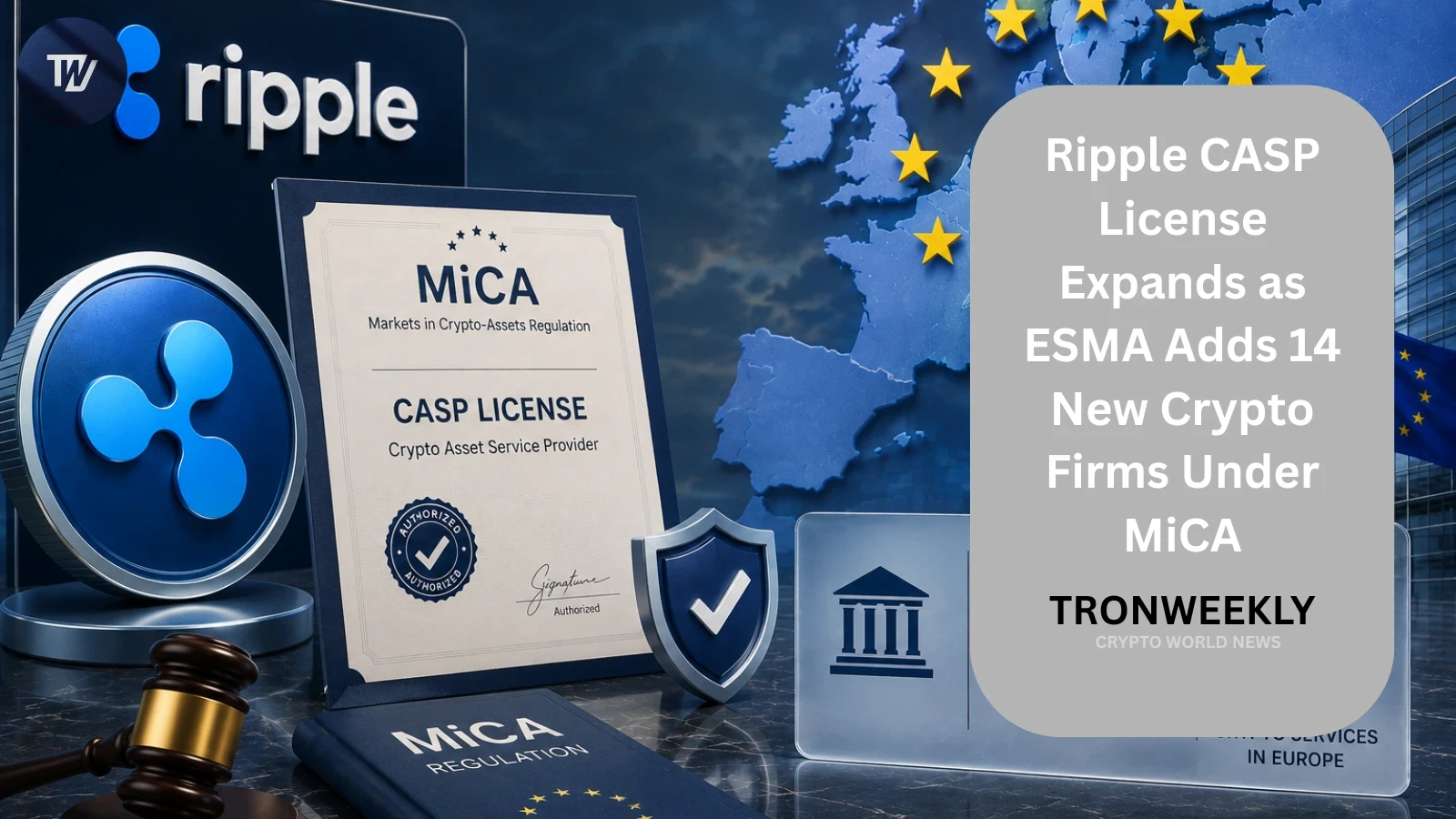
Ripple Payments Europe in Luxembourg now holds a full CASP authorization and, together with its Luxembourg EMI license, can deliver crypto and stablecoin payments across the entire European Economic Area.
4
Post-deadline licensing wave includes major global players such as Standard Chartered, FalconX, Sygnum Europe, and Ronin EM, illustrating continued growth in the MiCA-licensed market.
Europe's crypto regulatory map just got bigger. The European Securities and Markets Authority added 14 new crypto-asset service providers to its MiCA register on July 16, pushing the total number of authorized firms to 294, according to Crypto Times. Among the new entrants: Ripple Payments Europe, Croatia's Hrvatska poštanska banka, and Bison Bank.
The additions come more than two weeks after the July 1 grandfathering deadline — the cutoff date for existing crypto firms to secure MiCA authorization or lose the right to operate in the EU. Rather than slowing down, approvals have accelerated. CoinGape reports that 51 new licenses were granted in just three weeks after that deadline, signaling a market that is growing, not shrinking.
Ripple Gets Full EU Crypto Authorization in Luxembourg
Ripple Payments Europe SA, the European arm of blockchain payments company Ripple, is now fully authorized under MiCA. The firm is based in Luxembourg and holds both a MiCA crypto-asset service provider license and an e-money institution license, according to CoinGape. Together, those two licenses let Ripple offer crypto and stablecoin payment services across all 30 countries in the European Economic Area.
MiCA includes a passporting rule. That means a license granted in one EU member state — like Luxembourg — automatically allows a firm to operate in every other EU country. Ripple's Luxembourg base gives it a single regulatory home while serving the entire bloc. Finance Feeds noted this makes Ripple a standout example of how crypto firms are using EU rules to scale quickly across borders.
Banks Join the MiCA Register Alongside Crypto Firms
The July 16 update was not just about pure-play crypto companies. Traditional banks also made the list. Volksbank Schwarzwald-Donau-Neckar, Raiffeisenbank Auerbach-Freihung, and Kaiser Partner Privatbank all received MiCA authorization, according to Crypto Times. Croatia's Hrvatska poštanska banka — a state-linked postal bank — was also added.
The mix of banks and fintech firms in the same register is a key sign of how MiCA is reshaping European finance. Crypto services are no longer just for specialist firms. Traditional banks are now entering the space with full regulatory cover. That blurs the line between conventional banking and digital-asset services in ways Europe has not seen before.
BitPay, OSL, and Major Global Players Clear Post-Deadline Hurdle
BitPay secured its MiCA license from the Netherlands regulator after the July 1 cutoff, joining a wave of global names that cleared the post-deadline process. OSL EU GmbH in Austria also earned authorization, expanding the register's reach into Central Europe, according to Tron Weekly. Both additions show that ESMA is still actively processing applications well past the transition deadline.
Other major names that received licenses in the post-deadline period include Standard Chartered, FalconX, Sygnum Europe, and Ronin EM, according to Finance Feeds. The presence of a global bank like Standard Chartered alongside crypto-native firms signals that institutional players are treating MiCA authorization as a serious business priority, not a compliance afterthought.
294 Authorized Firms and Counting as ESMA Keeps Processing
The MiCA register has now grown to 294 authorized firms across the EU. ESMA added 37 licenses in one batch after the transition, then added 14 more on July 16 alone. The pace suggests the regulator is working through a large backlog of applications, not wrapping up, according to Crypto Times.
The overall picture is one of expansion. More firms, more countries, more types of institutions — all entering a single regulated framework for crypto in Europe. MiCA was designed to bring order to a fragmented market. With 294 entities now on the register and approvals still coming, it appears to be doing exactly that.
Sentiment
Mostly PositiveNEGATIVENEUTRALPOSITIVE
Publishers
12
Articles
0
Reach
12
A
AnonymousAuthor