Etna Eruption Disrupts Flights Across Sicily
Etna Eruption Disrupts Flights Across Sicily
Anonymous
Key Points
1
The ash cloud was moving south toward Catania Airport, where officials were monitoring it with visible and thermal surveillance cameras.
2
The Institute of Geophysics and Volcanology also reported frequent explosive activity at Etna’s summit craters, along with ash clouds, pyroclastic debris and lava at the summit.
3
The eruption followed other volcanic activity earlier in the year: Etna had also caused disruption at Catania Airport in July.
4
Passengers were being redirected to Palermo, about 200 kilometers from Catania, rather than simply facing cancellations at the affected airport.
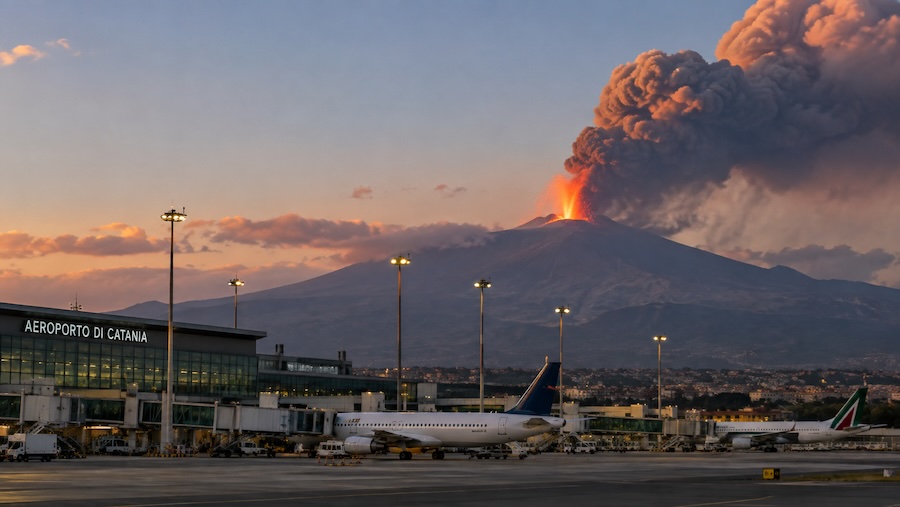
Mount Etna erupted in Sicily on Monday, sending ash 4 kilometers into the air and forcing Catania Airport to suspend all arrivals. Italy's aviation authorities issued a red alert after ash clouds moved south toward the airport. Officials closed airspace sectors C1 and B3 until at least 4 p.m., then extended the suspension to 10 p.m. Flights were diverted to Palermo and other airports across Sicily.
Italy's Institute of Geophysics and Volcanology reported near-continuous ash emissions, frequent explosive activity at the summit craters, and visible lava. Officials warned that the eruption could intensify, producing larger ash clouds and pyroclastic flows — fast-moving currents of hot gas and rock. Passengers were advised to check with airlines before traveling.
Ash Cloud Forces Airport Closure and Flight Diversions
Catania's Vincenzo Bellini Airport suspended arrivals as the ash moved toward the runway. The airport operator initially closed the airspace until 4 p.m., but later extended the shutdown to 10 p.m. Airspace sectors C1 and B3 were fully closed. Officials used visible and thermal surveillance cameras to monitor the ash cloud's movement and intensity.
Travelers faced significant disruptions, with flights rerouted to Palermo, about 200 kilometers away. TravelWires reported that airspace sectors remained closed due to ongoing volcanic activity. Rather than canceling flights, airlines chose to divert passengers to alternative Sicilian airports, reducing total travel losses across the region.
Volcano Shows Signs of Continued Dangerous Activity
The Institute of Geophysics and Volcanology documented variable-rate degassing and ash emissions from Etna's summit craters. The agency reported frequent explosive activity, visible ash clouds, pyroclastic debris, and lava flows at the peak. Scientists flagged the danger of pyroclastic flows — avalanches of burning gas and rock that can travel fast and destroy everything in their path.
Officials warned that volcanic activity could intensify further. Larger eruption columns and denser ash clouds could expand the no-fly zone beyond current boundaries. Passengers and airlines were told to remain alert and check conditions constantly before any air travel to or from eastern Sicily.
Etna's Repeated Disruption of Sicilian Air Traffic
Reuters reported that Mount Etna disrupted Catania Airport for a second time in 2026. The volcano also closed the airport in July with ash emissions and volcanic debris. Sicily's main airport has become increasingly vulnerable to volcanic shutdowns as Etna's activity continues to surge unpredictably.
Sentiment
Mostly NegativeNEGATIVENEUTRALPOSITIVE
Publishers
25
Articles
26
Reach
51
A
AnonymousAuthor


