Trump's Greenland Gambit
Trump's Greenland Push and Turkey Arms Talks Strain Transatlantic Security Commitments
Anonymous
Key Points
1
A formal working group of U.S., Danish, and Greenlandic representatives has been meeting regularly to draft a 'framework of a future deal' on Greenland, with Danish Foreign Minister Lars Lokke Rasmussen saying the group is expected to deliver a solution by year-end.
2
Denmark’s financial role in Greenland is substantial: an annual block grant of about $500-600 million funds more than half of Greenland’s public budget and roughly 20% of its GDP, with an additional $253 million pledged for healthcare and infrastructure through 2029.
3
Officials have debunked Trump’s claim that Greenland is surrounded by Chinese and Russian ships; Denmark’s Joint Arctic Command chief has said he has seen no such ships near Greenland in years, and vessel-tracking data show no evidence of them in the area.
4
Danish Prime Minister Mette Frederiksen said there are no plans to discuss Greenland during the Ankara visit, and Greenland’s Foreign Minister Mute Egede posted that Greenland’s future is up to its people, signaling official pushback from both Denmark and Greenland.
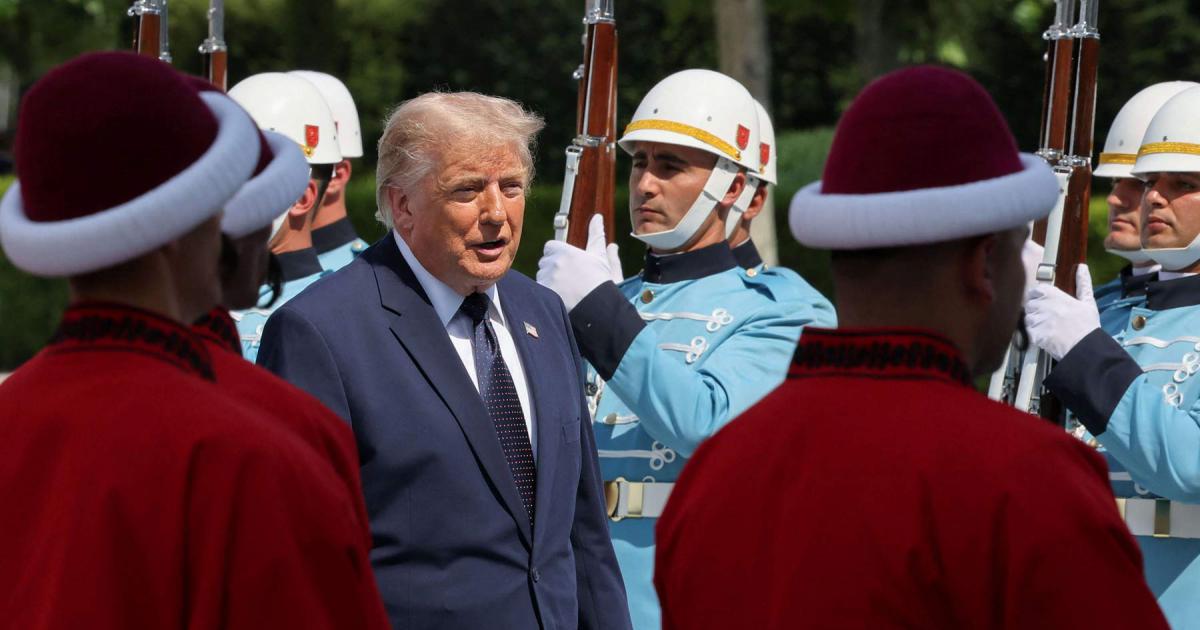
At the NATO summit in Ankara, President Trump declared that Greenland "should be controlled by the United States, not by Denmark," falsely claiming the Arctic island is surrounded by Russian and Chinese warships The Kenya Times. He also threatened to pull U.S. troops from Europe and signaled a major arms deal with Turkey — moves that sent shockwaves through an already strained alliance Middle East Online.
Danish Prime Minister Mette Frederiksen said Greenland is "not for sale" and "ready to defend" its territory. Greenland's Foreign Minister Múte Egede posted that the island's future "should be decided by its people" Iron Mountain Daily News. A trilateral U.S.-Danish-Greenlandic working group is already meeting and is expected to produce a formal deal by the end of 2026.
Trump's Warship Claim Collapses Under Scrutiny
Trump told reporters and allies that Greenland's coast is "covered" with Russian and Chinese ships. That claim is false AOL. Major General Søren Andersen, head of Denmark's Joint Arctic Command, said he has seen no Russian or Chinese combat vessels near Greenland in years. Vessel-tracking data back him up. Arctic expert Andreas Østhagen noted those navies operate in the Barents and Bering Seas — thousands of miles away.
Trump's broader argument is that Denmark underfunds Greenland and cannot defend the Arctic. That, too, is hard to square with the numbers. Denmark gives Greenland a block grant of roughly $590–610 million per year. That funds more than 50% of Greenland's public budget and about 20% of its GDP. Denmark has also pledged an extra $253 million for healthcare and infrastructure through 2029 The Kenya Times.
Greenland Wants Independence — Just Not From the U.S.
Over 70% of Greenlanders support eventual independence from Denmark, polls show. But they strongly reject U.S. annexation or "control" NTD. This puts Greenland in a tight spot. Leaving Denmark would cut off the $600 million annual block grant that keeps its budget running. Greenlandic leaders had hoped for U.S. investment to fill that gap — not a U.S. takeover.
The U.S. already has a major military foothold there. The Pituffik Space Base in northern Greenland hosts early-warning radar systems that track ballistic missiles aimed at North America. That access comes from a 1951 U.S.-Denmark Defense Agreement — a deal that remains in force. Trump's push for "control" goes far beyond what that treaty requires AOL.
Turkey F-35 Deal and the Price of Trump's Loyalty
On the summit's first day, Trump announced he would lift U.S. sanctions on Turkey under a law called CAATSA. Those sanctions had blocked Turkey from buying F-35 fighter jets after Ankara bought a Russian air-defense system in 2019. Lifting them clears the way for Turkey to re-enter the F-35 program Middle East Online. In exchange, Turkey's President Erdogan offered Trump a ceremonial welcome — and a closer bilateral bond.
Critics say the deal rewards Turkey for buying Russian weapons. It also bypasses Congress, which passed the CAATSA sanctions law. NATO Secretary General Mark Rutte tried to put a positive spin on the summit, saying European allies are "delivering" on defense. Several Eastern European nations wore "5% Club" pins at the summit, showing they hit the 5%-of-GDP defense spending target. Spain, at about 2% of GDP, did not — and Trump publicly ordered his Treasury Secretary to cut all trade with Madrid NTD.
What a U.S. Troop Pullout Would Mean for Europe
Trump's threat to pull U.S. forces from Europe is not new. But saying it at a NATO summit raises the stakes. The U.S. has roughly 100,000 troops stationed across Europe. A withdrawal would leave Eastern European members — especially those bordering Russia — dangerously exposed Iron Mountain Daily News. The threat also weakens NATO's core promise: that an attack on one member is an attack on all.
Trump justified the threat by pointing to Europe's response to the recent U.S. war with Iran. Several countries — including Spain — refused to let U.S. aircraft use their airspace or bases. Trump called Spain a "wasted cause" and a "terrible partner" AOL. Spain's government said it was handling the remarks with "tranquility and normality," adding that as an EU member, its trade is protected by the broader bloc — meaning any U.S. embargo on Spain alone would trigger EU-wide retaliation.
Sentiment
Mostly NegativeNEGATIVENEUTRALPOSITIVE
Publishers
78
Articles
161
Reach
239
Topics
A
AnonymousAuthor


