Venezuela Quake, Tsunami Threat
Powerful Twin Earthquakes Strike Venezuela, Triggering Widespread Panic and Regional Tsunami Alerts
Anonymous
Key Points
1
The first tsunami wave was expected at roughly 10:30 pm local time, with a tsunami warning already in place for coastal areas.
2
A local resident described the shaking as 'never felt anything so strong,' illustrating the intensity of the quake in the capital region.
3
Images and video circulating on social media showed buildings collapsed or heavily damaged in parts of the affected area, while officials had not yet confirmed casualties.
4
In addition to Puerto Rico and the U.S. Virgin Islands, the tsunami warning also indicated potential hazards for Aruba, Curacao and Bonaire.
5
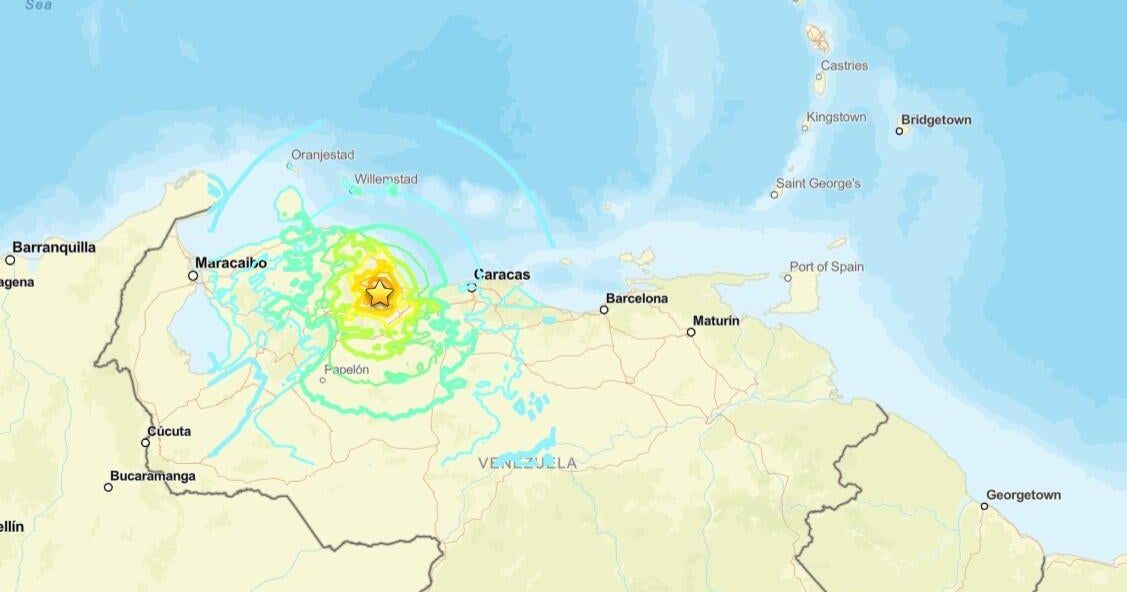
USGS data placed the epicenter about 28 km northwest of Montalbán at a depth of 13.2 km, and the region has a history of significant quakes including the 1967 Caracas event, the 1997 Cariaco quake, and the 2018 magnitude-7.3 tremor.
A magnitude 7.1 earthquake struck northern Venezuela on Wednesday afternoon, shaking Caracas and triggering a tsunami warning across the Caribbean. The quake hit at 3:04 PM local time, with the epicenter about 28 kilometers northwest of Montalbán at a shallow depth of just 13.2 kilometers, according to USGS. Tremors were felt as far as 800 miles away, reaching Bogotá, Colombia, and parts of Guyana, CBS News reported.
Buildings cracked and facades collapsed across Caracas. One resident told Daily Express they had "never felt anything so strong," describing furniture visible through collapsed apartment walls. No official death toll was confirmed by early evening, though multiple injuries were reported in the Guatire area, according to CBS News.
Tsunami Warning Expands to Cover Caribbean Islands
The U.S. Tsunami Warning System issued its first advisory for Puerto Rico and the U.S. Virgin Islands at 3:13 PM, just nine minutes after the quake struck. By 6:30 PM, the warning expanded to include the British Virgin Islands and the ABC islands — Aruba, Curaçao, and Bonaire — according to CBS News. Authorities warned of "hazardous sea-level fluctuations and strong ocean currents" along beaches and in harbors.
The first tsunami fluctuations were estimated to arrive in Puerto Rico and the Virgin Islands around 7:19 PM local time, Yahoo News reported. A second, larger wave crest was expected around 10:30 PM in more distant Caribbean areas. Coastal evacuations affected thousands of residents and tourists throughout the evening, according to CBS News.
Caracas Neighborhoods Hit Hard, Evacuations Ordered
Venezuela's Interior Minister Diosdado Cabello issued the first official damage report at 4:10 PM, warning of "alarming situations" in Caracas's Altamira neighborhood. He urged all citizens to stay in open spaces. "Collapsed homes and buildings... aftershocks could further damage some structures," he said, according to Mahoning Matters.
Social media videos showed collapsed walls at the Buenaventura Shopping Center in Guatire and clouds of dust rising over the Caracas skyline. Dust columns from falling building facades were visible across multiple neighborhoods, the Associated Press reported. Seismologists noted the shallow 13.2 km depth was the key driver of severe surface shaking and structural failures.
Venezuela's Fragile Infrastructure Faces a Major Test
The quake struck close to the El Palito refinery in Puerto Cabello, which was already running at roughly 20% capacity before the disaster. Venezuela's oil production had already fallen below 700,000 barrels per day in early 2026. Any structural failure at the refinery would worsen the country's existing fuel crisis, analysts warned.
Venezuela's aging buildings made the damage worse. The country's GDP had contracted by 30% in early 2026, leaving little money for maintenance or rebuilding. Reconstruction costs could require $15 to $20 billion, according to research cited by Yahoo News — funds the government does not currently have.
Venezuela Sits on One of the Region's Most Active Fault Lines
Wednesday's quake is not Venezuela's first major tremor. The country sits at the boundary of the Caribbean Plate and the South American Plate — one of the most seismically active zones in the Americas. A magnitude 6.6 quake struck Caracas in 1967, killing roughly 240 people. A magnitude 6.9 quake hit Cariaco in 1997, and a magnitude 7.3 quake struck off Venezuela's northeast coast in 2018, according to CBS News.
The 2018 quake was much deeper — about 76 miles down — which limited its surface damage. Wednesday's event, at just 13.2 km deep, was far more dangerous to buildings at the surface. Seismologists warned of a "prolonged aftershock sequence" that could bring down already-weakened structures in the hours and days ahead.
Sentiment
Mostly NegativeNEGATIVENEUTRALPOSITIVE
Publishers
222
Articles
761
Reach
983
A
AnonymousAuthor


