Japan's AI Transformation
NVIDIA Nemotron Powers Japan's Shift to Industry-Specific AI, Building a National Enterprise Stack
Anonymous
Key Points
1
Fujitsu will promote societal implementation of physical AI by collaborating with major robotics firms FANUC, Yaskawa Electric, and Kawasaki Heavy Industries, while working to standardize and open up the collaborative control platform.
2
Halos for Robotics has been launched as a full-stack safety system for physical AI, aiming to provide safety and governance across robotics deployments.
3
NVIDIA's Nemotron family is released with open weights and data, enabling customization and deployment across regulated and data-localized environments within Japan's enterprise AI stack.
4
Japan's push for industry-focused AI is driven by demographic pressures—aging population and declining birthrate—that create labor shortages and spur digital transformation efforts across manufacturing and other sectors.
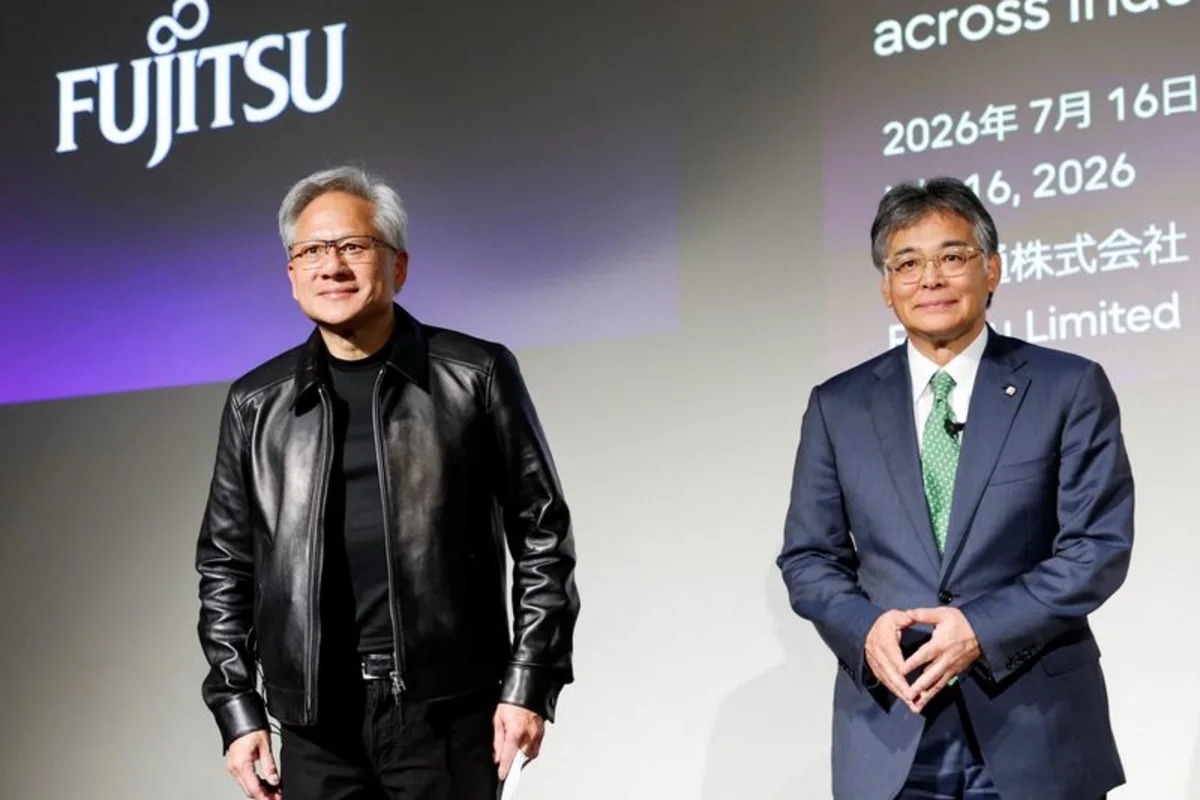
NVIDIA CEO Jensen Huang traveled to Tokyo to announce a sweeping set of AI and robotics partnerships with Japan's biggest industrial firms, including FANUC and Yaskawa Electric, according to Yahoo Finance. The deals center on NVIDIA's Nemotron-Nano-9B-v2-Japanese, an open-weight language model built for deployment inside Japan's factories, hospitals, and enterprise software — without sending sensitive data overseas.
Japan's push is not just about technology. An aging population and a shrinking workforce are forcing companies to move fast on automation. Industry-specific AI — trained on Japanese language and workflows — is now the country's answer to a labor crisis that shows no signs of slowing down.
FANUC and Yaskawa Lead the Robotics AI Push
NVIDIA is partnering directly with FANUC, Yaskawa Electric, and Kawasaki Heavy Industries on physical AI — robots that can sense, decide, and act in real factory settings, according to Yahoo Finance. Fujitsu is also joining the effort, working to standardize the software layer that lets different robots work together on shared tasks.
To make these deployments safe, NVIDIA launched Halos for Robotics — a full-stack safety system designed to govern how physical AI behaves on the factory floor. The goal is to give companies a single framework for safety across every robot in their operation, from assembly arms to remote-presence machines.
Nemotron Opens the Door to Local AI Control
The Nemotron model family is released with open weights and open data. That means Japanese companies can take the base model, retrain it on their own data, and run it inside their own servers — no cloud required, according to Head Topics. This matters most in regulated industries like healthcare and finance, where data cannot leave the building.
Institutions like the Institute of Science Tokyo, SoftBank, Hitachi, NTT DATA, and Sakana AI are already building Nemotron-based applications for contact centers, medical records, and enterprise software. The shift marks a move from tech demos to tools that fit inside existing workflows and deliver measurable ROI.
Labor Shortages Are the Real Engine Behind Japan's AI Bet
Japan has one of the world's oldest populations. Fewer workers mean less output — unless machines can fill the gap. That pressure is pushing manufacturers to adopt AI faster than they otherwise would, according to Yahoo Finance. Robotics and enterprise AI are not optional upgrades here. They are survival tools.
Remote-presence robotics — machines operated by a human from a different location — are one of the fastest-growing use cases. A single worker can oversee multiple robots across multiple sites. That kind of leverage is exactly what Japan's shrinking workforce needs to stay productive.
Foreign Infrastructure Remains a Sticking Point for Japan
Even with open-weight models and local deployment, Japan's AI stack still runs on NVIDIA hardware. Critics point out that local control is only partial when the chips, tools, and core model architecture come from a US company, according to Head Topics. That dependency is a quiet tension inside an otherwise enthusiastic rollout.
Still, Japan's broader strategy is clear: build a national AI platform that Japanese organizations can govern. Open models, locally stored data, and Japanese-language tuning are the building blocks. NVIDIA is supplying the foundation — but Japan intends to own what sits on top of it.
Sentiment
Mostly PositiveNEGATIVENEUTRALPOSITIVE
Publishers
57
Articles
304
Reach
361
A
AnonymousAuthor


