Klopp's Bold Germany Debut
Jürgen Klopp Names Unconventional 44-Player Germany Squad for Upcoming Nations League Matches
Anonymous
Key Points
1
In a video message to supporters, Klopp said he wanted Germany’s new approach to be visible immediately, warning: “It might get a bit wild, but I’ll take that; it just has to be lively.”
2
Newcomer Philipp Treu said Klopp’s influence was already striking, saying: “You feel like you’d walk through fire for him,” while Eintracht Frankfurt striker Younes Ebnoutalib had reportedly been courted by Morocco before choosing Germany.
3
Said El Mala described Klopp’s recruitment call as “short and to the point” and said the coach’s cheerful personality quickly eased his nerves. El Mala, who extended his Cologne contract through 2031, had previously been omitted from Germany’s 2026 World Cup squad despite recording 13 goals and five assists in the German league.
4
Although Gnabry had only just returned from injury, he was one of just four players—alongside Nico Schlotterbeck, Jamal Musiala and Finn Dahmen—permitted to remain for the entire international period, underscoring Klopp’s belief that he can play a leading role in Germany’s rebuild.
5
Klinsmann said the two groups should not be interpreted as an A and B team; Klopp’s stated purpose is to gain the broadest possible assessment of his options before settling on a core squad for the next major tournament.
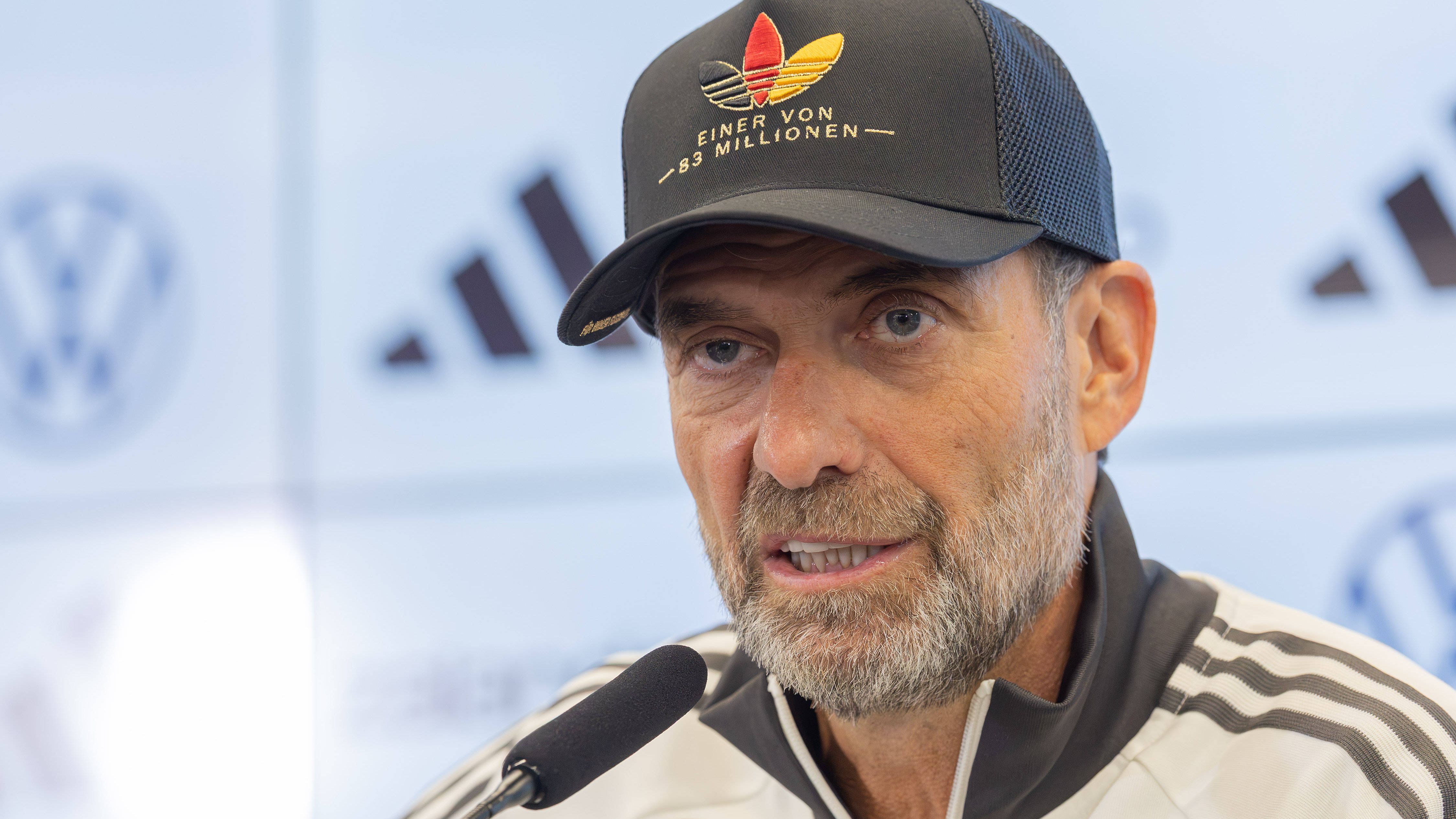
Jürgen Klopp launched his Germany coaching career with an unconventional 44-player squad split into two groups for four Nations League matches, starting this week. The strategy includes 16 uncapped players and limits most stars to just two games, balancing his need to rebuild after the team's 2026 World Cup failure while protecting them from club overload, according to reports. Klopp promised supporters a livelier, more flexible Germany: "It might get a bit wild, but I'll take that; it just has to be lively."
Klopp's Two-Squad Experiment Aims Beyond Mere Evaluation
The 44-player roster represents a radical departure from traditional 23-26 player squads. Jürgen Klinsmann emphasized this is not an A and B team but a broad assessment of Klopp's options for Euro 2028. Only four players—Jamal Musiala, Joshua Kimmich, Serge Gnabry, and Nico Schlotterbeck—will stay for all four matches. The first group of 24 faces the Netherlands and Greece. The second group of 20 plays Serbia and Greece. This split protects elite players from burnout while giving 16 debutants immediate senior exposure.
Newcomers Embrace Klopp's Infectious Personality
Uncapped players have already felt Klopp's impact. Defender Philipp Treu said: "You feel like you'd walk through fire for him." Winger Saïd El Mala, who extended his Cologne contract through 2031 after 13 goals and five assists in the league, described Klopp's recruitment call as "short and to the point." Forward Younes Ebnoutalib chose Germany over Morocco's pursuit. Klopp has already set four rules for the squad, aiming to reshape Germany's culture after years of underperformance at major tournaments.
Star Omissions Reveal Klopp's Form-Based Selection Criteria
World Cup top scorer Deniz Undav and Galatasaray winger Leroy Sané were left out over form concerns. Serge Gnabry's recall came just days after returning from serious injury, signaling Klopp's confidence in his ability to lead Germany's rebuild. Marc-André ter Stegen takes over as primary goalkeeper after Manuel Neuer's retirement. These choices suggest Klopp prioritizes character and attitude alongside on-pitch ability, avoiding players he views as mentally stale or physically unreliable.
German Football Legends Back the Risk-Taking Approach
Lothar Matthäus, Hans-Joachim Watzke, and Jürgen Klinsmann publicly praised Klopp's unorthodox strategy. Analysts called it "extraordinary" and "revolutionary," arguing it drives internal competition and builds squad depth. Klopp's long track record advocating for player welfare adds credibility to the load-management argument. According to sports analysts, the split roster protects stars like Florian Wirtz and Kai Havertz from overplaying while giving fringe players their first real test. The gamble is whether Nations League matches can serve dual purposes—competitive fixtures and extended auditions—without sacrificing cohesion.
Sentiment
Mostly NegativeNEGATIVENEUTRALPOSITIVE
Publishers
31
Articles
27
Reach
58
A
AnonymousAuthor


