Automating Solar with AI
Gritt secures $34M funding to automate solar farm construction with AI, addressing labor shortages
Anonymous
Key Points
1
Gritt leverages off-the-shelf hardware and rental partnerships (for example, Kawasaki robotic arms and loaders) rather than building hardware in-house, a strategy meant to speed up deployment and reduce upfront capital expenditure.
2
As of the latest reporting, two Gritt systems are already in operation in the field and are actively collecting data to improve performance.
3
Gritt plans aggressive scaling, targeting the deployment of 48 systems within six months and counting contracts with three of the ten leading American construction companies in the energy sector.
4
Industry observers note that Obvious Ventures’ Andrew Beebe emphasizes Gritt’s blend of technical AI expertise with real-world on-site experience, underscoring practical know-how as a differentiator.
5
The broader market context cited includes a U.S. construction worker shortage of around 650,000 workers and projections that solar installations will triple by 2030, with automation increasingly seen as essential to meet demand.
Solar construction startup Gritt has raised $26 million in a Series A round, bringing its total funding to $34 million, to deploy AI-powered robots that install solar panels faster than human crews alone can manage. Techmeme reported the company emerged from stealth with backing from Obvious Ventures, Union Square Ventures, and Active Impact Investments.
The company, founded by Carnegie Mellon graduates Puneet Puri and Vishal Dugar, says its systems can push a typical crew's daily output from 800 panels to as many as 4,000 — a nearly five-fold increase. Whalesbook noted Gritt already holds contracts tied to 2.8 gigawatts of solar installations over the next 18 months.
Off-the-Shelf Robots Do the Heavy Lifting
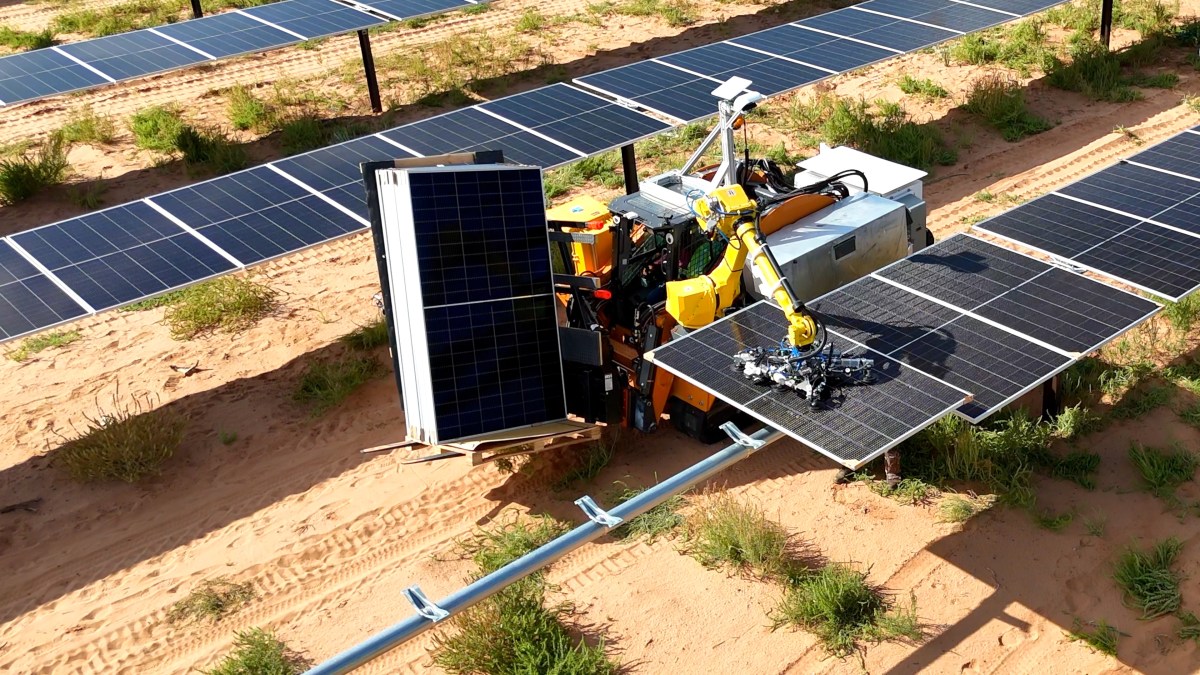
Gritt does not build its own hardware. Instead, it rents existing machines — such as Kawasaki robotic arms and standard loaders — and runs them with its own AI software. Zamin reported the system handles the dangerous, repetitive parts of the job: unloading large glass panels, moving them to frames, and placing them with sub-millimeter precision.
This approach keeps upfront costs low and speeds up deployment. Rather than spending years designing custom machines, Gritt can drop its software onto gear that construction crews already use and trust. Finsmes noted the San Francisco-based company combines robotics and AI into one integrated system built for outdoor job sites.
Two Systems Running, 48 More Coming in Six Months
As of now, Gritt has two systems actively working in the field and collecting real-world data to sharpen performance. The company plans to scale fast — targeting 48 deployed systems within six months. Pulse2 reported Gritt already counts three of the ten largest American energy construction companies among its clients.
That pace of growth reflects investor confidence in the company's model. Obvious Ventures' Andrew Beebe pointed to Gritt's rare mix of deep AI expertise and hands-on job site experience as a key edge over rivals still stuck in the lab.
A 650,000-Worker Shortage Is Driving Demand for Automation
The U.S. construction industry is short roughly 650,000 workers right now. At the same time, solar installations are projected to triple by 2030. That gap between labor supply and energy demand is exactly the problem Gritt is designed to solve. Whalesbook described automation as increasingly essential to meet the pace of solar buildout.
Solar farms require crews to handle heavy, fragile panels repeatedly across long shifts — work that is both physically demanding and prone to injury. By handling the lifting and placing, Gritt's systems let human workers focus on faster, safer tasks. The result is more panels installed per day with the same size crew.
$34 Million Bet on AI Beating the Solar Bottleneck
The Series A brings Gritt's total raised to $34 million, according to Zamin. The round was led by Obvious Ventures with participation from Union Square Ventures and Active Impact Investments. Finsmes confirmed the funding will go toward scaling deployments and improving the AI systems already in the field.
Gritt's strategy — use existing hardware, write smarter software, and get to job sites fast — puts it in a strong position as solar demand surges. With 2.8 gigawatts of contracted work and major construction partners already signed, the startup is moving quickly from pilot project to industry standard.
Sentiment
Mostly PositiveNEGATIVENEUTRALPOSITIVE
Publishers
11
Articles
5
Reach
16
A
AnonymousAuthor


