Ryanair Window Probe
US NTSB Leads Probe After Ryanair Flight's Window Shatters, Injuring Passenger
Anonymous
Key Points
1
The incident occurred in Greek airspace, not over the Republic of North Macedonia as initially believed.
2
The flight was operated by Malta Air, Ryanair's subsidiary, rather than directly by Ryanair.
3
Svetlana Maksimovic, the wife of Ljubisa Karovic, described the incident as 'chaos broke out' and noted her husband’s seatbelt helped prevent him from being fully ejected.
4
FAA officials indicated early indications may not mirror the 2018 Southwest incident and are reevaluating the agency’s response, with a senior official saying, 'Did we miss something? Way too early to tell — but we can’t take it off the board yet.'
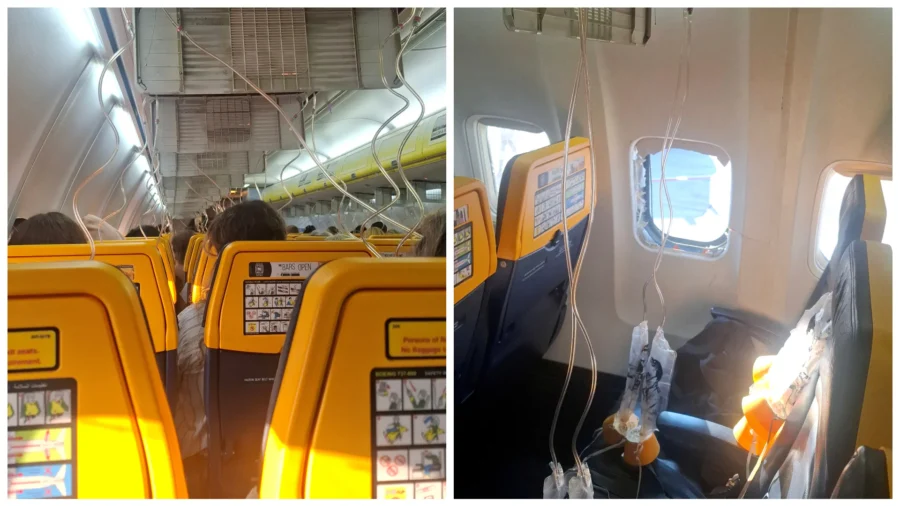
A Ryanair passenger was nearly sucked out of a Boeing 737 window over Greece on July 10, and now US investigators are running the probe. The US National Transportation Safety Board is leading the investigation after Greece handed over authority, citing the NTSB's aviation-safety expertise, according to NTD.
The flight, operated by Malta Air — Ryanair's subsidiary — was heading from Thessaloniki to Germany when a piece of engine broke off and shattered a window. Rapid decompression followed. Passengers grabbed 61-year-old Serbian traveler Ljubisa Karovic as he was partially pulled through the broken window. His seatbelt helped stop him from being fully ejected. The plane made an emergency landing, and Karovic was taken to a hospital.
Engine Debris Shatters Window, Triggers Chaos Onboard
Shortly after takeoff from Thessaloniki, a piece of the CFM56 engine's fan cowl — a cover around the engine's front — broke off and struck the fuselage. It shattered a window. The cabin rapidly lost pressure. Passengers scrambled to hold Karovic inside the aircraft as he was partially sucked out, according to Cleveland.com.
Karovic's wife, Svetlana Maksimovic, described the scene as complete disorder. She said 'chaos broke out' and that her husband's seatbelt was the key factor in keeping him from being fully ejected. Karovic, 61, was hospitalized after the emergency landing. The incident occurred in Greek airspace, not over North Macedonia as some early reports suggested, according to NTD.
NTSB Takes Lead, Echoes of Two Past Southwest Crashes
Greece delegated the investigation to the NTSB because the Boeing 737 NG was made in the US. The NTSB has handled similar cases before. In 2016 and 2018, Southwest Airlines flights involving the same aircraft type suffered engine failures. In the 2018 Southwest case, a passenger died after being partially pulled out of a broken window, according to PennLive.
After those incidents, the NTSB pushed Boeing to redesign the fan-cowl structure. The FAA then issued an airworthiness directive requiring airlines to complete modifications by 2028. Southwest has already finished about 80% of the required fixes ahead of that deadline, according to Cleveland.com.
FAA Unsure if This Matches 2018 Southwest Incident
FAA officials said early signs may not point to the same root cause as the deadly 2018 Southwest flight. Investigators are still collecting data and have not confirmed a direct link. One senior official put it plainly: 'Did we miss something? Way too early to tell — but we can't take it off the board yet,' according to Head Topics.
The FAA said it is reevaluating its own response to the earlier incidents in light of this new event. Ryanair's 737 NG fleet uses CFM56 engines — the same engine type involved in the 2016 and 2018 Southwest failures. That detail has drawn fresh scrutiny from investigators, according to The Epoch Times.
Boeing 737 NG Fan-Cowl Design Back Under the Microscope
The Boeing 737 NG is one of the most common commercial jets in the world. Its CFM56 engine's fan cowl has now been linked to multiple serious incidents. The NTSB had already flagged the design after 2018, calling on Boeing to make structural changes. That process is still ongoing under the FAA's 2028 deadline, according to PennLive.
The Greece incident puts new pressure on both Boeing and the FAA to move faster. Investigators have not yet said whether Ryanair's fleet — operated through its Malta Air subsidiary — had received any of the required modifications. The NTSB has not set a timeline for releasing its findings, according to NTD.
Sentiment
Mostly NegativeNEGATIVENEUTRALPOSITIVE
Publishers
11
Articles
260
Reach
271
A
AnonymousAuthor


