Australian Labor Market Softens
Australia's Job Market Softens as Unemployment Rate Edges Up to 4.5%
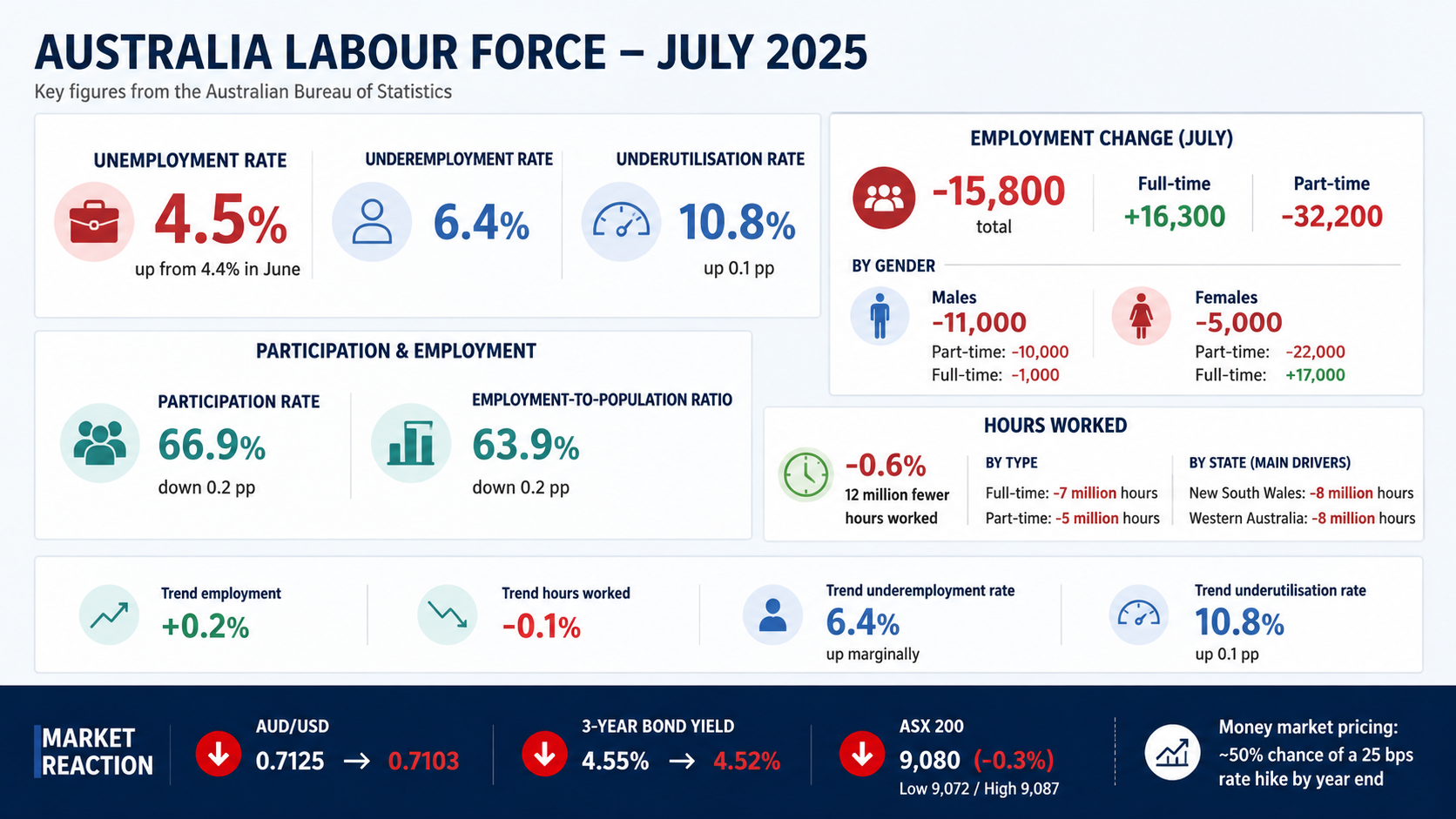
Key Points
July's ABS Labour Force Survey used seven rotation groups instead of the usual eight, after three groups exited following June and two new groups joined, which increased standard errors and reduced precision of the estimates.
The NSW adjustment used in June was removed for July, while the Victoria adjustment remained, illustrating ongoing methodological tweaks to the rotation group adjustments.
ABS also announced changes under Labour Force Modernisation, including removing adjustment factors for February and August from August 2026 data onward, with supplementary data collected monthly from respondents in their last month, and cautions to interpret short-term changes carefully.
Youth unemployment in July eased to 10.4%, a detail not highlighted in the broader summary but reported in the ABS release.
Total hours worked across all jobs fell by about 12 million hours in July (down 0.6%), underscoring weaker labor utilization alongside the employment dip.
Australia's job market weakened in July as employment fell by 15,800 and unemployment rose to 4.5%, signaling a slower economy ActionForex. The decline follows a strong June revision of 80,200 jobs and marks a sharp reversal that gives the Reserve Bank of Australia room to pause interest rate hikes.
Part-Time Jobs Drop While Full-Time Gains Persist
Part-time employment fell sharply by about 32,000 jobs in July, while full-time positions actually increased ActionForex. This split signals a shift in how many hours workers are getting rather than a broad collapse in hiring demand. The divergence suggests employers are cutting back on flexibility but keeping core staff.
Hours Worked and Participation Both Sink
Total hours worked across all jobs fell by about 12 million hours in July, a 0.6% decline that underscores weaker labor utilization ActionForex. The participation rate slipped to around 66.9%, and the employment-to-population ratio dropped to roughly 63.9%. Underemployment hovered near 6.3–6.4%, showing ongoing slack in the labor market without a crisis in job quality.
Youth Unemployment Eases Despite Broader Weakness
Youth unemployment fell to 10.4% in July, offering a bright spot in otherwise softening labor conditions ActionForex. The improvement among younger workers contrasts with the overall slowdown and suggests that entry-level hiring remains relatively stable even as part-time roles contract across the economy.
Data Revisions and Measurement Changes Add Uncertainty
The Australian Bureau of Statistics switched to seven rotation groups in July instead of the usual eight, which increased standard errors and reduced estimate precision. The NSW adjustment used in June was removed for July, while Victoria's adjustment remained, showing ongoing tweaks to the data collection method.
Going forward, the ABS will remove adjustment factors for February and August beginning in August 2026, part of a broader Labour Force Modernisation effort. Analysts caution against overreacting to a single month and stress that trend data reveal the true underlying health of the job market more clearly than monthly swings.
Sentiment
Mostly NegativePublishers
14
Articles
14
Reach
28


