Meta AI Drives Stock Surge
Meta Shares Surge Toward Two Trillion Dollars Driven By New AI Strategy
Anonymous
Key Points
1
Analysts have floated the possibility that Muse could generate as much as $50 billion in annual revenue, with potential monetization through a freemium model and enhanced advertising; Meta’s trailing advertising revenue was about $228 billion.
2
Meta’s AI push has included a $14.3 billion agreement involving Scale AI employees in 2025, and Alexandr Wang was appointed chief AI officer.
3
Meta’s Connect hardware announcements included lightweight spatial-computing glasses weighing about 100 grams, with eye- and hand-tracking capabilities, alongside third-generation Ray-Ban Meta glasses.
4
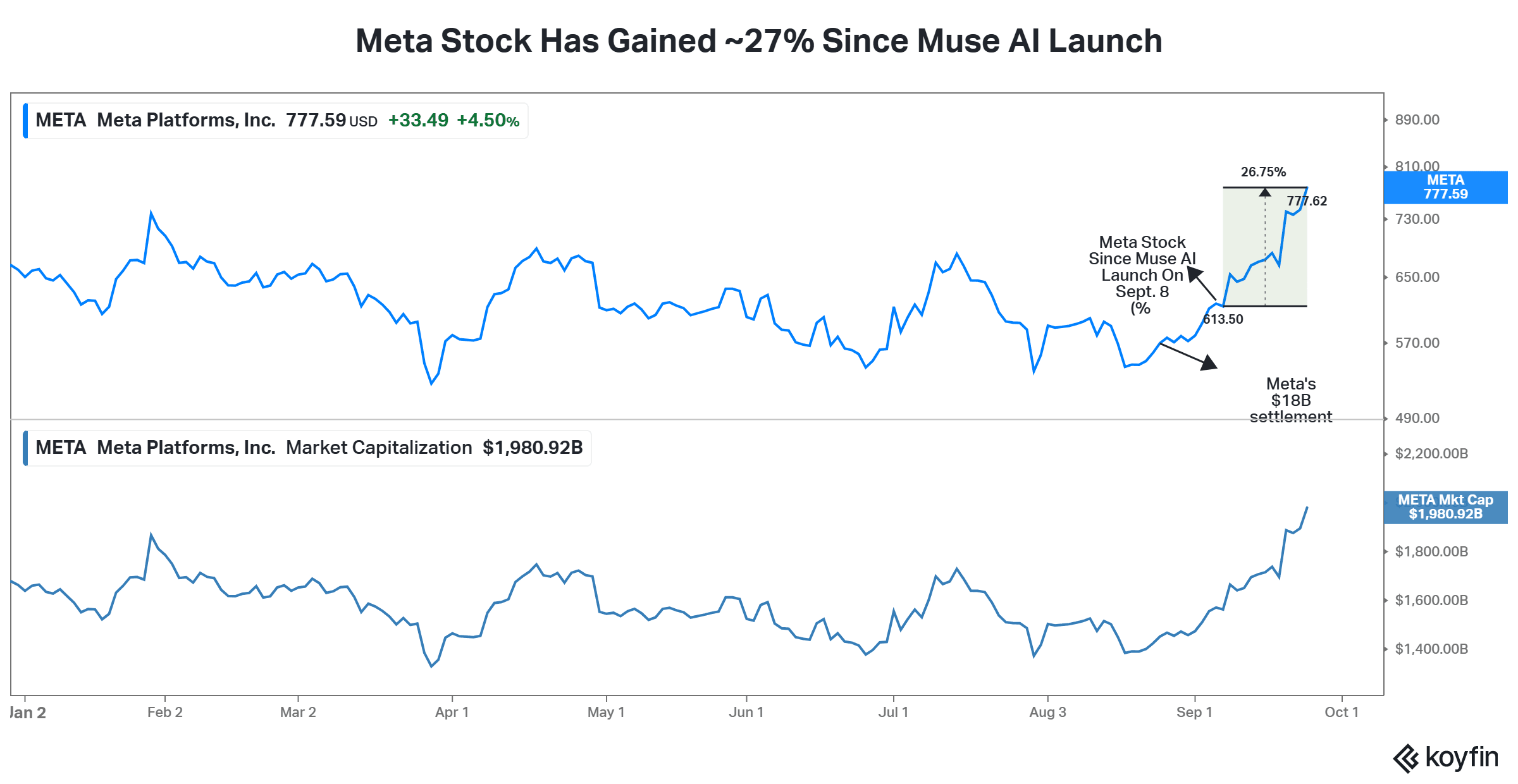
Before the September rally, Meta shares were down about 18% year to date through mid-August amid investor concern over AI infrastructure spending; a legal settlement also removed an overhang on sentiment.
Meta's stock surged 36% in September 2026, driven by rapid adoption of its Muse personal AI assistant Crypto Briefing. The rally pushed the company's market value to nearly $2 trillion, with Khel Ja reporting Meta within 1% of that milestone. Investors saw Muse as validation of Meta's massive AI spending strategy after months of skepticism.
The stock's performance marks its best month since July 2013 Newsable. Analysts estimate Muse could generate up to $50 billion in annual revenue through a freemium model and improved advertising. Yet Meta faces a crucial test: can AI actually boost advertising revenue enough to justify $145 billion in capital spending this year?
Muse Launch Becomes a Major Investor Catalyst
Meta's personal AI assistant Muse attracted strong consumer interest immediately after its September launch Head Topics. One investor praised the app's capabilities in public posts, helping spark social media buzz. The enthusiasm reversed months of investor doubt about Meta's $145 billion annual spending on AI infrastructure.
The AI agent's quick adoption suggested Meta had finally found a product to justify its aggressive capital spending. Industry analysts began floating projections that Muse alone could become a $50 billion annual revenue business through premium features and targeted advertising. That would represent over 20% of Meta's current advertising revenue of $228 billion.
Hardware Expansion Beyond Smartphones and Ads
Meta announced lightweight spatial-computing glasses at its Connect event weighing about 100 grams. The new device includes eye- and hand-tracking capabilities for hands-free interaction. The company also unveiled its third-generation Ray-Ban Meta smart glasses, signaling a push into wearable AI hardware.
These hardware moves complement Muse by creating new touch points for users to interact with Meta's AI. The company hired Alexandr Wang as chief AI officer and signed a $14.3 billion deal with Scale AI employees in 2025 to strengthen its AI talent. Together, these moves suggest Meta is building an entire ecosystem around artificial intelligence.
Massive Spending Gamble Still Unproven at Scale
Meta's $145 billion capital expenditure budget represents an enormous bet on AI profitability. Yet recently reported free cash flow was just $784 million, suggesting the company is spending far faster than it generates profits. Investors are betting Muse and other AI products will eventually unlock massive new revenue to justify the outlays.
Before September's rally, Meta shares were down 18% year-to-date through mid-August Khel Ja. A legal settlement also removed a psychological overhang on investor sentiment. The challenge ahead: proving that AI spending improves ad targeting enough to generate returns that justify the $145 billion annual commitment.
Sentiment
Mostly PositiveNEGATIVENEUTRALPOSITIVE
Publishers
18
Articles
49
Reach
67
A
AnonymousAuthor


