Mars' Ancient Patterns
Curiosity Rover Documents Expansive Honeycomb Polygons, Revealing Mars' Ancient Past
Anonymous
Key Points
1
Boxwork ridges on Mount Sharp host tiny egg-like nodules on their surfaces; Tina Seeger of Rice University leads the investigation, with ground-level imagery from 2025 revealing these nodules and a hypothesis that minerals cement the ridges first, followed by groundwater episodes depositing the nodules around them.
2
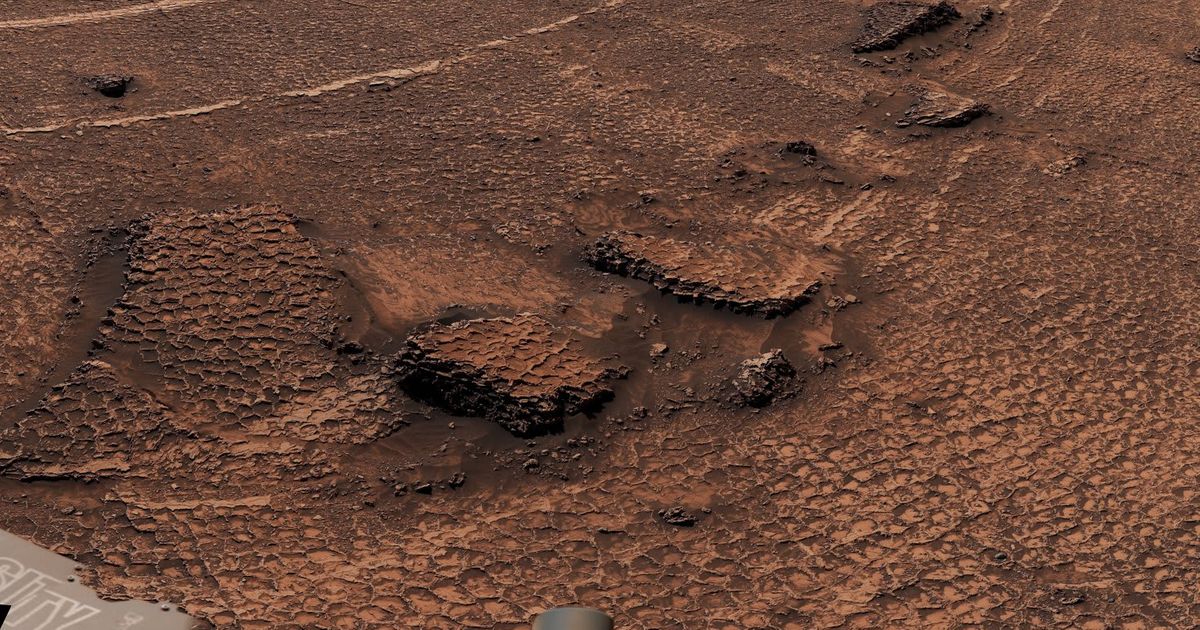
The 360-degree panorama captured in mid-June 2026 (Sol 4930–4931) reveals Miraflores, a roughly 20-foot-tall butte with a sand-covered summit, and shows polygonal fractures ranging about 1.5 to 3 inches across that wrap around the butte.
3
Scientists are weighing multiple formation pathways for the polygonal patterns, including mud cracks from ancient wet-dry cycles, repeated heating and cooling, and sediment compression that squeezes water out of buried sediment; some research also considers burial-related pressure as a driver.
4
Experts have linked these textures to Mars’ ancient climate context, with remarks noting Earth-like wet-dry cycles and their potential relevance to past environmental conditions; this line of thinking was highlighted by researchers such as William Rapin.
NASA's Curiosity rover has found a vast field of honeycomb-like polygonal fractures on Mars, baffling scientists with their sheer scale. The patterns, spotted in a valley called Valle Grande, stretch across the terrain and wrap around a nearby rocky butte, marking one of the most striking geological finds in the mission's 14-year history, according to Gizmodo.
Each polygon measures roughly 1.5 to 3 inches across. Scientists say the patterns could be mud cracks, frost damage, or the result of ancient buried sediment being squeezed of its water. No one is certain yet — and that's what makes this discovery so striking, Tech Times reported.
A 360-Degree Panorama Reveals the Honeycomb Field
Curiosity captured a full 360-degree panorama on Sol 4930–4931, which is mid-June 2026. The images show thousands of small polygons covering the valley floor. They curve and bend around Miraflores, a roughly 20-foot-tall butte with a sand-covered top, according to Starlust.
The scale of the field is what stumped researchers most. Polygonal fractures have been seen on Mars before, but never spread this widely across a single area. Tech Times noted that scientists have been studying Mars for 14 years and still haven't seen anything quite like this.
Three Competing Theories for How the Polygons Formed
Scientists are weighing three main ideas. The first is mud cracks. On Earth, wet soil dries out and cracks into polygons. Mars may have gone through the same wet-dry cycles long ago. Researcher William Rapin has pointed to this Earth-like process as a strong candidate, according to Starlust.
The second idea is repeated heating and cooling. Temperature swings on Mars can crack rock over time. The third idea is sediment compression — ancient buried mud may have had water squeezed out of it under pressure, causing it to crack and harden. Tech Times reported that no single explanation has been ruled out yet.
Egg-Like Nodules Found on Mount Sharp's Boxwork Ridges
The honeycomb field isn't the only mystery Curiosity is chasing. On Mount Sharp, the rover has found tiny egg-shaped nodules sitting on top of boxwork ridges — raised rocky lines that form a grid-like pattern. Ground-level images from 2025 captured these features up close, according to Gizmodo.
Tina Seeger of Rice University is leading the investigation into the nodules. Her team thinks minerals hardened the ridges first. Then groundwater came back later and deposited the nodules around them. It's a two-step process that hints at a long and complex water history beneath the Martian surface.
What These Patterns Tell Us About Mars' Ancient Climate
Curiosity landed on Mars in 2012. In the years since, it has built a picture of a planet that once had liquid water, weather cycles, and maybe even conditions friendly to life. The honeycomb polygons add another layer to that picture, according to Indy100.
If the mud-crack theory holds up, it means Valle Grande went through repeated wet and dry periods — just like riverbeds or lake shores on Earth. Newsbreak noted that scientists are still working to figure out which formation pathway is most plausible, with data analysis ongoing.
Sentiment
Mostly PositiveNEGATIVENEUTRALPOSITIVE
Publishers
12
Articles
25
Reach
37
A
AnonymousAuthor


