Securing Vital Shipping Lanes
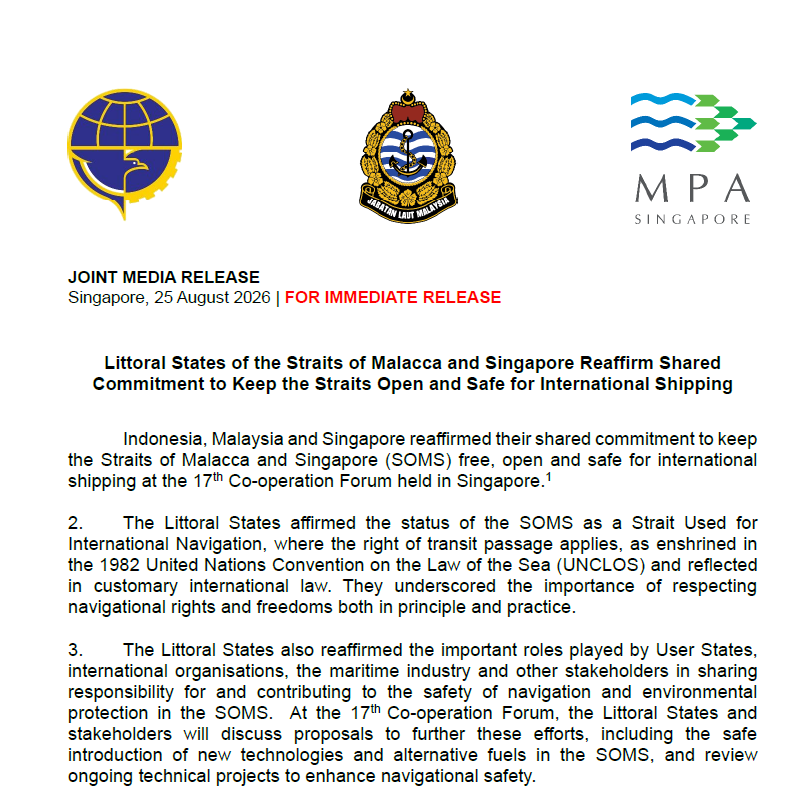
Indonesia, Malaysia, and Singapore Reaffirm Commitment to Maintaining Open and Safe Malacca Straits
Anonymous
Key Points
1
The Straits of Malacca and Singapore handle significant global traffic and energy flows, with more than 100,000 vessels passing through annually and about a quarter of global seaborne trade plus around a third of the world’s oil and gas supplies.
2
The Cooperative Mechanism, established in 2007, provides the framework for littoral–user-state cooperation on navigational safety and environmental protection in SOMS and is the first and only implementation of UNCLOS Article 43. It comprises three pillars: the Aids to Navigation Fund, the Project Co-ordination Committee, and the Co-operation Forum.
3
Forum discussions include proposals for the safe introduction of new technologies and alternative fuels in SOMS, alongside reviews of ongoing technical projects to enhance navigational safety.
4
Singapore’s Transport Minister Jeffrey Siow highlighted the SOMS as a ‘shining’ example of sustained international cooperation, stressing that differences among the littoral states have not halted collaboration on maritime issues.
Three Asian nations pledged to keep the Straits of Malacca and Singapore open and safe for global shipping at a major international forum. Maritime Port Authority Singapore, speaking for Indonesia, Malaysia, and Singapore, reaffirmed that the waterway will remain free for international commerce — a critical commitment given that over 100,000 ships pass through annually carrying about a quarter of global seaborne trade and roughly a third of the world's oil and gas supplies. Media Selangor reported the commitment was made during the 17th Cooperation Forum in Singapore, where officials emphasized that open sea lanes cannot be taken for granted amid rising regional and global tensions.
Singapore Transport Minister Jeffrey Siow called the straits a 'shining' example of international cooperation between nations with different interests. Newsy Today noted that Siow highlighted how the littoral states have maintained collaboration on maritime safety despite their political differences. The three countries stressed that keeping these vital waterways secure and accessible requires shared responsibility among coastal nations, shipping companies, international organizations, and all maritime stakeholders.
The Cooperative Mechanism: A First-Ever Framework for Shared Waters
Indonesia, Malaysia, and Singapore established the Cooperative Mechanism in 2007 to manage navigational safety and prevent pollution in the straits. Maritime Port Authority Singapore confirmed it remains the only implementation of Article 43 of international maritime law (UNCLOS). The framework operates through three main pillars: an Aids to Navigation Fund that maintains critical safety equipment, a Project Coordination Committee overseeing technical work, and the Cooperation Forum where officials meet to align policies. This setup lets user nations like Japan and China collaborate with coastal states on protecting one of the world's busiest shipping corridors.
New Technologies and Cleaner Fuels Transform Strait Operations
The three nations are advancing maritime safety by introducing new technologies and alternative fuels to the straits. Media Selangor reported that officials discussed proposals for safer integration of emerging systems alongside reviews of ongoing technical projects. Manifold Times noted that the industry is closely tracking marine fuel quality improvements — with 2026 showing significant gains in fuel standards — as ships transition toward cleaner energy. These upgrades aim to reduce accidents and environmental damage while supporting global shipping's shift away from traditional fossil fuels.
Why Open Straits Matter for Global Energy and Trade
The Straits of Malacca and Singapore carry roughly 25% of all cargo traded by sea and about 33% of the world's traded oil and gas. Maritime Port Authority Singapore emphasized that these waterways function as essential arteries for global commerce and energy security. More than 100,000 vessels navigate the straits annually, making it one of Earth's most strategically important shipping lanes. Any disruption — from accidents, piracy, or geopolitical conflict — would ripple through supply chains and energy markets worldwide, affecting prices and availability from Europe to North America.
A Unified Defense Against Incidents and Risks
The three littoral states committed to strengthening infrastructure, detecting risks early, and responding swiftly to maritime crises. Maritime Port Authority Singapore stated that the forum's approach brings together coastal governments, shipping companies, and international bodies to safeguard navigation collectively. Officials are investing in better monitoring systems and emergency protocols to catch problems — from collisions to environmental spills — before they escalate. This coordinated effort reflects a broader recognition that no single nation can secure these straits alone; success requires constant communication and shared commitment across all maritime stakeholders.
Sentiment
Mostly PositiveNEGATIVENEUTRALPOSITIVE
Publishers
11
Articles
4
Reach
15
A
AnonymousAuthor


