Atlas Robot's AI Debut
Boston Dynamics' Atlas Robot Delivers World Cup Ball, Demonstrating Advanced AI Learning
Key Points
Atlas's on-field performance is learned, not hard-coded: it was trained from hours of video of professional players, uses retargeting technology to map human motions to Atlas's body, and relies on reinforcement learning with thousands of simulations to refine movements.
When standard Wi-Fi failed due to crowds, Atlas stayed connected via a radio backchannel; designers also had to adjust its locomotion for grass, changing how it learns to walk and run to be more robust.
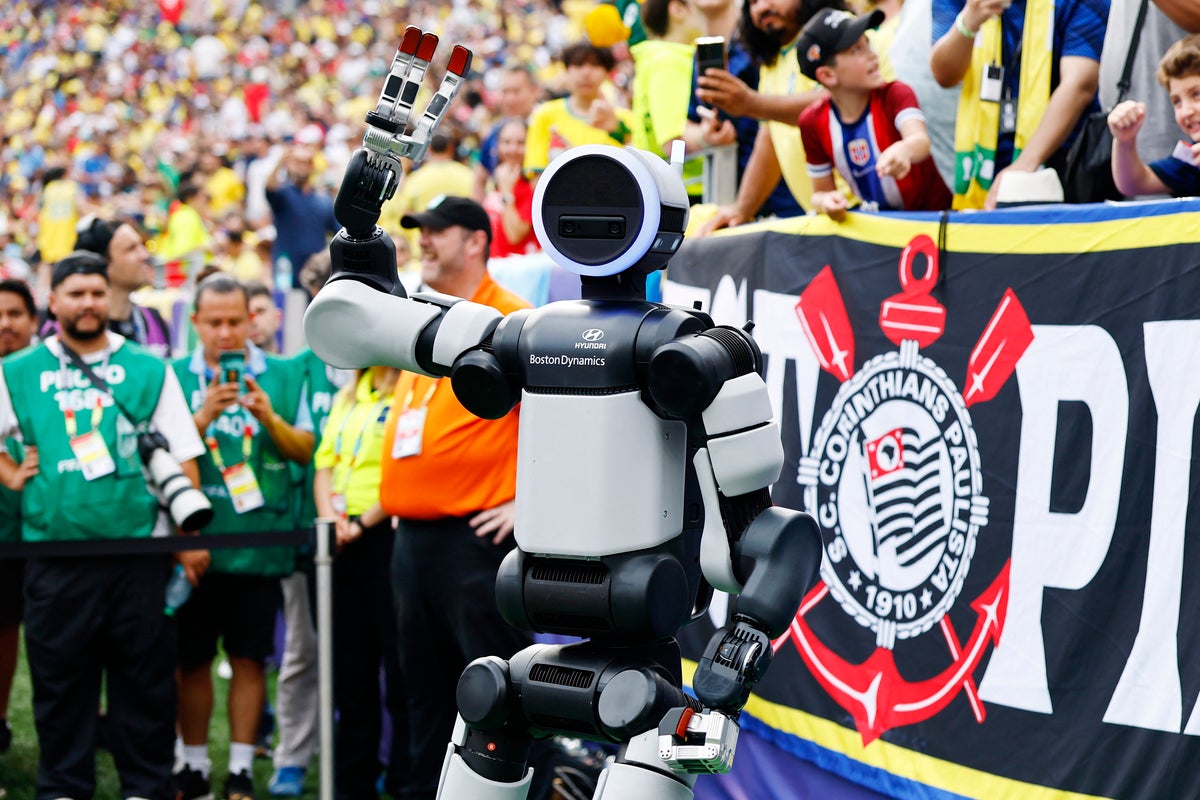
Atlas stands about five feet tall, is fully electric, possesses 56 degrees of freedom, and can swap its batteries without human help—hardware that underpins its on-field capabilities.
Hyundai frames Atlas’s World Cup debut as part of its broader 'Next Starts Now' robotics campaign, stressing that robotics can be a partner to humanity and signaling a longer-term push toward practical applications.
A humanoid robot stole the halftime show at the 2026 FIFA World Cup. Atlas, built by Boston Dynamics and standing just five feet tall, walked onto the field at New York/New Jersey Stadium and handed the match ball to the referee during the Brazil vs. Norway Round of 16 clash, according to The Independent.
The moment was backed by Hyundai, a FIFA partner, as part of its 'Next Starts Now' robotics campaign. On the field, Norway's Erling Haaland scored both goals in a 2-1 upset over Brazil — and Atlas mimicked his goal celebration, according to Free Malaysia Today.
Atlas Learned to Move by Watching Pro Players
Atlas did not follow a fixed script on the field. Its movements were trained using hours of video of professional soccer players, according to The Auto Channel. Engineers used retargeting technology to map human motions onto Atlas's body. Then they ran thousands of simulations using reinforcement learning — a method where the robot tries moves, gets feedback, and improves over time.
Boston Dynamics says this approach means Atlas refines its behavior through real-world data, not hard-coded commands. The result: a robot that can walk, run, and even celebrate like a human, The Independent reported.
Grass and Crowds Created Unexpected Engineering Hurdles
Getting Atlas onto a soccer pitch was not straightforward. Standard Wi-Fi failed because the packed stadium overwhelmed the signal, so engineers switched to a radio backchannel to keep Atlas connected, according to The Auto Channel. The team also had to retrain Atlas's walking and running style specifically for grass, making its movements more stable on an uneven surface.
Atlas has 56 degrees of freedom — meaning 56 independent ways its joints can move — and runs on a fully electric system. It can even swap its own batteries without human help, Free Malaysia Today reported. That hardware gave engineers the flexibility to adapt its gait for the field.
Hyundai Eyes Mass Production of Atlas by 2028
The World Cup debut was more than a publicity stunt. Hyundai plans to mass-produce Atlas-style robots at its Georgia plant by 2028, according to Hyundai via The Auto Channel. The goal is to deploy them for high-risk tasks — jobs too dangerous or repetitive for humans. Hyundai framed the appearance as proof that robots can be partners to people, not just machines on a factory floor.
South Korea's Seoul Economic Daily reported that Hyundai sees this moment as a signal of where practical robotics is heading. The company wants Atlas to move from staged demos to real work environments within a few years, Seoul Economic Daily noted.
A Memorable Night for Both Robots and Norway
The tech spectacle shared the spotlight with a major soccer upset. Haaland scored both of Norway's goals, leading a 2-1 victory over five-time World Cup champion Brazil, according to The Independent. Atlas then mimicked Haaland's celebration on the pitch, blending sport and technology in a single viral moment.
Hyundai called it the first-ever live match integration of a humanoid robot into a FIFA World Cup event, The Auto Channel reported. For Boston Dynamics, it marked Atlas's biggest public stage yet — a five-foot electric robot performing in front of one of the world's largest sporting audiences.
Sentiment
Mostly PositivePublishers
11
Articles
14
Reach
25


