Yongin Chip Plant Accelerates
Samsung Accelerates Yongin AI Chip Plant Operation to 2029 Amid Surging Demand and Government Support
Anonymous
Key Points
1
Site preparation for Y1 at Yongin is planned for the second half of 2026, with fab construction beginning in 2027 and follow-up steps (land compensation, expropriation rulings, contractor selection) required to keep the 2029 operation target on track.
2
The accelerated Yongin plan was discussed at a Mega Project Public-Private Joint Review Meeting chaired by the president, underscoring high-level government-business coordination behind Korea’s AI-chip push.
3
Samsung’s Yongin capacity roadmap shows current output at about 650,000 wafers per month, with projections to reach 720,000 next year and 770,000 per month in the following year, highlighting rapid near-term scaling.
4
SK Group has pledged roughly 470 trillion won for two new fabs and an AI data centre in the region, complementing Samsung’s mega-project investments and signaling broader corporate backing for Korea’s AI ecosystem.
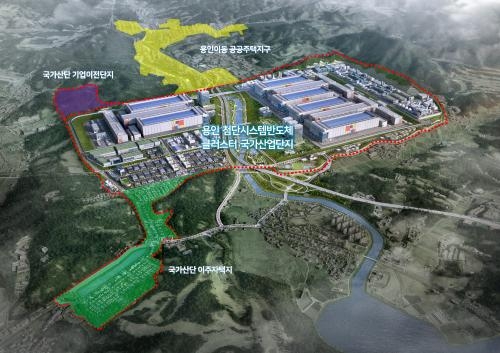
Samsung Electronics is moving up the launch of its first chip factory in Yongin, South Korea, to 2029 — one to two years ahead of schedule, according to Seoul Economic Daily. The shift is driven by surging global demand for AI chips, including high-bandwidth memory, and a government push to fast-track the Yongin National Industrial Complex near Seoul.
The Yongin complex is a massive undertaking. Samsung plans six factories there in total, targeting output of one million wafers per month at full capacity. The accelerated timeline puts the first plant, known as Y1, on track to begin site preparation in the second half of 2026, with full fab construction starting in 2027, Seoul Economic Daily reported.
Government and Samsung Align to Beat the Clock
The new 2029 target was discussed at a Mega Project Public-Private Joint Review Meeting chaired by South Korea's president, according to Seoul Economic Daily. That high-level meeting signals how seriously the government is treating semiconductor leadership as a national priority. Officials are moving to speed up land compensation, expropriation rulings, and contractor selection to keep the timeline on track.
To power the complex, planners are proposing a 3 gigawatt LNG power plant near Yongin. Water and grid infrastructure are also being fast-tracked. Without those utilities in place, even the best construction schedule falls apart.
Samsung's Wafer Output Is Already Climbing Fast
Samsung's current chip output stands at roughly 650,000 wafers per month, according to Seoul Economic Daily. The company projects that number will rise to 720,000 next year and 770,000 the year after. Those gains come even before the Yongin plants come online, showing how aggressively Samsung is scaling up right now.
The Yongin complex is part of a broader cluster strategy. Samsung has earmarked around 2,030 trillion won for its combined Pyeongtaek and Yongin operations, with an additional 400 trillion won for two new plants in Gwangju, Guru Focus reported. That makes this one of the largest industrial investments in South Korean history.
SK Group Joins the AI Chip Investment Wave
Samsung is not alone in this push. SK Group has pledged roughly 470 trillion won for two new chip fabs and an AI data center in the same region, according to Crypto Briefing. That commitment adds major corporate weight behind South Korea's plan to build a dominant AI chip ecosystem.
Together, Samsung and SK Group are reshaping the country's industrial map. The combined scale of these investments — spanning fabs, data centers, and power infrastructure — signals that South Korea is betting big on AI hardware as a long-term economic engine.
Why 2029 Matters for the Global AI Race
AI chip demand is outpacing supply worldwide. Companies building large language models and data centers need more advanced chips, faster. Getting Y1 online a year or two early gives Samsung a window to capture that demand before rivals can respond, Guru Focus noted.
The 2029 target is ambitious but not guaranteed. Land compensation and utility buildout are the two biggest risks to the schedule. If either slips, the construction window shrinks. South Korean officials appear to be treating those risks seriously — which is exactly why the president is chairing the review meetings himself.
Sentiment
Mostly PositiveNEGATIVENEUTRALPOSITIVE
Publishers
11
Articles
14
Reach
25
Topics
A
AnonymousAuthor


