Profit Rises Amid Disruptions
Energean Reports Higher First-Half Profit and Confirms Full-Year Outlook Despite Production Decline
Anonymous
Key Points
1
Energean’s adjusted EBITDAX fell 5% year over year to $478 million, while operating profit declined to $291.21 million from $329.06 million, highlighting weaker underlying operating performance despite the rise in net profit.
2
Half-year production was 124,000 barrels of oil equivalent per day, with the Israeli shutdown lasting from February 28 to April 9 before operations resumed.
3
Energean Israel reported $314.3 million in operating cash flow and nearly doubled its cash and cash equivalents to $213.8 million, although the subsidiary carried $2.77 billion in borrowings and had equity of $465.3 million.
4
The company commissioned a second oil train, increasing liquids capacity, while continuing to advance the Katlan, Irena and Nitzana developments toward planned start-ups in 2027 and 2028.
5
Energean’s planned consolidation of its Egyptian offshore concessions is intended to double production and unlock more than 4 trillion cubic feet of exploration potential, giving Egypt a larger role in the group’s diversification strategy.
Energean, the Eastern Mediterranean oil and gas producer, posted a 45% jump in first-half profit to $160 million, Yahoo Finance reported. The gain came despite lower production and operating profit, benefiting instead from reduced finance costs, favorable currency moves, and a lower tax bill in Italy. The company maintained its full-year production guidance of 130,000 to 140,000 barrels of oil equivalent per day.
A 41-day Israeli government shutdown from late February to early April disrupted output but didn't derail Energean's plans. Free cash flow surged 35% to roughly $250 million, while net debt edged lower, Market Screener noted. Energean kept its 2026 outlook intact and declared a quarterly dividend of 10 cents per share.
Weaker Operations Masked by Financial Gains
Under the surface, Energean's core business softened in the first half. Adjusted EBITDAX fell 5% to $478 million, while operating profit dropped to $291.21 million from $329.06 million a year earlier, Ask Traders reported. Revenue and production both declined, revealing stress in underlying operations.
The profit surge came from financial tailwinds, not operational strength. Lower interest costs and a favorable pound-to-dollar shift lifted bottom-line results. A smaller tax charge in Italy also helped. Higher prices for crude oil and liquids provided additional relief from weaker volume.
Israel Shutdown and Production Recovery
Production hit 124,000 barrels per day in the half-year, down from prior periods. The Israeli shutdown lasted 41 days, from February 28 through April 9, Yahoo Finance reported. After restart, operations quickly recovered, helping offset earlier losses and supporting the company's maintained full-year guidance.
Energean Israel, the subsidiary, generated $314.3 million in operating cash flow. Its cash reserves nearly doubled to $213.8 million. However, the unit still carries $2.77 billion in borrowings, keeping leverage elevated despite improved cash generation.
Liquids Expansion and New Project Pipeline
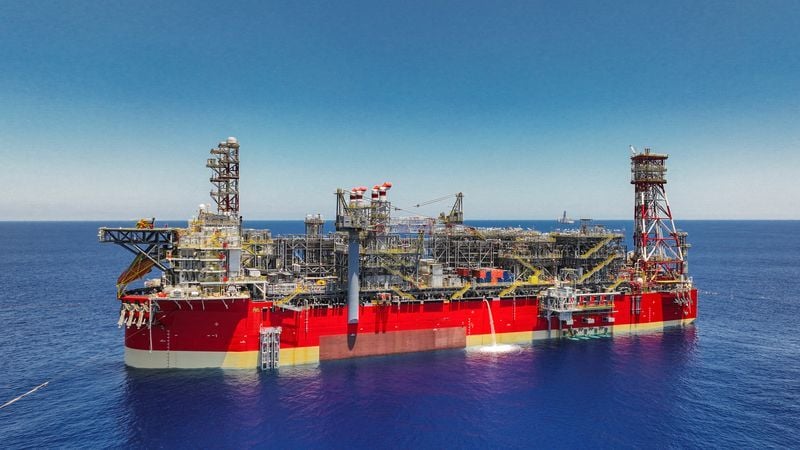
Energean commissioned a second oil train to boost liquids capacity, strengthening its portfolio beyond gas. The company is advancing three key developments—Katlan, Irena, and Nitzana—targeting production starts in 2027 and 2028. These projects aim to reduce reliance on Israeli operations.
Egypt offers crucial diversification. Energean plans to consolidate its offshore concessions there, aiming to double production and unlock over 4 trillion cubic feet of exploration potential, Market Screener noted. The company also secured a roughly $1.4 billion gas sales agreement in Israel, diversifying revenue streams beyond the shut-prone Tamar field.
Leverage Risk Persists Despite Cash Improvement
Energean remains highly leveraged, creating vulnerability to output disruptions. The Israeli suspension showed how quickly geopolitical risks can halt cash generation. Even with free cash flow hitting $250 million, the company must balance debt repayment against new investments in diversifying assets.
Net debt edged lower in the half-year, a positive sign. However, Energean Israel's $2.77 billion in borrowings against $465.3 million in equity shows thin cushion. The company's strategy—new projects, Egyptian expansion, and liquids growth—aims to build resilience and reduce geographic concentration risk.
Sentiment
Mostly NegativeNEGATIVENEUTRALPOSITIVE
Publishers
13
Articles
27
Reach
40
Topics
A
AnonymousAuthor


