IQE's AI Datacentre Breakthrough
IQE secures multi-year $14 million contract for AI data centres, boosting market momentum despite losses.
Anonymous
Key Points
1
IQE raised £81 million to fund its growth strategy, with a focus on Indium Phosphide (InP) solutions for AI data centres.
2
IQE’s chief executive Jutta Meier emphasized the Newport facility’s central role in supporting AI and datacentre growth, and highlighted that the company’s epitaxy portfolio enables high-performance infrastructure from the datacentre to the edge.
3
The market reaction to the contract news included a stock move, with IQE trading above key moving averages and supported by positive technical indicators, signaling improved momentum despite the company’s loss-making position.
4
Analysts and investors see potential for sticky, multi-year revenue from the deal due to IQE’s volume-production model, though continued losses and rising debt remain significant funding risks.
5
The news underscores deeper engagement with a strategic global technology customer and alignment with next-generation optical chip technologies, reflecting IQE’s broader move into AI and datacentre ecosystems.
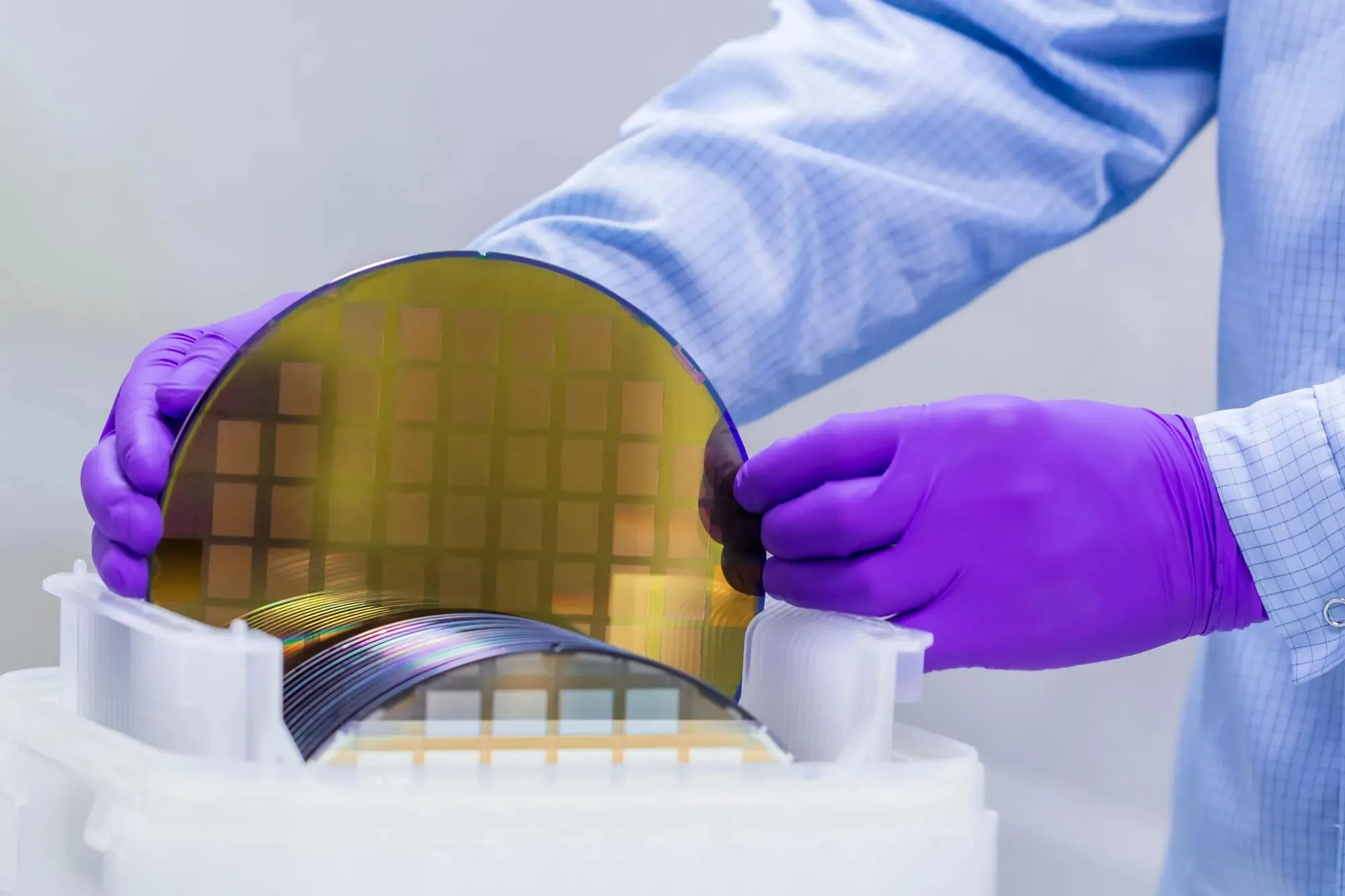
Welsh semiconductor firm IQE has landed a multi-year, $14 million production contract from a major global technology customer to supply advanced wafer products for AI and data centre applications, according to Compound Semiconductor. The order will be made at IQE's Newport foundry in Wales, marking a significant step for the company into the fast-growing AI chip supply chain.
Chief executive Jutta Meier said the Newport facility plays a "central role" in supporting AI and data centre growth. The deal spans multiple years, giving IQE a steadier revenue stream — though the company remains loss-making and is still working to turn its finances around, Electronics Weekly reported.
Newport Foundry Lands a High-Stakes AI Deal
The $14 million contract covers high-performance storage technologies used in AI and data centre systems, Compound Semiconductor reported. IQE will manufacture the wafers at its Newport, Wales site. The customer has not been named publicly, but IQE describes them as a "strategic global technology" partner — suggesting a major hyperscale or cloud computing firm.
IQE is also working with the same customer on future projects. These include opportunities across multiple stages of the data lifecycle, Electronics Weekly noted. That hints at a deepening relationship, not just a one-off order.
Indium Phosphide and Optical Chips Power the Contract
The deal is built on IQE's epitaxy portfolio — a range of advanced semiconductor materials grown in ultra-thin layers. Key technologies include indium phosphide (InP), silicon photonics and gallium arsenide VCSELs. In plain terms, these are the optical chips that move data at very high speeds inside data centres.
IQE raised £81 million to back its growth plan, with indium phosphide solutions for AI data centres at the core of that strategy, according to ADVFN. CEO Meier said the company's portfolio "enables high-performance infrastructure from the datacentre to the edge" — meaning it supports everything from giant server farms down to smaller local computing nodes.
Stock Jumps, But Financial Troubles Linger
IQE's share price rose on the contract news, trading above key moving averages and showing strong technical momentum, ADVFN reported. Investors responded positively to the prospect of locked-in, multi-year revenue — a rarity for a company that has struggled with losses and rising debt.
The company still runs a negative gross profit and negative free cash flow. That means it spends more than it earns, and must rely on outside funding to keep going. The £81 million raise helps, but analysts warn that without a clear path to profitability, financial risks remain high. The $14 million deal is a boost — but not yet a fix.
Why This Deal Matters for the AI Chip Race
Data centre spending is surging globally as companies pour money into AI infrastructure. Cloud giants and hyperscalers — firms that run massive server networks — need faster, more efficient optical chips to handle the load. IQE's materials sit at the heart of that supply chain, ADVFN noted.
For a small Welsh manufacturer, winning a $14 million order from a global tech giant signals growing credibility. If IQE can expand the relationship and hit production targets, it could become a key supplier in the next generation of AI hardware. The bigger question is whether it can fix its finances fast enough to get there.
Sentiment
Mostly PositiveNEGATIVENEUTRALPOSITIVE
Publishers
11
Articles
11
Reach
22
A
AnonymousAuthor


