New Hyundai SUV Debut
Hyundai prepares to unveil the redesigned Bayon SUV at the Paris Motor Show.
Anonymous
Key Points
1
Hyundai’s Paris presentation will also include a new C-segment SUV making its European premiere, a new derivative of an existing model and the company’s first all-electric light commercial vehicle.
2
Hyundai has not confirmed that the Indian and European Bayon versions will debut simultaneously; the two markets are expected to receive differences in styling, cabin design, powertrains and equipment.
3
In Brazil, the Bayon is expected to enter production at Hyundai’s Piracicaba plant, which has an annual capacity of 215,000 vehicles, with a commercial launch likely in the first quarter or first half of 2027.
4
The Indian Bayon is estimated to cost about Rs 9 lakh to Rs 14 lakh ex-showroom and is expected to compete with models such as the Skoda Kushaq, Volkswagen Taigun and Maruti Suzuki Victoris.
5
The India-spec SUV’s expected 1.5-liter petrol engine is rated at approximately 115 PS and 144 Nm, while the proposed factory-fitted CNG version would reportedly use Hyundai’s 1.5-liter Hy-CNG dual-cylinder system; if launched, it would be Hyundai’s first factory-CNG model longer than four metres.
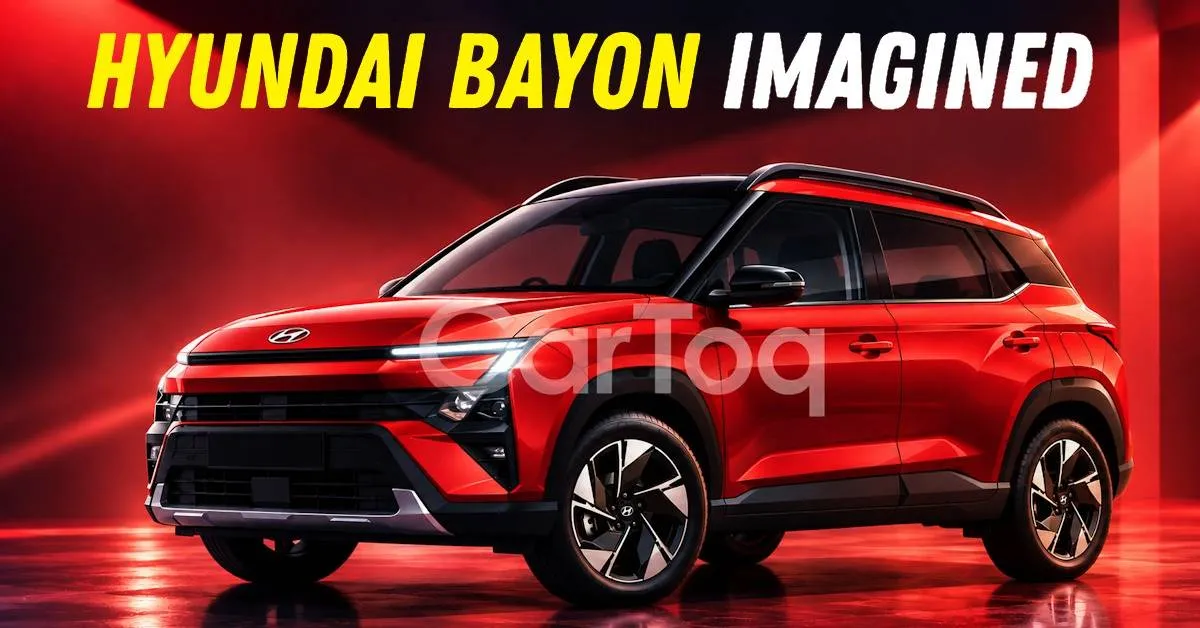
Hyundai is set to unveil a redesigned Bayon B-SUV at the Paris Motor Show on October 12, 2026, with an India launch expected around the same time during the festive season. CarToQ reports the new Bayon will sit between Hyundai's smaller Venue and larger Creta, featuring the company's bold "Art of Steel" design language with split LED lighting, pronounced cladding, and a more upright, boxier shape than the original model.
The India-spec Bayon is expected to cost between Rs 9 lakh and Rs 14 lakh ex-showroom and use a 1.5-liter petrol engine with around 115 PS of power. Hyundai is also preparing a factory-fitted CNG version using its dual-cylinder system — a first for the company in vehicles longer than four meters. Separately, Brazil will get a 1.0-liter turbo engine starting production in early 2027.
How the Bayon Fills Hyundai's India Lineup Gap
The Bayon bridges the gap between Hyundai's compact Venue sub-4-meter SUV and the midsize Creta. CarToQ notes the new model targets buyers shopping for vehicles like the Skoda Kushaq, Volkswagen Taigun, and Maruti Suzuki Victoris. At roughly 4.2 meters long with a 2.60-meter wheelbase, the Bayon offers more space than the Venue while staying affordable compared to the Creta.
Engine Options and Powertrain Strategy
The Indian Bayon will offer a 1.5-liter naturally aspirated petrol engine producing 115 PS and 144 Nm of torque. Buyers can choose between a 6-speed manual or CVT automatic transmission. Hyundai is also preparing an optional factory-fitted CNG variant using the company's 1.5-liter Hy-CNG dual-cylinder system, which would give it better fuel economy for budget-conscious buyers.
Brazil's version takes a different approach. The South American market will receive a 1.0-liter turbocharged flex-fuel engine making 115 hp and 172 Nm of torque, paired with a 6-speed automatic transmission. Production is scheduled to start in the first half of 2027 at Hyundai's Piracicaba plant in São Paulo, which can build 215,000 vehicles annually.
Paris Debut Reveals Global Design and Broader Lineup
Hyundai Motor Europe will showcase the redesigned Bayon at its October 12 media conference in Paris Expo Porte de Versailles. Senior Vice President Simon Loasby said the team wanted to "create an Intelligent Utility Vehicle, where intelligent technology and thoughtful design come together for modern urban lifestyles." The vehicle features Hyundai's new "Art of Steel" styling with H-Edge LED lighting signatures and a more premium cabin.
Beyond the Bayon, Hyundai's Paris Motor Show lineup will include a new C-segment SUV making its European debut, a new derivative of an existing model, and the company's first all-electric light commercial vehicle (e-LCV). The multi-model strategy underscores Hyundai's push to refresh its European product range while expanding into emerging markets.
Market Positioning as an "Intelligent Utility Vehicle"
Hyundai is branding the Bayon as an "Intelligent Utility Vehicle" rather than a traditional SUV, emphasizing built-in generative AI voice assistance and advanced technology for urban buyers. In India, dealerships have already opened unofficial bookings with a token amount of Rs 11,000. The pricing range of Rs 9 lakh to Rs 14 lakh positions it as an affordable option for first-time SUV buyers and those trading up from hatchbacks or sedans.
Sentiment
Mostly PositiveNEGATIVENEUTRALPOSITIVE
Publishers
31
Articles
20
Reach
51
A
AnonymousAuthor


