Ferrari's Hybrid Hypercar Unveiled
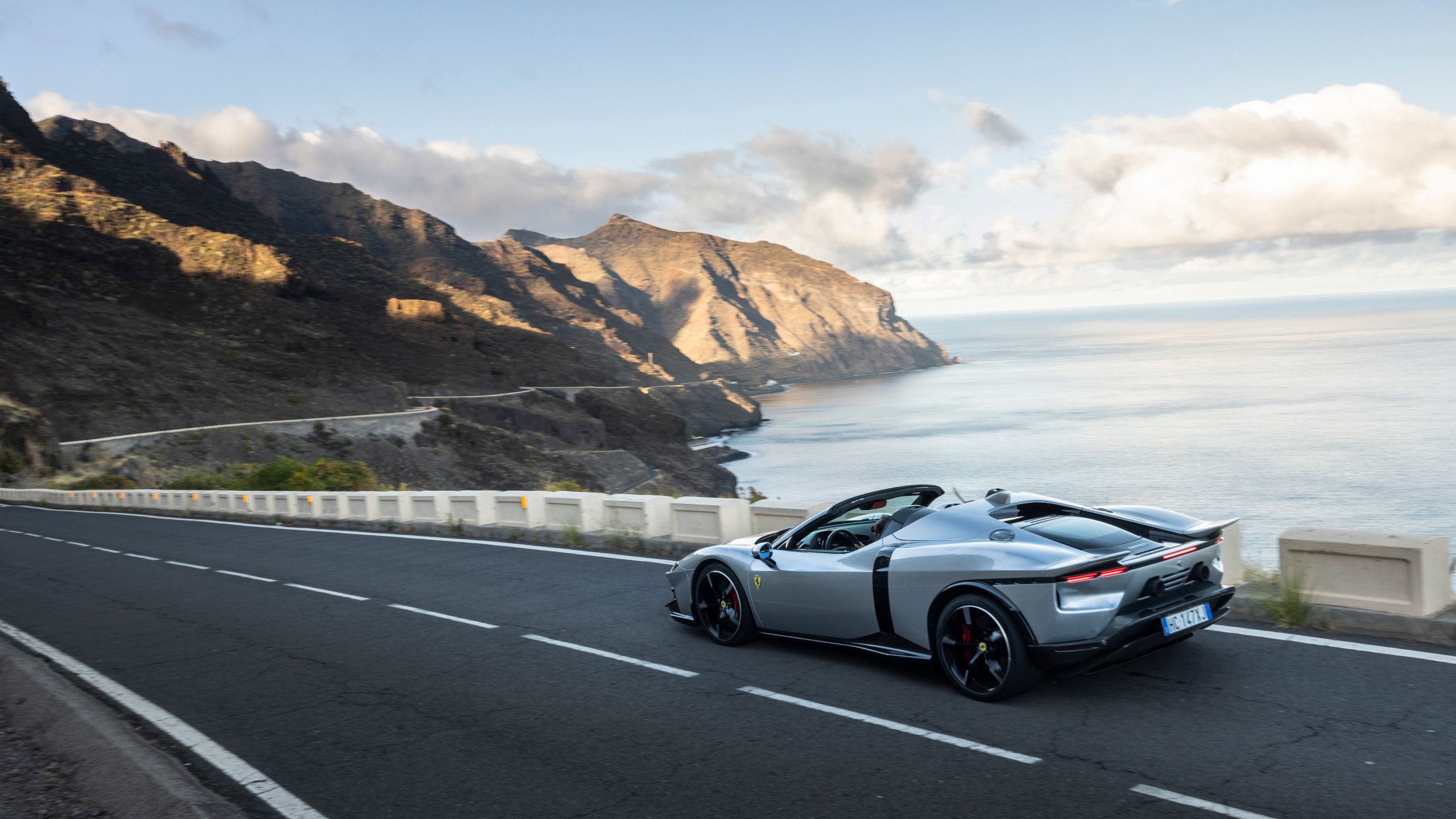
Ferrari 849 Testarossa Spider Debuts in Tenerife, Fusing Hybrid Power with Open-Air Hypercar Drama
Anonymous
Key Points
1
On Tenerife, the 849 Testarossa Spider drew a large crowd during a shoot, prompting police involvement and a €200 fine for blocking access to a pier, underscoring the model's show-stopping presence and logistical quirks.
2
Autocar details the powertrain: the ICE develops 819 bhp and the electric part adds 217 bhp for a total of 1,036 bhp and 641 lb-ft; it uses two front-axle radial-flux motors with independent transmissions for asymmetric torque vectoring, plus an axial-flux MGU-K between engine and gearbox; the 7.45 kWh battery cannot be DC charged and offers around 15 miles of EV range.
3
Auto Express notes the roof operation is highly practical, with the folding mechanism able to open or close in 14 seconds at speeds up to 45 km/h (28 mph), enhancing everyday usability of the Spider.
4
Auto Express also asserts the Spider delivers no discernible drop-off in performance or driveability vs the coupe, making it a daily-usable supercar with added open-air drama.
Ferrari has unveiled the 849 Testarossa Spider in Tenerife, a drop-top version of its SF90-derived hypercar that produces a staggering 1,036 bhp from a plug-in hybrid V8 system. Autocar reports the car combines an 819 bhp petrol engine with a 217 bhp electric system, making it one of the most powerful open-top road cars ever built.
The Tenerife launch proved as dramatic off-track as on it. During a photo shoot, the car drew such a large crowd that police were called and the crew received a €200 fine for blocking access to a pier, according to Wallpaper.
A Hybrid Powertrain Built for Maximum Drama
The 849 Testarossa Spider's powertrain is a technical tour de force. Autocar details that two front-axle radial-flux motors provide independent torque to each wheel, enabling asymmetric torque vectoring — meaning Ferrari can send more power to one wheel than the other mid-corner for sharper handling. An axial-flux MGU-K unit sits between the engine and gearbox to recover energy under braking.
The 7.45 kWh battery offers around 15 miles of pure electric range but cannot be DC fast-charged. Total system output hits 641 lb-ft of torque alongside that 1,036 bhp peak. Ferrari positions this setup as usable every day, not just on a track.
Dropping the Roof Floods the Cabin with V8 Sound
Ferrari's core argument for the Spider is simple: removing the roof transforms the experience. The flat-plane V8's soundtrack, which can feel muted inside the coupe, floods the cockpit when the roof is down. Wallpaper highlights that Ferrari deliberately chose Tenerife to show off this sonic boost in an open-air setting.
The roof itself is highly practical. Auto Express notes that the folding mechanism opens or closes in just 14 seconds and works at speeds up to 45 km/h (28 mph). That means drivers can raise or lower the roof without stopping, adding real everyday convenience to the car's drama.
No Performance Penalty for Losing the Roof
Open-top hypercars often sacrifice stiffness and speed for style. The 849 Testarossa Spider bucks that trend. Auto Express asserts there is no discernible drop-off in performance or driveability compared to the coupe. The car remains as sharp and composed with the roof gone as it is with it in place.
Reviewers call the roof-down experience extraordinary, with the added theatre intensifying every run. The sense of occasion rises sharply without the coupe's enclosed shell muffling the engine. Ferrari's goal of building a daily-usable supercar with open-air drama appears, by most accounts, to have been met.
Critics Question the Name and Styling Choices
Not everything has won universal praise. Head Topics reports that some critics argue the "849" name breaks from Ferrari tradition, which typically uses more evocative monikers. The car's visual ties to the SF90 also draw scrutiny, with some feeling the styling does not mark a bold enough departure for a new flagship.
The engine note also divides opinion. The flat-plane crank design, while rev-happy, can feel less characterful than rivals using different configurations. Still, Ferrari's bet is that the sum of parts — the power, the sound, the usability, and the spectacle — is greater than any individual criticism. The €200 fine in Tenerife suggests at least one crowd agreed.
Sentiment
Mostly PositiveNEGATIVENEUTRALPOSITIVE
Publishers
11
Articles
10
Reach
21
A
AnonymousAuthor


