Humanoid Robot Combat Unleashed
EngineAI Launches World's First Humanoid Robot MMA Tournament in China, Highlighting AI Combat
Anonymous
Key Points
1
During the URKL opening bout, the white humanoid 'White Eagle' landed a head kick on its black opponent 'Matador,' partially detaching the head and, after the head rolled away, Matador was carried out as White Eagle celebrated with a biceps-flexing display.
2
URKL’s 2026 season is planned as a tiered, year‑long competition, with the first stage scheduled from July to August and the finals set for November to December.
3
Hollywood martial arts star Donnie Yen attended the Shenzhen event as a special guest, highlighting the tournament’s high-profile appeal.
4
EngineAI supplied the standard T800 platform to competing teams free of charge, using hardware access as a way to attract outside developers rather than as a direct revenue stream.
5
Judging is based on six core parameters: motion control, balance algorithms, perception systems, real-time decision-making, power management, and structural durability.
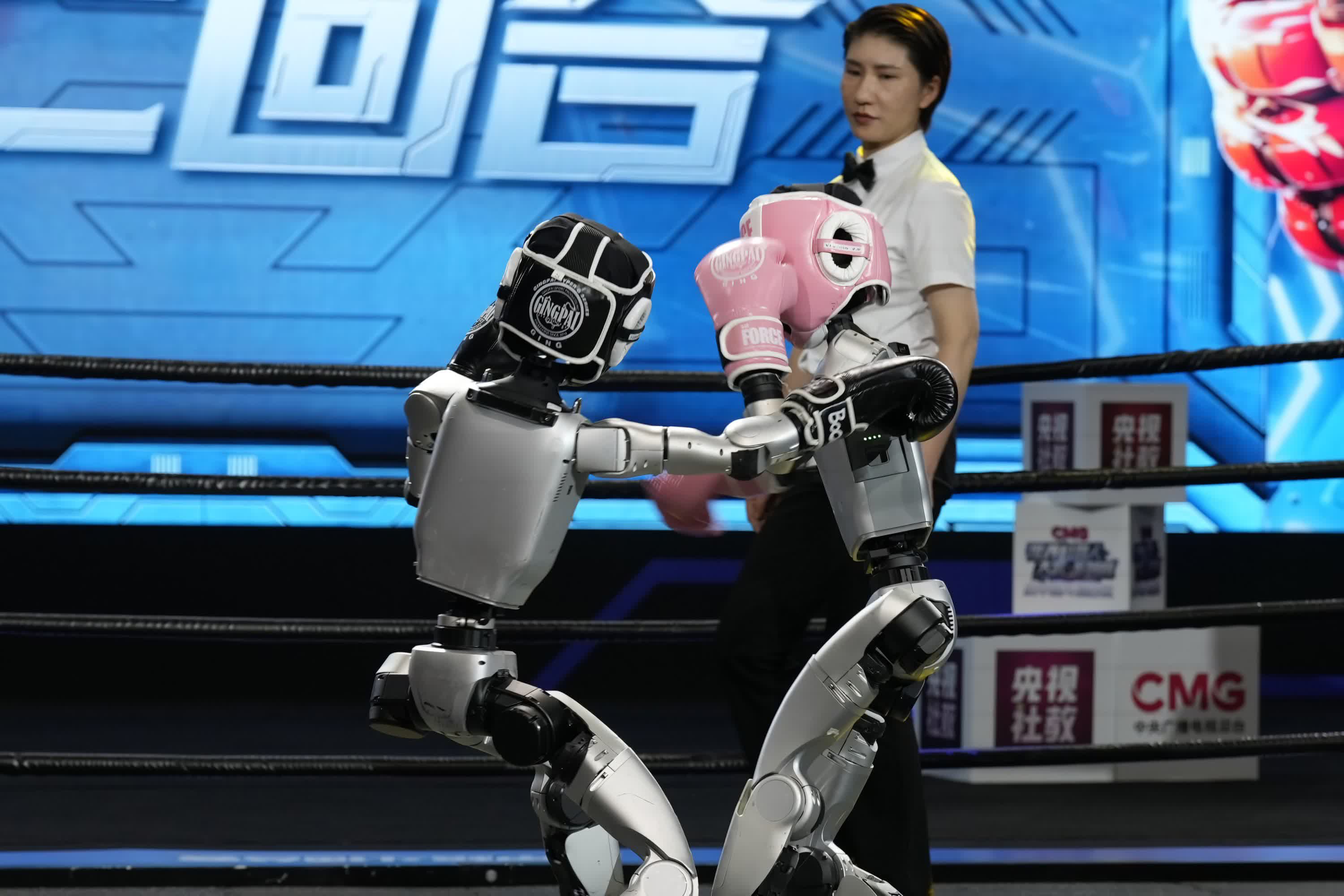
A humanoid robot was decapitated during the world's first full-contact robot MMA tournament in Shenzhen, China — and then kept fighting. The headless machine, nicknamed 'Matador,' was carried off the arena floor after its opponent 'White Eagle' landed a head kick so powerful it sent the head rolling across the mat, according to Newsweek.
The event, called the Ultimate Robot Knock-out Legend (URKL), was organized by Shenzhen robotics company EngineAI. It featured 32 international teams, a prize pool of 10 million yuan (roughly $1.4 million), and a special appearance by Hollywood martial arts star Donnie Yen. The spectacle quickly drew attention worldwide as a milestone in competitive robotics.
White Eagle Decapitates Matador in Opening Bout
The tournament's very first fight set the tone for the entire event. The white-colored robot 'White Eagle' landed a clean head kick on its black-armored opponent 'Matador.' The blow partially detached Matador's head. Then the head rolled away entirely. Matador's team carried the robot out of the arena, according to Newsweek.
White Eagle did not miss the moment. The robot struck a biceps-flexing pose to celebrate — a programmed victory display that delighted the crowd. The decapitation clip spread rapidly across social media, turning what was already a high-profile event into a global talking point overnight.
Every Team Starts With the Same T800 Robot
EngineAI gave all 32 teams the exact same machine: its standardized T800 humanoid robot platform. The company handed out the hardware free of charge. The goal was to attract outside developers and software talent, not to make money on robot sales, according to Sun Herald.
That means the competition is really about software, not steel. Teams can adjust protective armor and tweak settings, but everyone starts with the same body. Judges score each robot across six areas: motion control, balance, perception, real-time decision-making, power management, and structural durability. The team that programs its robot best wins.
Donnie Yen Attends as China Bets Big on Robot Combat
Hollywood martial arts star Donnie Yen, best known for the Ip Man film series, attended the Shenzhen event as a special guest. His presence signals how seriously organizers are treating URKL as mainstream entertainment, not just a tech showcase, according to Bradenton.com.
China's broader ambition here is hard to miss. EngineAI is positioning URKL as a global competitive sport. The 2026 season is already planned as a year-long, tiered competition. The first stage runs from July to August. The finals are set for November to December. Teams from leading universities are already signed on to compete.
What This Means for the Future of Robotics Competition
URKL is more than a spectacle. By standardizing hardware, EngineAI created a true test of AI and software engineering. Every punch, kick, and block is driven by code. The robot that stays upright and adapts fastest wins. That framework could push rapid advances in how humanoid robots move and make decisions in real time.
The decapitation moment — gruesome as it sounds — actually proved a key point. Even after losing its head, Matador's body kept functioning for a moment. That kind of structural and software resilience is exactly what engineers are racing to improve. With 10 million yuan on the line and a global audience watching, the stakes for 2026 just got very real, according to Kansas.com.
Sentiment
Mostly NegativeNEGATIVENEUTRALPOSITIVE
Publishers
14
Articles
12
Reach
26
A
AnonymousAuthor


