Derailment Track Integrity
TSB Finds Track Deficiencies and Dangerous Goods Residue in Repentigny CN Derailment Probe
Anonymous
Key Points
1
The derailment occurred with a CN freight train traveling about 77 km/h (approximately 48 mph), just under the 80 km/h speed limit for the Joliette subdivision.
2
TS B and local reports indicate 13 tank cars contained dangerous goods residue on board, contradicting earlier statements that no dangerous substances were involved in the derailment.
3
Initial site observations highlighted more than anchors and ties: inspectors noted damage to rails, ties and fastenings, with work focused on rail wear, alignment, gauge and support conditions to assess stability under load.
4
Reported counts of affected cars vary across sources, with figures including 46 derailed cars, 49 cars, and a 172-wagon train, underscoring early inconsistencies in incident characterization.
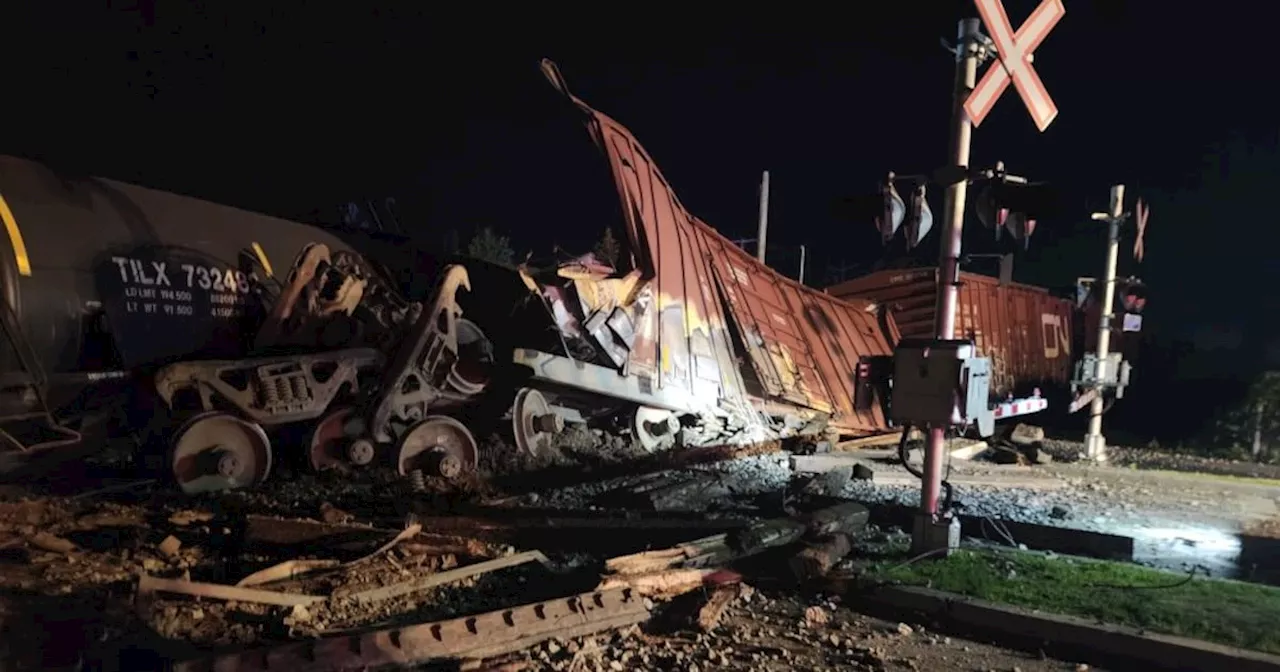
Canada's Transportation Safety Board has found serious track deficiencies along a CN Rail line near Repentigny, Quebec, after a freight train derailed on July 5, sending 49 cars off the tracks northeast of Montreal. The train was traveling at about 77 km/h — just under the 80 km/h speed limit — when it derailed, according to CP24.
Investigators found missing and displaced rail anchors, skewed ties, and problems with track alignment and support. No injuries were reported. But CP24 confirmed that 13 tank cars were carrying dangerous goods residue — contradicting earlier statements that no hazardous materials were involved.
TSB Pinpoints Track Faults That Caused the Derailment
The TSB deployed investigators to the site shortly after the July 5 derailment. They found multiple structural problems along the Joliette subdivision, according to Head Topics. Inspectors flagged missing rail anchors — metal clips that hold rails in place — as well as ties sitting at wrong angles. These defects can shift stress along the track and raise derailment risk.
The TSB also noted damage to rails, ties and fastenings beyond just the anchors and ties. Investigators are studying rail wear, alignment, gauge width and how well the track supports weight under load, Global News reported. The agency has issued a formal rail safety advisory to Transport Canada urging a full check of track integrity across the corridor.
CN Rebuilds 750-Metre Stretch After Cars Jump the Rails
CN Rail announced it rebuilt the track and its foundation over a 750-metre stretch following the derailment. The work covered the section where the 172-car freight train lost control. Early reports varied widely on how many cars derailed — figures of 46 and 49 have both been cited — highlighting confusion in the first hours after the incident, according to The Traveler.
The derailment hit a busy commuter rail corridor. Service was disrupted for a period before resuming at reduced speeds. CN and transport officials imposed slower speed limits as a safety measure while the investigation continues.
Dangerous Goods Residue Found in 13 Tank Cars
One of the most significant findings to emerge was the presence of dangerous goods residue in 13 tank cars. Officials had initially said no dangerous substances were involved in the derailment. That claim was later walked back. Residue in tank cars can still pose environmental and safety risks even after the bulk cargo has been removed.
The TSB has not yet said what materials the residue came from. Investigators are reviewing the full manifest of the train's cargo alongside the track condition data. Local authorities monitored the site throughout the response, Head Topics reported, and no dangerous goods were released into the environment.
Investigation Ongoing as Safety Scrutiny Grows
The TSB investigation remains open. Officials are analyzing maintenance records and inspection logs for the Joliette subdivision to understand how the track reached its deficient state. The board has not yet named an official cause, according to Global News. Both CN's maintenance practices and Transport Canada's oversight role are expected to face scrutiny.
The Repentigny derailment adds to a string of high-profile rail incidents that have kept Canada's rail safety system under pressure. The TSB's advisory to Transport Canada signals that regulators may need to act before the full investigation wraps up. Results are expected to lead to new safety requirements for track inspections along busy freight corridors.
Sentiment
Mostly NegativeNEGATIVENEUTRALPOSITIVE
Publishers
10
Articles
26
Reach
36
A
AnonymousAuthor


