First T. Rex Trackway
Scientists discover the first connected trackway of an adult T. rex in North Dakota.
Anonymous
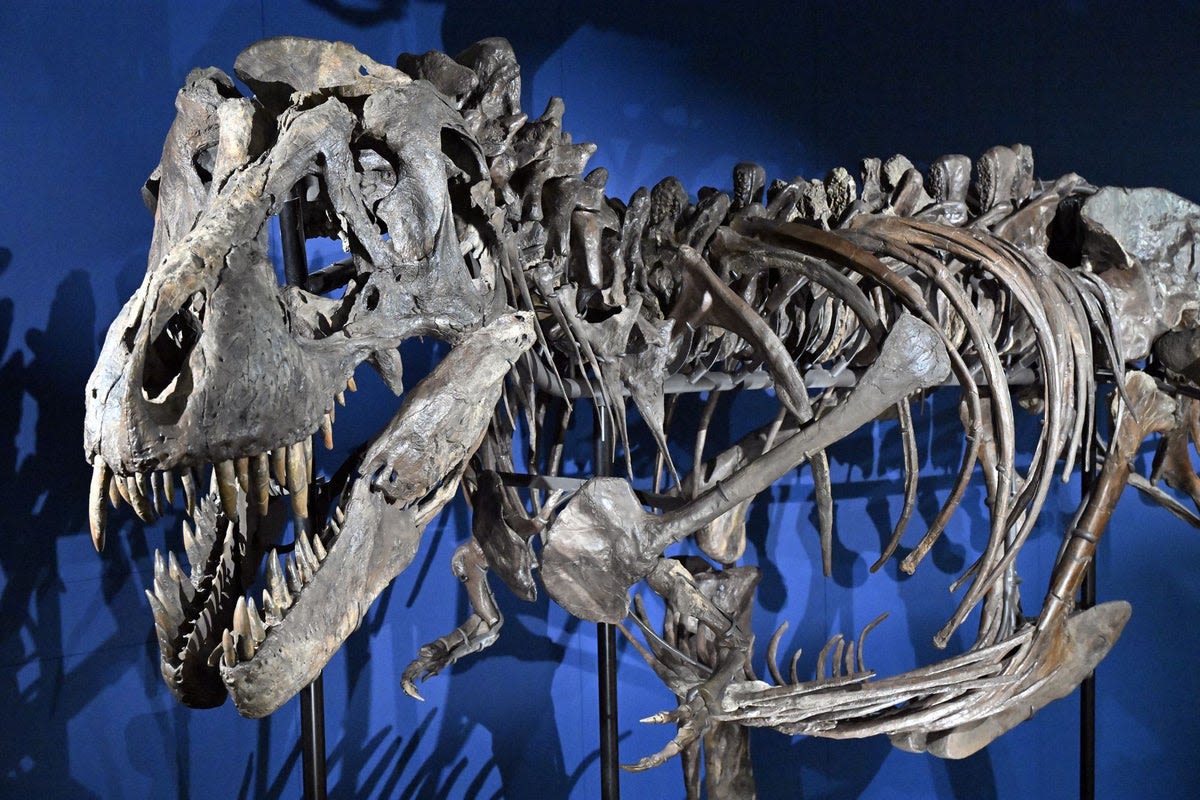
Scientists have documented the first connected trackway attributed to an adult Tyrannosaurus rex: four three-toed footprints preserved across roughly 7 meters in North Dakota’s Hell Creek Formation. Colorado high school teacher Kent Hups discovered the tracks while volunteering at a fossil dig in 2025, prompting researchers from the Denver Museum of Nature & Science and Liverpool John Moores University to investigate. The footprints date to about 66.5 million years ago and are identified as likely T. rex tracks based on their shape, size and the abundance of T. rex fossils in the area, though the identification is an interpretation rather than direct proof. The alternating left and right prints reveal a walking sequence and indicate a pace of roughly 1.5 to 2 meters per second, or 5.4 to 7.2 kilometers per hour, suggesting a brisk walk rather than a sprint. The discovery provides rare evidence of the dinosaur’s movement and behavior that isolated footprints cannot show.
Key Points
1
The tracks were preserved in fine-grained sandstone concretions cemented with calcium carbonate, a hardened material that was more resistant to later erosion than the surrounding rock.
2
Researchers initially remained skeptical of the find: lead excavation paleontologist Tyler Lyson did not accept the first wedge-shaped impression as a T. rex footprint until further excavation revealed the complete four-print sequence.
3
The team used high-resolution 3D surface scans of the trackway, allowing the fossil surface to be documented and analyzed beyond the original field site.
4
Tyler Lyson emphasized that the trackway captures behavior that skeletal fossils generally cannot: “Bones tell us an enormous amount about these animals, but footprints capture a moment of behavior. With a trackway, we can actually follow an animal as it moved across the landscape.”
5
Kent Hups said the discovery reflected the scientific habits he teaches his students: “Science starts with curiosity, passion, and careful observation.” He had noticed the three wedge-shaped rocks while looking for an easier route out of a rocky ravine during the dig.
Sentiment
Mostly NegativeNEGATIVENEUTRALPOSITIVE
Publishers
16
Articles
27
Reach
43
A
AnonymousAuthor


