AI Credential Security
1Password Launches Claude AI Integration for Secure Credential Access with Zero-Exposure Security
Anonymous
Key Points
1
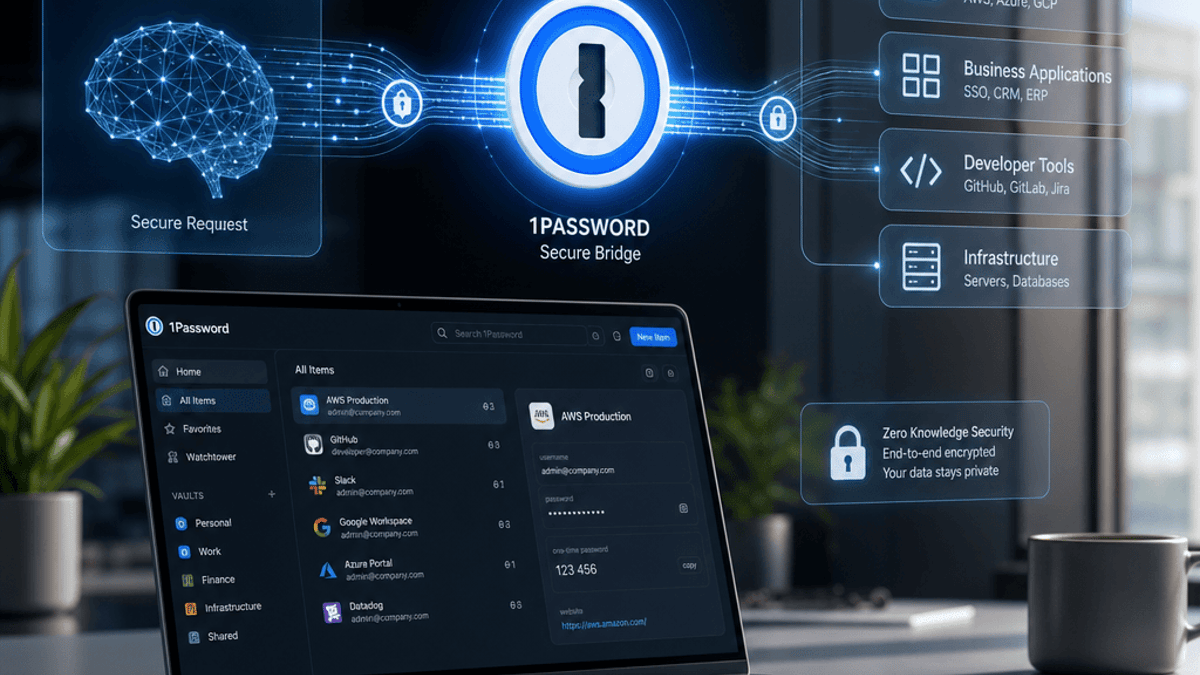
1Password's Claude integration uses Model Context Protocol (MCP) environments—the plumbing that connects AI tools to external services—within its Unified Access platform to securely broker credentials for tasks without exposing them to the AI.
2
Access requests are approved via a biometric prompt, and the granted permissions last only for the current session, preventing ongoing access beyond the task.
3
1Password plans to expand support to payment cards and identity information in a future update, broadening the types of data that can be securely accessed by Claude.
4
The vault can store not just passwords but also two-factor authentication codes, passkeys, and API tokens, expanding what users can securely manage through 1Password.
5
Real-world use scenarios discussed include Claude scanning Stripe transactions for red flags and assisting Audible account tasks, illustrating practical workflow automation.
1Password has launched a direct integration with Anthropic's Claude AI, letting the assistant log into apps and complete multi-step tasks using stored passwords — without ever seeing those passwords. TechBuzz reported the feature uses a "zero-exposure" framework, injecting credentials at the target site at runtime rather than passing them to the AI model.
The integration is available now on Mac across all 1Password plans — business, family, and individual. It works through Claude's browser extension, Claude Cowork, and Claude Code, and requires the 1Password desktop app and browser extension alongside the Claude desktop app. TechZine noted that Claude performs tasks without actually seeing the passwords themselves.
How Claude Accesses Passwords Without Ever Seeing Them
The system works through what 1Password calls a Unified Access platform, built on Model Context Protocol (MCP) — the plumbing that connects AI tools to outside services. When Claude needs to log into a site, it sends a request. The user approves it with a biometric prompt, like a fingerprint. Then 1Password injects the credential directly into the site. Claude never receives the actual password.
Access is granted per task and lasts only for the current session. After autofill, if a form submission fails, any lingering secrets are wiped. The vault is never exposed to the AI model, its memory, or Anthropic's systems. 1Password says the platform currently protects over 1.3 billion credentials across thousands of businesses.
Agentic Mode Locks the Vault During AI Browser Sessions
A key new feature is Agentic Mode, which activates when Claude takes control of the browser. In this mode, the vault is locked down immediately. Claude can only access the specific credentials approved for the current task. No other stored data is reachable during the session.
This design limits the blast radius if something goes wrong. Even if Claude were to act unexpectedly, it could not reach passwords, two-factor authentication codes, passkeys, or API tokens beyond what the user already approved. Daily Guardian noted the feature lets users authorize Claude to act on their behalf across web services without surrendering full vault access.
Real Tasks Claude Can Now Handle: Stripe, Audible, and More
1Password highlighted several practical use cases for the integration. One example has Claude scanning Stripe transaction data for red flags. Another involves Claude completing tasks inside an Audible account. In both cases, Claude logs in, does the work, and logs out — without the user typing a single password.
The vault can store more than standard passwords. It also holds two-factor authentication codes, passkeys, and API tokens. 1Password plans to expand support to payment cards and identity information in a future update, broadening what Claude can securely access during automated workflows.
1Password's Broader Push Into AI Security Partnerships
This Claude rollout is part of a wider strategy. 1Password has also explored similar integrations with OpenAI and GitHub, positioning itself as the security layer for AI-assisted work. The company frames the platform around three pillars: discovery, governance, and audit — knowing what credentials exist, controlling who uses them, and tracking every access event.
The move reflects a growing industry concern: as AI agents take on more real-world tasks, they need access to sensitive systems. Traditional password sharing with AI — copying and pasting credentials — creates serious exposure. 1Password's approach tries to solve that by keeping the AI in the loop without letting it hold the keys.
Sentiment
Mostly NegativeNEGATIVENEUTRALPOSITIVE
Publishers
13
Articles
5
Reach
18
Topics
A
AnonymousAuthor


