AI Scaling Paradox
New Report Finds Most Executives Tie Job Security To AI But Lack Plans
Anonymous
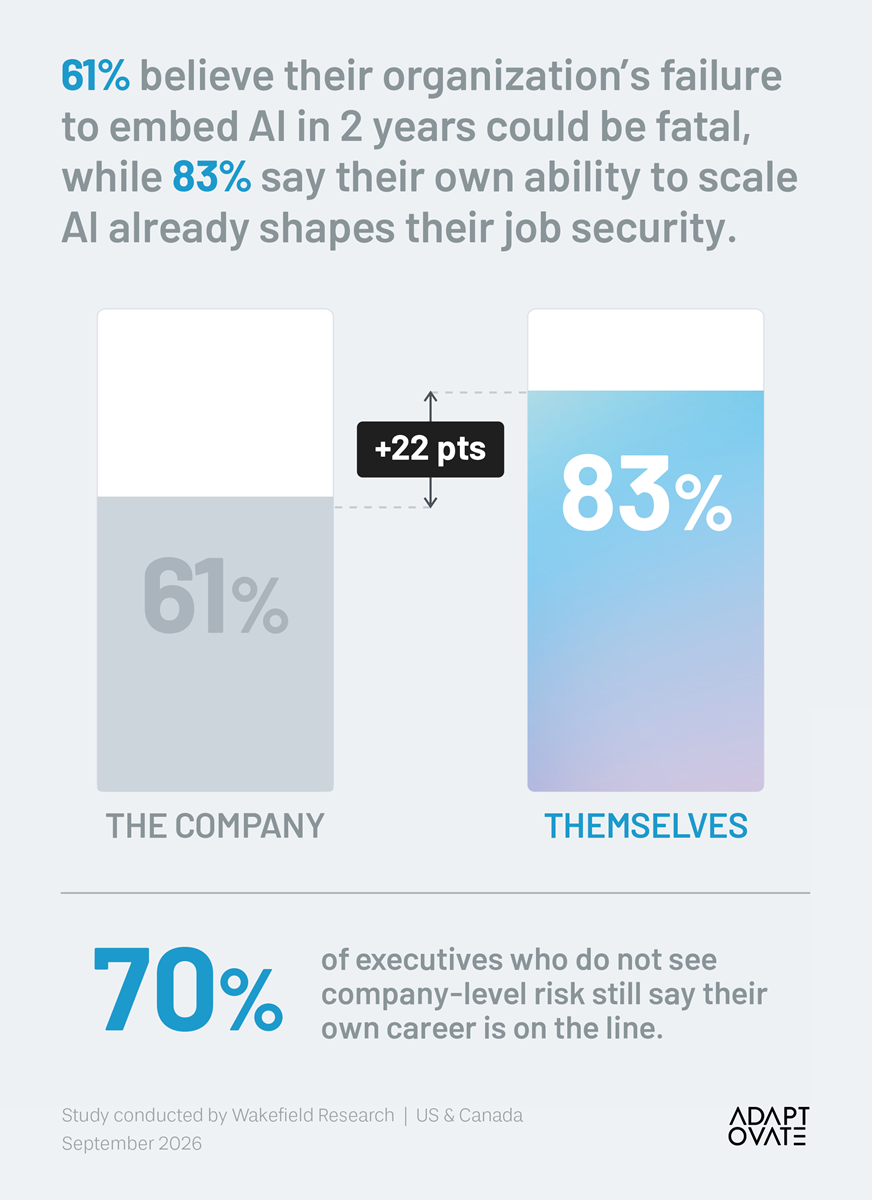
Eighty-three percent of executives say their jobs depend on scaling artificial intelligence, yet only 19% of their companies have a plan to do it. ADAPTOVATE surveyed 300 C-suite leaders from U.S. and Canadian firms with at least $10 million in annual revenue, revealing a massive gap between AI ambition and execution. The crisis hits hardest at mid-size companies, where the pressure is highest but resources are tightest.
The problem isn't a lack of strategy knowledge — 78% of CEOs already know what they need to do. Instead, 55% cite a shortage of skilled workers, and 82% say internal gatekeepers are blocking progress. Fort McMurray Today reported that 90% of executives worry their best AI pilots never spread beyond their teams, signaling that companies can start projects but can't scale them.
The Execution Gap Isn't About Strategy
Most executives already understand AI's importance. Sudbury Star noted that 78% of CEOs said they know exactly what their organization needs to do to scale AI. The bottleneck isn't vision or leadership buy-in — it's implementation. Companies can't move from pilot projects to company-wide programs because they lack the internal structure, talent, and decision-making speed to make it happen.
Talent Shortage and Internal Gatekeepers Block Progress
Skilled AI workers are in short supply. Fifty-five percent of executives named lack of talent as their top barrier to scaling AI, according to Sault Star. But talent alone doesn't explain the freeze. Eighty-two percent of respondents said internal gatekeepers — people or departments who control resources or decisions — are slowing down progress. This suggests companies are caught between needing more people and having people who won't let go of power.
Mid-Size Companies Face the Biggest Squeeze
The AI execution gap hits mid-size firms the hardest. Owen Sound Sun Times reported that the problem is 'not an AI-specific problem but a problem that hits hardest at mid-size companies.' These firms feel the pressure to compete with larger rivals but lack the resources and formal processes that big organizations have. They're trapped between startup agility and enterprise structure.
Most Executives Doubt AI Agents Will Last
Despite the urgency around AI, most leaders are skeptical about where the technology is headed. Eighty-eight percent of executives told Montreal Gazette they believe AI agents will eventually become obsolete. This skepticism may explain why so many companies hesitate to commit heavily to AI transformation — they're not sure which bets will pay off, and they're afraid of backing the wrong technology.
Sentiment
NeutralNEGATIVENEUTRALPOSITIVE
Publishers
12
Articles
11
Reach
12
A
AnonymousAuthor


