Global Retail Shifts East
China's live-commerce market rivals US e-commerce, revealing a vast gap Western brands must address now.
Anonymous
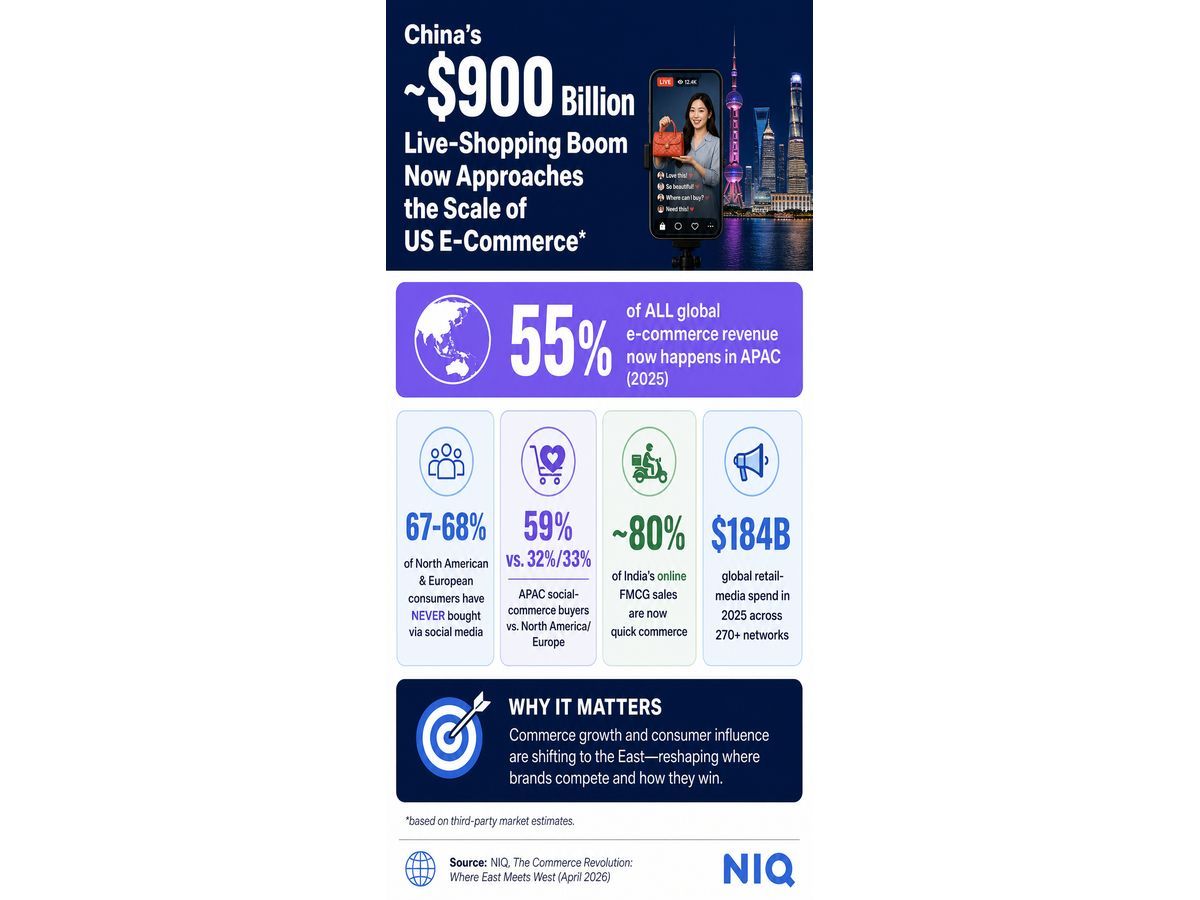
China's live-commerce market has grown to roughly $900 billion, now approaching the total size of the entire US e-commerce sector, according to NielsenIQ. The finding comes from NielsenIQ's new global report, *The Commerce Revolution: Where East Meets West*, which maps how Asian retail formats are reshaping global shopping.
Live commerce — where hosts sell products in real time via video streams — was pioneered in Asia. Yet most Western consumers have still not tried it. National Post reports that Western brands treating these channels as experiments risk being left behind as the gap widens.
Asia Now Owns More Than Half of Global E-Commerce
The Asia-Pacific region accounts for nearly 55% of all global e-commerce, according to Edmonton Sun. That share reflects years of faster adoption, better mobile infrastructure, and formats built from scratch for the smartphone era. The West, by contrast, still leans on traditional online shopping carts and static product pages.
China leads that APAC dominance. Its $900 billion live-commerce market did not exist a decade ago. Hosts stream live video, show products in action, answer questions in real time, and close sales instantly. It blends entertainment with shopping in a way that static e-commerce does not.
Live Commerce Turns Browsing Into a Real-Time Experience
Live commerce is simple to describe: a host goes live on a platform, picks up a product, and viewers can buy it with one tap. Sales happen fast. Viewers feel urgency. Discounts expire in minutes. In China, platforms like Douyin and Taobao Live have made this the default way millions of people shop daily.
The format drives impulse purchases in a way that no banner ad or product listing can match. Hosts build trust with their audiences over weeks and months. That loyalty converts into sales at scale. NielsenIQ's report frames this as a fundamental shift — not a trend, but a new channel with staying power.
Western Brands Still Treating the Channel as an Experiment
Despite the scale in Asia, live commerce remains a novelty in North America and Europe. A handful of brands have tested it on TikTok Shop or Instagram Live. But most have not committed resources, built creator partnerships, or connected live-selling to their broader sales data. The Crag and Canyon notes that NielsenIQ sees this hesitation as a serious risk.
The report argues the gap is still closeable — but only if brands act now. The window for early-mover advantage in Western live commerce is open, but it will not stay open. Brands that wait for the format to become mainstream will face the same catch-up problem that late movers faced in traditional e-commerce.
NielsenIQ Urges Brands to Connect Data, Media, and Commerce
NielsenIQ's core message is structural. The shift is not just about adding a new sales channel. It is about moving from managing separate channels to building a single connected system. That system links shopper data, media spending, and commerce tools into one engine that can react in real time.
According to Edmonton Sun, NielsenIQ says the brands that lead the next decade will "read the East as a roadmap and act on it now." For Western retailers, that means studying what works in China and Southeast Asia — and building the infrastructure to replicate it before competitors do.
Sentiment
NeutralNEGATIVENEUTRALPOSITIVE
Publishers
4
Articles
4
Reach
4
A
AnonymousAuthor