Global TV Shipments Rise
Global TV Shipments Grow 3.6% in Second Quarter Despite Market Headwinds
Anonymous
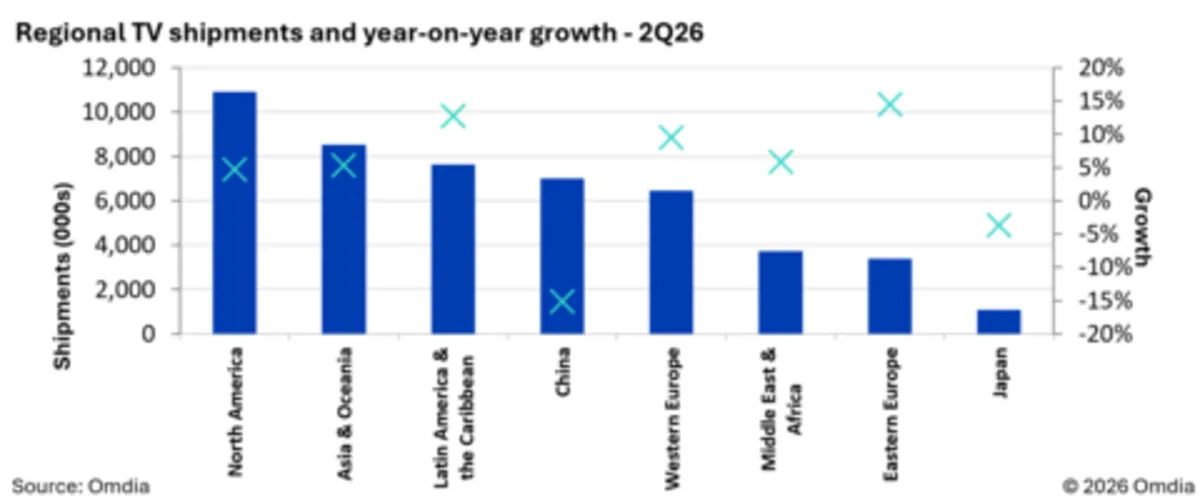
Global TV shipments grew 3.6% year-over-year to 48.8 million units in the second quarter of 2026, buoyed by the FIFA World Cup and Amazon Prime Day sales events. Omdia reported the modest gain masks a deeply divided market, with developed regions gaining traction while China's collapse threatens overall momentum.
China's TV shipments plummeted 15.1% year-over-year as government stimulus programs ended and consumer spending slowed. The world's largest TV market has become the primary drag on global growth, offsetting strong gains in Western Europe, North America, and emerging markets.
Western Europe and North America Lead Growth
Major developed markets continued their recovery in 2Q26. Western Europe and North America both posted significant double-digit growth rates, capitalizing on FIFA World Cup viewing demand and well-timed promotional events. Omdia highlighted these regions as bright spots in an otherwise uneven global landscape.
Emerging markets also contributed to global gains, though at a slower pace than developed economies. The combination of sporting events and retail promotions created temporary demand spikes that masked underlying weakness in consumer purchasing power across most regions.
Memory Constraints Push Brands Toward Premium 4K Models
Tight memory supply is reshaping product lineups across the TV industry. Omdia predicts brands will abandon lower-resolution models and shift heavily toward 4K TVs, where memory demand per unit is higher but margins are healthier. This strategy helps manufacturers maximize profits despite supply constraints.
The move protects brand revenue even as unit volumes face pressure. Higher-end 4K sets command premium prices, allowing companies to weather soft demand in price-sensitive segments. Memory availability will remain a key production lever through 2026 and beyond.
RGB LED Display Market Heats Up With Rapid Competition
RGB LED display shipments hit 295,000 units in 2Q26, a segment drawing intense competition from multiple manufacturers. Omdia flagged this emerging category as a bright spot in display technology, though market consolidation may come as players vie for share.
The RGB LED space remains too small to offset TV market weakness globally. Yet it signals where the industry is investing future growth, particularly as brands develop new display technologies to differentiate themselves in a crowded consumer TV market.
Inflation and Weak Consumer Demand Cloud Outlook
Persistent consumer inflation continues to weigh on TV spending worldwide. Shoppers are delaying purchases or trading down to cheaper models, a trend that undercuts manufacturer profit margins even as unit volumes stabilize. The FIFA World Cup and Amazon Prime Day provided only temporary relief.
Looking ahead, Omdia expects headwinds to intensify unless consumer confidence recovers. China's weakness and inflation-driven demand destruction in other regions pose the biggest risks to 2026 TV shipment forecasts. Strategic shifts toward 4K and premium segments offer manufacturers a partial hedge.
Sentiment
NeutralNEGATIVENEUTRALPOSITIVE
Publishers
5
Articles
5
Reach
5
A
AnonymousAuthor


