AMD's AI Market Challenge
AMD Unveils Helios AI System, With Microsoft Adopting to Challenge Nvidia’s Data Center Dominance
Anonymous
Key Points
1
Azure will add two new VM series powered by 6th Gen AMD EPYC Venice processors: the HDv2 series for agentic AI and data pipelines, and the HXv2 series aimed at semiconductor design workloads.
2
AMD and Microsoft will deploy Pensando DPUs in AMD AI backend networking and select Azure services, with Azure Boost used to scale cloud networking performance across the fleet.
3
Lisa Su, AMD Chair and CEO, highlighted the collaboration by stating: "Microsoft’s new AMD deployments mark an important milestone as we deliver leadership compute solutions to Azure customers."
4
Industry context shows Nvidia dominating the data-center GPU market (over 95%), with AMD around 4.5%, and observers predicting AMD could reach 20%–25% share as Helios deployments scale.
5
Meta plans to deploy up to 6 gigawatts of AMD computing capacity over time, beginning with 1 gigawatt using Helios racks later this year.
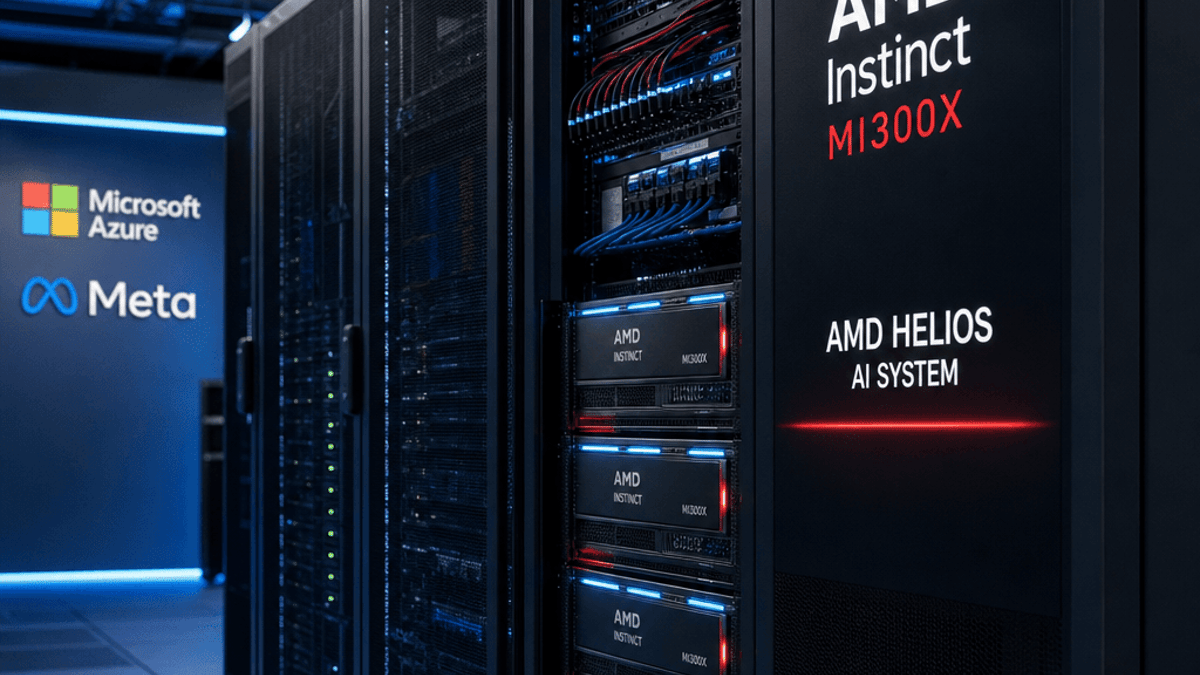
AMD has launched Helios, its first rack-scale AI system, taking direct aim at Nvidia's grip on the data-center market. Microsoft will deploy Helios in Azure data centers later this year, joining Meta, OpenAI, and Oracle as early customers, according to CNBC.
The system bundles AMD's Instinct MI455X GPUs, Venice CPUs, Pensando networking chips, and ROCm software into a single rack unit. AMD says Helios delivers a lower cost per token for AI workloads — meaning cheaper AI processing — than rival systems. Shipments to customers are planned for the second half of 2026, per Market Screener.
Microsoft Deepens AMD Ties Across Azure Fleet
Microsoft's Azure will get two new types of computing servers powered by AMD's 6th Gen EPYC Venice processors. The HDv2 series targets agentic AI and data pipelines. The HXv2 series is built for semiconductor design work, according to TechBuzz.
AMD and Microsoft will also roll out Pensando DPUs — chips that handle networking tasks — across AMD AI backend infrastructure and select Azure services. Azure Boost will use these chips to push cloud networking speeds higher across the full Azure fleet, Market Screener reported.
Lisa Su Calls Azure Deal a Leadership Milestone
AMD Chair and CEO Lisa Su welcomed the deal with a clear statement. "Microsoft's new AMD deployments mark an important milestone as we deliver leadership compute solutions to Azure customers," she said. The partnership covers Helios for frontier AI model inference, plus broader Azure AI services, per Newsmax.
AMD's ambitions stretch well beyond Microsoft. Meta plans to deploy up to 6 gigawatts of AMD computing capacity over time. It will start with 1 gigawatt of Helios racks later this year, according to CNBC. That scale of deployment would rank among the largest GPU rollouts outside of Nvidia hardware.
Helios Could Chip Away at Nvidia's 95% Market Hold
Nvidia currently controls over 95% of the data-center GPU market. AMD sits at roughly 4.5%, according to TechBuzz. Those numbers have barely moved in years, but Helios could change the math.
Industry observers say AMD could reach 20% to 25% market share as Helios deployments scale up. Helios competes directly with Nvidia's Grace Blackwell and Vera Rubin platforms, as Newsmax noted. A shift of that size would mark the biggest shake-up in AI chip supply in years.
Sentiment
Mostly PositiveNEGATIVENEUTRALPOSITIVE
Publishers
52
Articles
58
Reach
110
A
AnonymousAuthor


