Ukraine to Make Patriots
US Licenses Ukraine to Produce Patriot Missiles, Strengthening Defenses Against Russian Attacks
Anonymous
Key Points
1
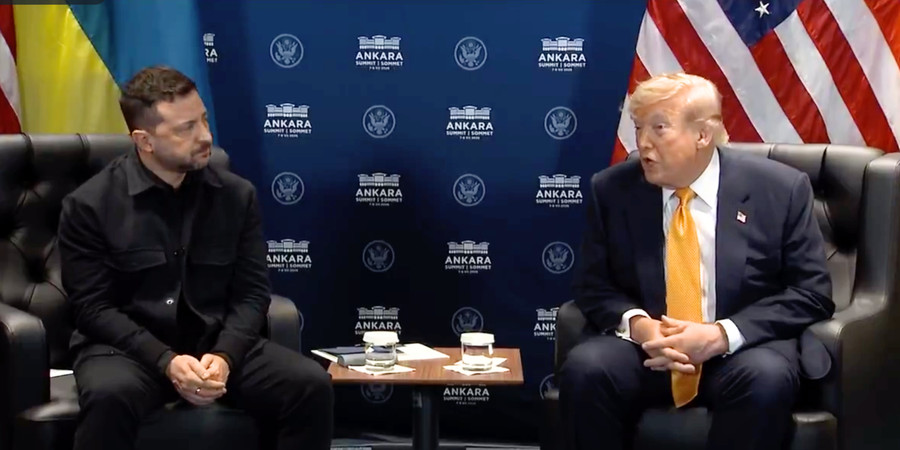
Trump announced a license for Ukraine to manufacture Patriot missiles during the Ankara NATO summit, telling Zelensky that 'we're going to give a license to you to make Patriots' and noting the company had not yet been informed.
2
Trump and Zelensky appeared to have a more cordial relationship during the Ankara meeting, marking a departure from the harsh exchanges seen in the Oval Office last year.
3
The July 2 Russian attack killed more than 30 people in Ukraine, underscoring the ongoing intensity of strikes as Kyiv seeks expanded air defenses.
4
Ukraine has targeted Russian energy infrastructure as part of its broader operations, including the St. Petersburg Oil Terminal and facilities in the Leningrad region.
5
Market analysis cited by CryptoBriefing suggested the perceived likelihood of a direct NATO-Russia clash had fallen to about 17.5% (YES) amid the escalation and the production authorization.
President Trump announced at the NATO summit in Ankara that the U.S. will license Ukraine to manufacture Patriot air defense missiles domestically. "We're going to give a license to you to make Patriots," Trump told Zelenskyy. "Make them yourself." Stars and Stripes reported that Trump admitted he had not yet informed U.S. defense contractors before making the announcement.
The announcement came days after Russia's July 2 strike on Kyiv killed more than 30 people using 74 missiles and 496 drones, Times of Israel reported. Ukraine's air defenses failed to intercept any of the 29 ballistic missiles aimed at the capital because PAC-3 interceptor stockpiles were depleted.
Trump and Zelenskyy Strike a Warmer Tone in Ankara
The Ankara bilateral meeting marked a sharp contrast from the tense Oval Office exchanges of last year. Newsmax noted that Trump praised Zelenskyy during the summit, and observers described the two leaders as far more cordial. Trump framed the license as a way to shift the production burden directly to Ukraine, saying, "We have Patriots, but we don't have that many. We need them for ourselves, too."
Zelenskyy welcomed the move but stressed the urgency of immediate missile transfers. "We need to find a way to get as quick as possible, as much as possible, missiles for Patriot systems," he said. Ukraine has lobbied for domestic production rights since at least May 2026, when Zelenskyy made a public appeal on CBS News' Face the Nation.
24-Month Production Gap Leaves Ukraine Exposed Now
Defense analysts warn the license offers no quick fix. Building a Patriot PAC-3 interceptor takes a minimum of 24 months. Producing the solid rocket engine components takes even longer — roughly 30 months. Modern missile manufacturing depends on a fragile global supply chain that cannot simply be moved to a war zone overnight.
Trump called the timeline "pretty quick," but experts pushed back hard. George Beebe of the Quincy Institute warned that Russia will strike any production facility "as soon as the first cornerstone is laid." He added that Ukraine would have to pull existing Patriot batteries away from front-line defense just to protect the new factory — weakening the very shield it is trying to build.
Contractors Blindsided as ITAR Waivers Loom Large
Lockheed Martin and RTX Corporation — the two primary Patriot manufacturers — were not briefed before Trump's public statement, Human Events reported. Both firms must now build co-production frameworks with Ukrainian state enterprises. To make that happen, the White House will need to issue unprecedented waivers under the International Traffic in Arms Regulations, the strict U.S. export control law that governs sensitive weapons technology.
Analysts also flagged serious intellectual property risks. Transferring Patriot guidance, telemetry, and solid-fuel propulsion secrets to an active war zone could expose that technology to Russian or Chinese intelligence services. Setting up a secure, combat-zone production facility is expected to cost billions of dollars — a bill likely to fall on Western aid budgets.
Russia Escalates Rhetoric as NATO-Clash Odds Sit at 17.5%
Moscow responded sharply. Kremlin spokesman Dmitry Peskov dropped the term "special military operation" entirely, calling the conflict a "real war" driven by direct Western military integration. Foreign Minister Sergey Lavrov said Washington had abandoned any role as an "honest broker" and was fueling deeper escalation. Ukraine, meanwhile, struck the Omsk Oil Refinery — Russia's largest — with drones on July 6, more than 2,500 kilometers from the Ukrainian border.
Prediction market data compiled by CryptoBriefing puts the probability of a direct NATO-Russia military clash by December 31, 2026 at 17.5%. That figure has swung sharply in recent weeks following Ukraine's deep-strike energy campaign and the Patriot license announcement. Observers will now watch whether Congress passes export control carve-outs and how quickly U.S. contractors respond to the uncoordinated mandate from the White House.
Sentiment
Mostly NegativeNEGATIVENEUTRALPOSITIVE
Publishers
45
Articles
368
Reach
413
A
AnonymousAuthor


