Robot Labor Protest
Robots March Outside Warsaw Ministry Demanding Strict AI Regulation and Job Protection
Anonymous
Key Points
1
Organizer Grzegorz Kulis said that if robots become “several times more efficient and cheaper,” many business managers would choose them over human workers. He also said he was “terrified” by technological changes that could disrupt how society organizes work.
2
Kulis argued that Poland’s authorities are not doing enough to regulate artificial intelligence and humanoid robotics, saying: “I’m not saying that the Ministry are doing nothing ... but we believe they are not doing enough.”
3
Kulis has experience in both employment policy and robotics: he previously served on the Labor Market Council of Poland’s Ministry of Family, Labor and Social Policy and now leads a robotics company and an employment agency.
4
The demonstration was presented as taking place ahead of Poland’s national implementation of the European Union’s AI Act, linking the protest to an imminent regulatory milestone rather than only to general concerns about automation.
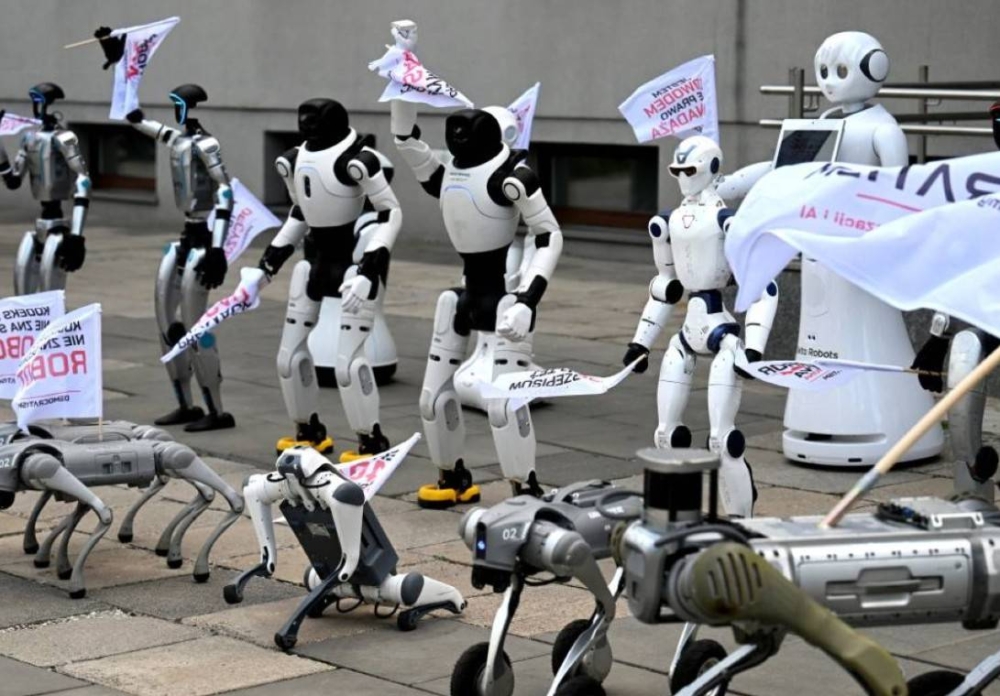
About 30 robots marched outside Poland's digital affairs ministry in Warsaw, waving flags and chanting slogans demanding AI regulation and job protection. Startup Fortune reported the demonstration, organized by the Democratism initiative, featured humanoid robots and dog-like quadrupeds to show that advanced machines can already operate in public spaces.
Organizer Grzegorz Kulis said policymakers must act now before AI disruption accelerates. Al Jazeera noted that the protest comes ahead of Poland's implementation of the European Union's AI Act, making it a timely call for regulation rather than just a general warning about automation.
Robots Show What Automation Could Do
The machines in Warsaw weren't just props. Qatar Tribune reported the robots were deployed to demonstrate that humanoid and dog-like robots can already function in real public environments. This practical display underscores Kulis's argument that regulation must keep pace with rapidly advancing capability.
Digital Affairs Minister Krzysztof Gawkowski acknowledged the stakes. He said that uncontrolled AI systems integrated into evolving humanoid robots pose a serious problem for Poland and Europe. The visible protest seems to have gotten his attention on the urgency of the issue.
Kulis: Robots Will Replace Workers if Cheaper
Kulis laid out the economic logic driving his concerns. If robots become "several times more efficient and cheaper," many business managers will choose machines over people. LinkedIn reported Kulis said he is "terrified" by technological changes that could reshape how society organizes work and employment.
He argued Poland's authorities are moving too slowly. "I'm not saying that the Ministry are doing nothing," Kulis said, "but we believe they are not doing enough." The gap between current regulation and the speed of robot development is widening, he insisted.
Kulis Brings Both Jobs and Robotics Experience
Kulis is not a casual observer of automation. He previously served on the Labor Market Council at Poland's Ministry of Family, Labor and Social Policy. This background in employment policy gives his warnings about job displacement real credibility in policy circles.
Today, Kulis leads both a robotics company and an employment agency. Qatar Tribune noted this dual experience — expertise in both what robots can do and what workers need — positions him as a bridge between technology and labor concerns. Few voices understand both sides so deeply.
Sentiment
Mostly NegativeNEGATIVENEUTRALPOSITIVE
Publishers
23
Articles
46
Reach
69
A
AnonymousAuthor


