Euclid's Quasar Discoveries
Euclid Discovers 31 Ancient Quasars, Illuminating Early Universe Black Hole Growth
Anonymous
Key Points
1
Euclid's deep survey has uncovered 31 ancient quasars—the largest set to date—expanding the census of early supermassive black holes and pushing back to when the universe was about 670 million years old.
2
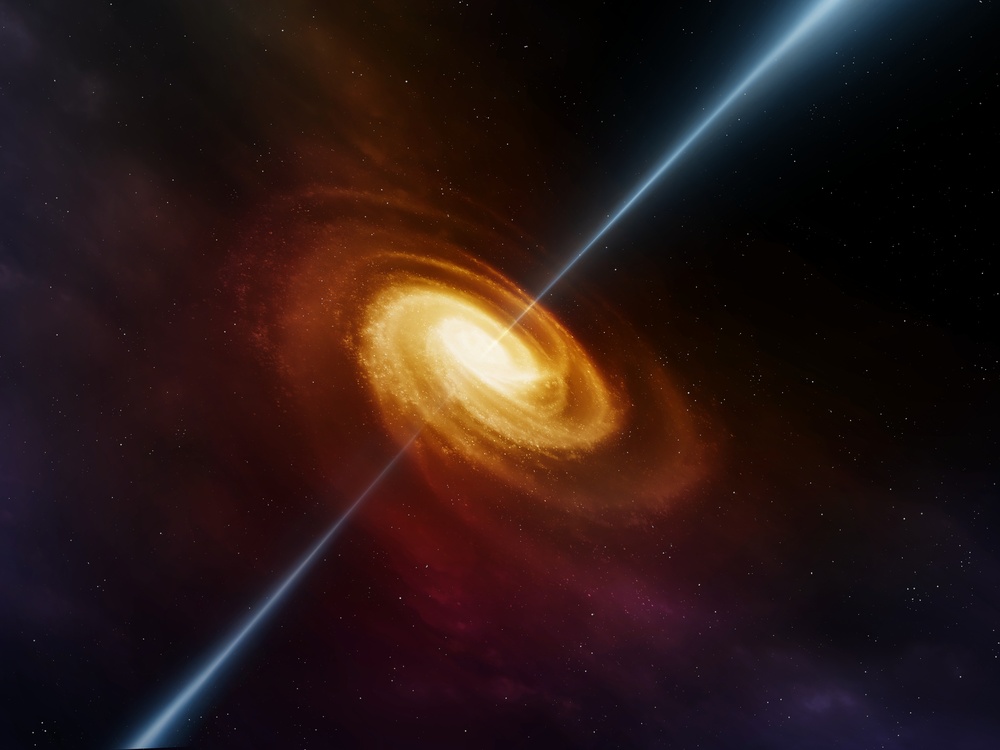
Quasars from this era are powered by supermassive black holes actively accreting material, with luminosity that can outshine the host galaxy by hundreds to thousands of times.
3
The light from these quasars is redshifted from ultraviolet into the near-infrared due to cosmic expansion, and Earth's atmosphere glows at those wavelengths, making faint signals hard to detect.
4
The discovery offers new insight into the dawn of galaxies and how the first supermassive black holes grew rapidly in the universe's infancy.
The European Space Agency's Euclid telescope has found 31 of the oldest quasars ever seen, more than doubling the number of known ancient quasars in a single discovery, according to ESA. The oldest two date to when the universe was just 670 million years old — roughly 5% of its current age.
Quasars are the brightest objects in the universe, powered by supermassive black holes that swallow huge amounts of material. These ancient giants blaze with the light of a trillion suns. Their discovery deepens a long-standing mystery: how did such massive black holes grow so fast so early in cosmic history?
31 Ancient Giants Found in Euclid's First Deep Survey
Euclid launched in 2023 and began its deep sky survey shortly after. The telescope has now catalogued 31 previously unknown quasars from the early universe, ESA confirmed. Two of them carry the designations EUCL J172902.75+641018.1 and EUCL J125308.55+705432.3, with redshifts of z=7.77 and z=7.69. Those numbers tell scientists exactly how far back in time the light traveled.
Redshift is what happens when light stretches as the universe expands. The higher the redshift number, the older the object. At these redshifts, ancient ultraviolet light arrives at Earth as near-infrared light. That makes these quasars very hard to spot — but Euclid is built for exactly this kind of search, according to Innovation News Network.
Why These Quasars Are So Hard to Detect
Finding quasars this old is extremely difficult. Their signals are faint after traveling billions of light-years. Earth's own atmosphere glows in the near-infrared wavelengths where these objects appear, masking weak signals. Ground-based telescopes struggle to cut through that glow, Space and Defense reported.
Euclid operates above the atmosphere, giving it a clean view. Its wide-field camera can scan large patches of sky in a single pass. That combination — sharp vision plus broad coverage — makes it far more efficient at hunting these rare objects than any ground-based tool. Before Euclid, only a handful of quasars from this era were known.
Supermassive Black Holes That Grew Too Fast, Too Soon
The quasars found by Euclid are powered by supermassive black holes actively pulling in gas and dust. As they feed, they release enormous amounts of energy — outshining their entire host galaxies by hundreds to thousands of times. Scientists like Joseph Hennawi and Daming Yang are studying them for clues about early cosmic growth, according to ESA.
The mystery is simple to state but hard to solve: black holes need time to grow big. Yet these objects were already enormous just 670 million years after the Big Bang. Standard models of black hole growth do not fully explain it. Each new quasar found from this era adds a data point that could help crack the puzzle.
A Growing Census That Rewrites Early Universe History
Before this discovery, only a small number of quasars from the universe's first billion years were known. Euclid's haul of 31 more than doubles that count in one stroke, ESA said. Researchers say this is just the beginning — Euclid's survey will continue for years and is expected to uncover many more.
Each quasar acts like a flashlight shining from the early universe. By mapping them, scientists can trace how the first galaxies formed and how the cosmos went from darkness to light in its earliest years. Innovation News Network noted that the findings offer a rare window into the "dawn of the universe."
Sentiment
Mostly PositiveNEGATIVENEUTRALPOSITIVE
Publishers
20
Articles
32
Reach
52
Topics
A
AnonymousAuthor


