Narwhal Tusk Secrets
Advanced 3D X-ray Techniques Reveal Narwhal Tusk's Unique Dual-Spiral Structure and Impressive Longevity
Key Points
Tensor tomography and related 3D X-ray imaging enabled researchers to map the nanoscale orientation of mineralized collagen fibrils inside the narwhal tusk, confirming a dual-spiral structure with an outer left-handed and an inner right-handed arrangement that act as a counterbalance.
The narwhal tusk can exceed two meters in length, illustrating just how long this single canine tooth can grow through the jaw and lip.
There is notable variation among male narwhals: some develop two long spirals, while others develop none at all, highlighting a broader biological and possibly sexual-selection context.
The tusk contains millions of nerve endings, which suggests potential sensory capabilities—such as detecting temperature or salinity changes in the water—beyond purely ornamental or signaling roles.
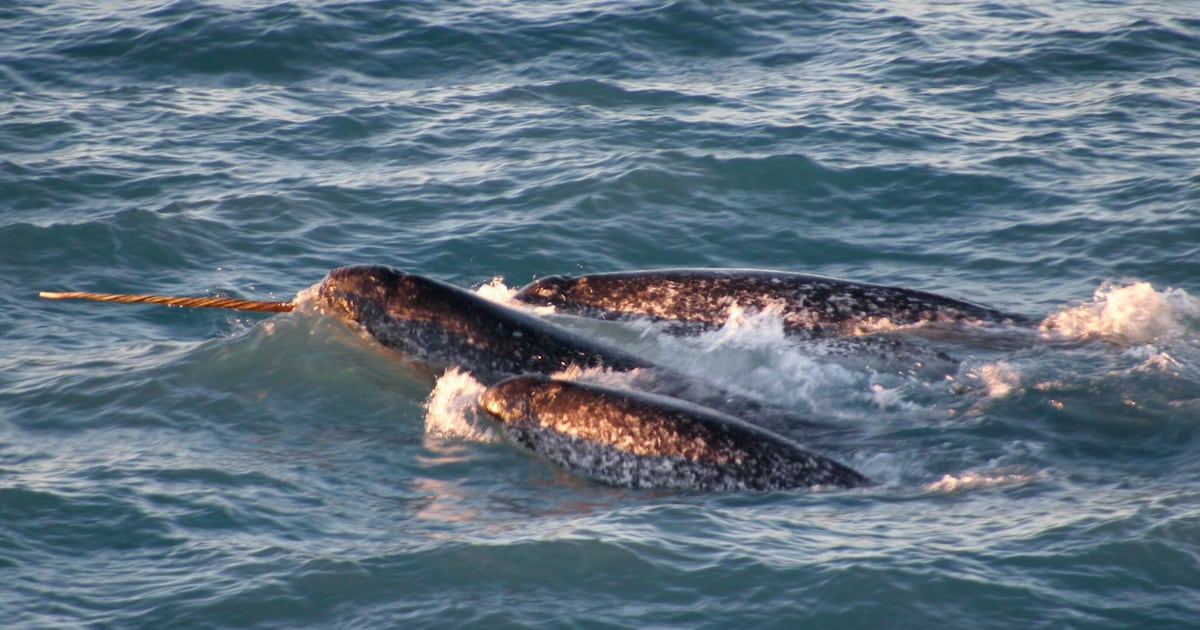
Scientists have cracked a centuries-old mystery: why the narwhal's tusk grows perfectly straight despite twisting like a corkscrew. An international research team found that the tusk contains two opposing spirals — an outer left-handed twist and an inner right-handed twist — that counterbalance each other, keeping the tooth remarkably straight, according to CTV News.
The discovery, made using advanced 3D X-ray imaging, reveals that the narwhal tusk is the only known straight tusk in nature. It can grow up to three meters long — longer than most adult humans are tall — and continues growing throughout the animal's entire life, which can exceed 80 years, CP24 reports.
Two Counter-Twisting Spirals Keep the Tusk Straight
The key to the tusk's shape is a dual-spiral structure. The outer layer, made of cementum, spirals to the left. The inner layer, made of dentine, spirals to the right. These two opposing helices pull against each other, canceling out any bend, according to Head Topics.
Researchers used a technique called tensor tomography to see this structure. Tensor tomography is a special kind of 3D X-ray that maps the direction of tiny mineralized collagen fibers inside the tusk — fibers far too small to see any other way. No other known tusk, in any species, uses this dual-spiral design, Archynetys reports.
Millions of Nerve Endings Hint at a Sensory Role
The tusk is packed with millions of nerve endings. Scientists believe this may allow narwhals to sense changes in the water around them, such as shifts in temperature or salinity. This suggests the tusk is more than just a showpiece — it may work like a living sensor, according to CTV News.
Still, the exact purpose of the tusk remains debated. Theories range from attracting mates and fighting rivals to helping find food. No single theory has strong enough evidence to settle the question. Scientists say the tusk likely serves more than one function, CP24 notes.
Tusk Variation Among Male Narwhals Raises New Questions
Not all male narwhals grow the same tusk. Some develop two long spiraling tusks. Others grow none at all. This wide variation points to a possible role in sexual selection — where females may choose mates based on tusk size or shape — though researchers have not confirmed this, Head Topics reports.
Growth layers inside the tusk, similar to tree rings, let scientists track age and health over time. Because narwhals can live more than 80 years, their tusks become long biological records. Each layer tells part of the animal's life story.
Unicorn Myths Debunked, but Engineering Gains Possible
During the Middle Ages, narwhal tusks were sold as unicorn horns, sometimes worth more than gold. The new research firmly closes the door on that myth. Scientists now describe the tusk as a mathematical marvel — a precise, natural structure built for both strength and flexibility, according to Archynetys.
The dual-spiral design could inspire new materials in engineering and medicine. Structures that resist bending while staying light are valuable in everything from aircraft parts to medical implants. Researchers say the narwhal tusk may offer a blueprint that humans have yet to match, Head Topics notes.
Sentiment
Mostly PositivePublishers
11
Articles
43
Reach
54


