Next-Gen DC Power
Infineon and LS Electric Partner to Develop Next-Gen DC Power for AI Data Centers and Grids
Anonymous
Key Points
1
LS Electric aims to become a total-solution provider for the global AI data center and power markets through this collaboration, strengthening its competitiveness in next-generation DC infrastructure.
2
The partners say that combining Infineon's semiconductor technology with LS Electric's system integration capabilities will accelerate the development and commercialization of next-generation DC power infrastructure.
3
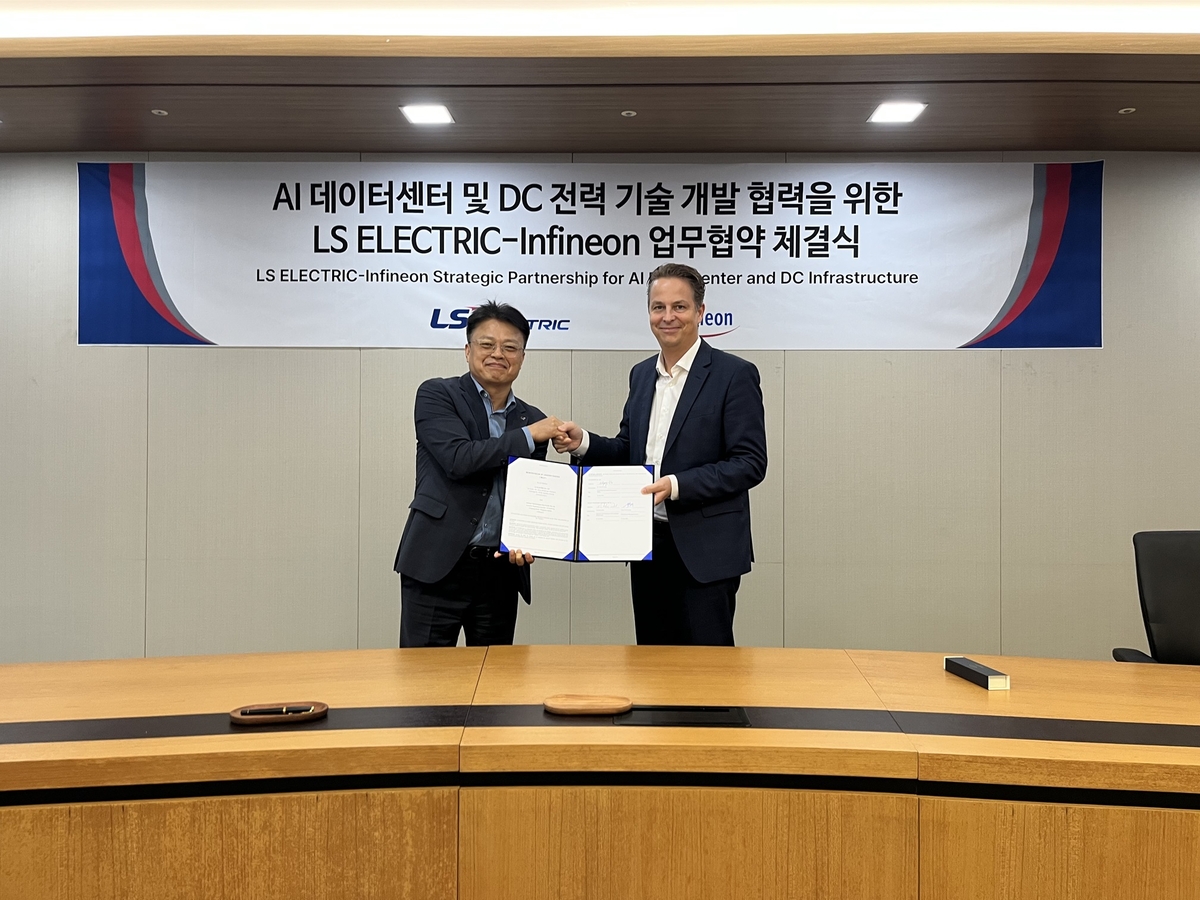
Signing ceremony for the MoU was attended by LS Electric executive vice president Ahn Gil-young, Infineon chief sales officer Andreas Weisl, and Infineon Korea CEO Lee Seung-seo.
4
Infineon is described as the world's number one power semiconductor company and will contribute its power semiconductors and control technology to the DC power infrastructure.
Infineon Technologies and LS Electric have signed a memorandum of understanding to jointly develop next-generation direct current power solutions for AI data centers and future power grids, according to MarketScreener. The deal pairs Infineon, the world's number one power semiconductor company, with South Korea's LS Electric to tackle surging energy demand from AI workloads.
The signing took place at LS Electric's Anyang R&D campus in South Korea. Executives from both companies attended, including Infineon's chief sales officer Andreas Weisl and Infineon Korea CEO Lee Seung-seo, alongside LS Electric executive vice president Ahn Gil-young, BizInfoTech reported.
Why DC Power Matters for AI Data Centers
Data centers that run AI workloads need enormous amounts of power. Most grids today deliver alternating current, or AC, which must be converted to direct current, or DC, before computers can use it. Each conversion step wastes energy. DC infrastructure cuts those steps, reducing losses and boosting efficiency in ultra-high-density environments, according to MarketScreener.
The partners say DC solutions also improve grid stability as more renewable energy sources come online. Renewables like solar and wind naturally produce DC power. Keeping energy in DC form for longer avoids unnecessary back-and-forth conversion, making the whole system cleaner and more efficient, SE Daily noted.
Three Core Technologies at the Heart of the Deal
The collaboration will focus on three key products. First, power conversion systems for energy storage. Second, solid-state transformers, which replace heavy traditional transformers with compact, semiconductor-based versions. Third, solid-state circuit breakers, which protect DC grids far faster than mechanical switches, according to BizInfoTech.
All three technologies rely heavily on advanced power semiconductors. That is where Infineon comes in. The German chipmaker will supply its power semiconductors and control technology. LS Electric will handle system design, integration, and bringing products to market, BigGo Finance reported.
LS Electric Eyes Global Data Center Market Leadership
LS Electric has set an ambitious goal. The South Korean company wants to become a total-solution provider for the global AI data center and power markets, BigGo Finance reported. The MoU with Infineon is a direct step toward that target, strengthening its position in next-generation DC infrastructure.
Infineon's chief sales officer Andreas Weisl said combining Infineon's semiconductor technology with LS Electric's system integration skills will speed up the development and commercialization of DC power infrastructure. SE Daily noted both sides see growing demand for high-efficiency power as AI workloads expand worldwide.
A German Chipmaker and Korean Integrator Bet on DC's Future
The deal reflects a broader industry shift. More data center operators are moving toward DC power distribution as AI drives electricity demand to record levels. Analysts widely expect DC infrastructure spending to grow sharply over the next decade as hyperscale data centers multiply, according to MarketScreener.
For Infineon, the partnership extends its reach into system-level solutions beyond chip sales. For LS Electric, it adds world-class semiconductor expertise to its portfolio. Together, the two companies are positioning themselves to capture a fast-growing slice of the global AI power market, BizInfoTech reported.
Sentiment
Mostly PositiveNEGATIVENEUTRALPOSITIVE
Publishers
13
Articles
13
Reach
26
Topics
A
AnonymousAuthor


