Shipbuilding Goes Digital
HD KSOE and Siemens Sign Pact to Develop AI-Powered Digital Shipyard, Setting New Industry Standard
Anonymous
Key Points
1
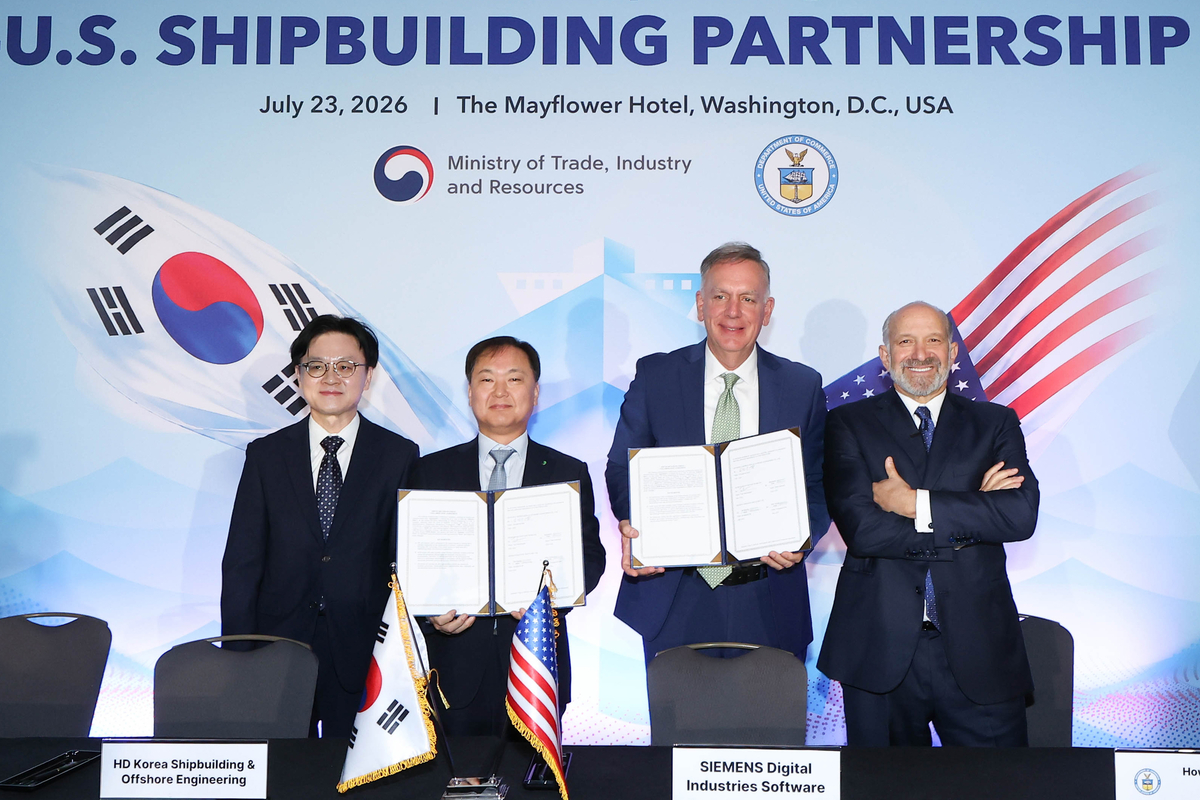
The signing occurred at the opening ceremony of the Korea-U.S. Shipbuilding Partnership Center (KUSPC) in Washington, D.C., with high-profile attendees including HD KSOE CEO Kim Hyung-kwan, Siemens CEO Tony Hemmelgarn, South Korea's Minister of Trade, Industry and Energy Kim Jung-kwan, and U.S. Secretary of Commerce Howard Lutnick.
2
The announcement is connected to the Make American Shipbuilding Great Again (MASGA) initiative, as part of Korea-U.S. efforts to modernize shipbuilding and strengthen U.S. competitiveness in the sector.
3
The contract has evolved in wording from a definitive agreement signed on the 23rd to later reports describing a final contract, signaling progression in formalizing the Next-Generation Marine Platform.
4
HD Korea Shipbuilding CEO Kim Hyung-kwan framed the initiative as AI redefining shipbuilding, stating: 'AI is not just a tool for increasing productivity; it is an innovative technology that redefines the very operation of the shipbuilding industry. We will build a future smart shipyard that combines AI and digital technology, setting a new standard for the shipbuilding industry.'
5
Siemens CEO Tony Hemmelgarn described the collaboration as aiming to build a standard blueprint for innovation in shipbuilding by combining Siemens’ industrial AI and digital twin capabilities with HD Hyundai’s operational strengths.
HD Korea Shipbuilding & Offshore Engineering (HD KSOE) and Siemens have signed a contract to build an AI-powered shipyard, marking one of the biggest digital leaps in global shipbuilding. The deal was inked at the opening of the Korea-U.S. Shipbuilding Partnership Center (KUSPC) in Washington, D.C., with top officials from both countries in attendance, including U.S. Secretary of Commerce Howard Lutnick and South Korea's Minister of Trade, Industry and Energy Kim Jung-kwan. Seoul Economic Daily reported the agreement signals a new era for the industry.
The partnership centers on what the two companies call a Next-Generation Marine Platform. It merges design, production, supply chain, quality control, and maintenance into one shared 3D data environment. The goal is to let every part of a shipyard talk to every other part in real time, cutting delays and quality problems before they start.
One Platform to Run an Entire Shipyard
The new platform works by creating a single digital thread across all shipyard operations. Instead of design teams, production crews, and supply managers working in separate systems, every team shares one live 3D data environment. According to BigGo Finance, this real-time sharing is meant to catch problems — like a parts shortage or a design flaw — before they cause delays on the factory floor.
The plan also includes building a virtual shipyard — a digital twin — that mirrors the real facility. Engineers can simulate work processes inside the virtual version before a single bolt is tightened in the real world. A digital twin is essentially a live digital copy of a physical place, updated continuously with real data.
Long-Term Vision: Robots Running the Yard Alone
The companies are not stopping at software. Their long-term target is a fully autonomous shipyard where robots and self-guided equipment operate without constant human direction. AI systems would manage scheduling, quality checks, and logistics on their own. Seoul Economic Daily described this as the "autonomous manufacturing era" for an industry that has relied on manual labor for generations.
HD KSOE CEO Kim Hyung-kwan put it plainly: "AI is not just a tool for increasing productivity; it is an innovative technology that redefines the very operation of the shipbuilding industry." He added that the company would "set a new standard for the shipbuilding industry" through smart, AI-driven facilities. Siemens CEO Tony Hemmelgarn said the two companies would build "a standard blueprint for innovation in shipbuilding" by combining Siemens' industrial AI with HD Hyundai's operational strengths.
Korea-U.S. Shipbuilding Push Drives the Deal
The signing did not happen in a vacuum. It took place at the launch of the Korea-U.S. Shipbuilding Partnership Center in Washington, D.C., a joint effort to rebuild U.S. competitiveness at sea. The event is tied to the Make American Shipbuilding Great Again (MASGA) initiative, a broader push to modernize American and allied shipbuilding capacity, according to BigGo Finance.
High-profile attendance underscored how seriously both governments are taking the effort. U.S. Commerce Secretary Howard Lutnick and South Korea's trade minister Kim Jung-kwan were both present for the signing. Seoul Economic Daily noted that HD KSOE is the intermediate holding company of HD Hyundai, one of the world's largest shipbuilding groups, giving the partnership significant industrial weight.
What Comes Next for the Partnership
The contract language has shifted from an initial "definitive agreement" signed on the 23rd to what later reports called a "final contract," signaling that the deal has moved from a handshake to a binding commitment. Both companies are now focused on rolling out the platform across HD KSOE's yards, with the virtual shipyard phase coming first before physical automation is introduced, according to BigGo Finance.
If it works, the model could spread well beyond Korea. Siemens has made clear it sees this as a template — not a one-off project. The company wants to export the blueprint to other shipbuilders globally. That would put Korea and Siemens at the center of how the world's ships get built for years to come.
Sentiment
Mostly PositiveNEGATIVENEUTRALPOSITIVE
Publishers
15
Articles
31
Reach
46
Topics
A
AnonymousAuthor


