Minimizing Military Conflict
Trump Downplays U.S.-Iran Conflict as Small Potatoes Despite Troop Casualties
Anonymous
Key Points
1
Vice President JD Vance said on Sept. 3, “I wouldn’t call it a war,” arguing there had been “no active shooting.”
2
The latest exchange followed U.S. strikes on Iranian targets near the Strait of Hormuz on Sept. 1—the second such attack in three days—which marked the first direct exchange of fire in weeks; Iran responded with missile launches against U.S. military sites in Jordan and Iraq.
3
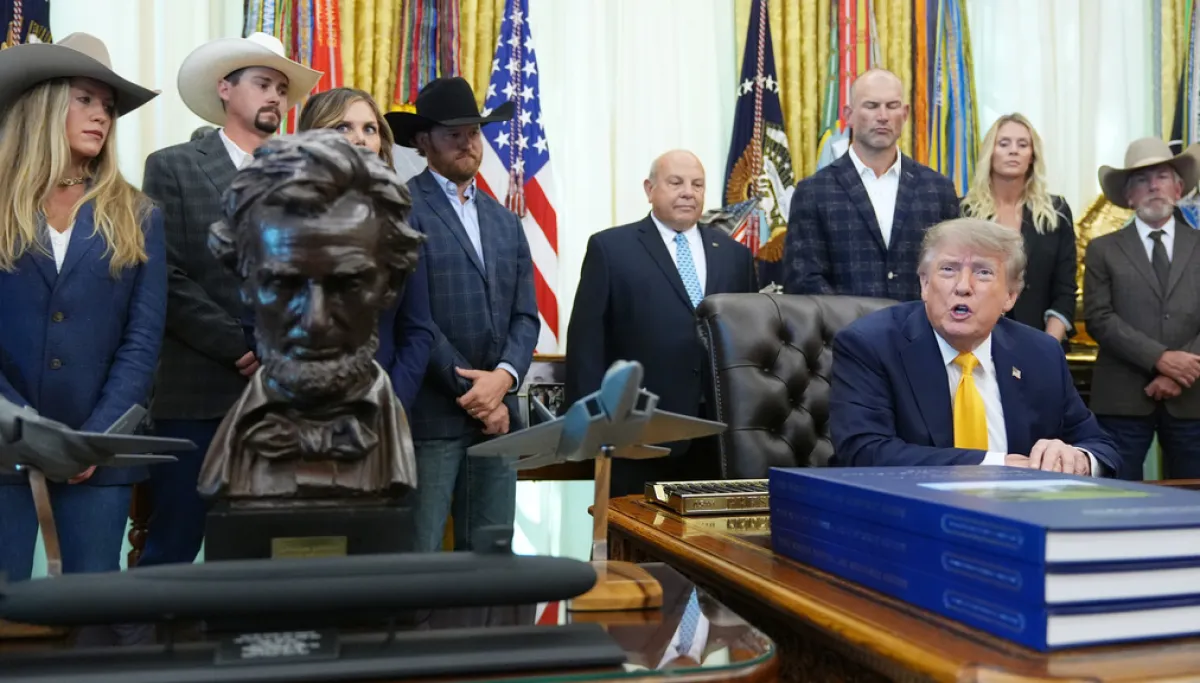
Trump made the remarks during an executive-order signing in the Oval Office on Sept. 4 and said the United States was “taking on a lot of oil” while controlling the Strait of Hormuz, where he claimed U.S. forces had recently struck boats and ships.
4
A reporter challenged Trump’s characterization by pointing to the USS Abraham Lincoln’s record-long deployment at sea, arguing that the conflict did not feel like “small potatoes” despite the administration’s comparison with earlier wars.
President Donald Trump called the six-month U.S.-Iran conflict "small potatoes" on September 4, defending Vice President JD Vance's refusal to label it a war. Trump acknowledged 18 U.S. service members killed and nearly 800 injured, yet claimed major wins: preventing Iran from getting nuclear weapons and controlling the Strait of Hormuz.
The remarks come after escalating military exchanges. PBS reported that political analysts David Brooks and Jonathan Capehart criticized the administration for minimizing troop sacrifices and potentially dodging War Powers Act requirements. A reporter challenged Trump's framing by pointing to the USS Abraham Lincoln's record-long deployment at sea.
Vance and Trump Reframe Six-Month Conflict
Vice President JD Vance said on September 3, "I wouldn't call it a war," citing an absence of "active shooting." WFMZ reported that Trump backed this language, describing the conflict as intermittent operations rather than sustained warfare. The administration's framing appears designed to avoid the legal and political costs of a formal war declaration.
U.S. Strikes Continue Near Nuclear Facilities
On September 1, the U.S. launched strikes on Iranian targets near the Strait of Hormuz—the second attack in three days and the first direct exchange of fire in weeks. Trump said U.S. forces struck Iranian radar, air-defense, maritime, and mine-laying capabilities. He also claimed the U.S. could target Pickaxe Mountain, a heavily fortified site near Iran's Natanz nuclear facility. Iran responded with missile launches against U.S. positions in Jordan and Iraq.
Critics Question Casualty Counts and Deployment Costs
PBS reported that Brooks and Capehart said the administration's language minimizes real costs to troops. Rep. Thomas Massie and other critics noted that 18 deaths and 800 injuries represent only part of the burden. The USS Abraham Lincoln's record-long deployment shows sustained operational strain. Journal-News reported the administration may be dodging War Powers Act requirements by avoiding a formal war declaration, which could affect the 2026 midterm elections.
Sanctions and Oil Control Shape Strategy
The administration has imposed sanctions on Turkey-based companies linked to Iran and sought to disrupt Iranian oil shipments. Trump claimed the U.S. is "taking on a lot of oil" while controlling the Strait of Hormuz. A reporter challenged this by pointing out that the conflict does not feel like "small potatoes" given the scale of military operations and the USS Abraham Lincoln's extended deployment.
Sentiment
Mostly NegativeNEGATIVENEUTRALPOSITIVE
Publishers
16
Articles
114
Reach
130
A
AnonymousAuthor


