London Robotaxi Pilot
Uber and Wayve launch London's first public robotaxi pilot with autonomous Ford Mustangs.
Anonymous
Key Points
1
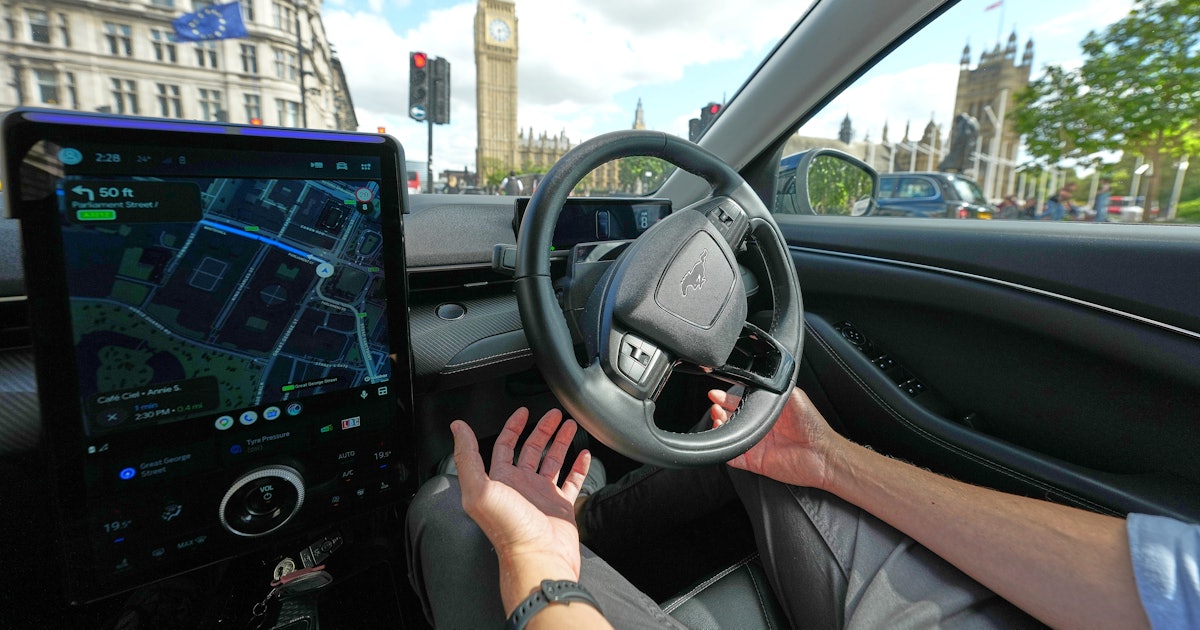
Initial fleet is limited to 15 Wayve-powered Ford Mustang Mach-E vehicles, with a safety driver on board during the launch phase and a plan to add vehicles gradually based on demand and regulatory readiness (airports not covered).
2
Wayve’s technology relies on cameras and radar with a single AI model (AV2.0) that learns from experience and does not depend on pre-built HD maps, aiming to generalize across London’s irregular streets.
3
Regulatory status remains a gating factor: Wayve is licensed under a minicab/private hire operator license for now, and Transport for London approvals are still needed for fully driverless operation.
4
Riders can opt in or out of autonomous rides in the Uber app (Trip Preferences); if matched with a Wayve vehicle, they can start the trip from the app and will see the autonomous status during the ride.
5
Public interest is high (about 140,000 Londoners registered interest), and Uber is exploring scaling with Nissan Leaf AVs and expansion to markets like Tokyo.
Uber and British AI firm Wayve launched London's first public robotaxi pilot on September 3, using 15 autonomous Ford Mustang Mach-E vehicles with safety drivers on board. Futurum Research describes the launch as a crucial proof point for "physical AI," validating Wayve's camera and radar-based technology without reliance on pre-built HD maps. Over 140,000 Londoners have registered interest in autonomous rides through the Uber app.
The service operates at no extra charge during the trial across UberX, Uber Comfort, and Uber Electric, excluding airports. Riders can opt in or out via Trip Preferences in the app. However, full driverless operation still awaits regulatory approval from Transport for London, keeping this stage a supervised pilot rather than a true robotaxi service.
Wayve's AI Driver Learns Without HD Maps
Wayve's AV2.0 architecture uses cameras and radar to navigate London's complex streets dynamically. Unlike competitors such as Waymo that rely on pre-mapped high-definition geofences, Wayve's foundational AI model learns from real-world driving experience and generalizes across unfamiliar roads. Wayve co-founder Alex Kendall acknowledged the technology is "still maturing" ahead of full driverless deployment but called London "one of the most complex driving environments in the world."
The platform-agnostic software integrates into Uber's global network. Passengers see autonomous status during rides on in-car interactive screens available in 64 languages. This approach sidesteps the heavy sensor suites and pre-mapping costs that traditional competitors require.
Regulatory Approvals Still Block Fully Driverless Operations
Transport for London granted Wayve private hire vehicle licenses for supervised operation only. The Guardian and transportation correspondents note that true driverless status requires separate approval from the UK Driver and Vehicle Standards Agency under a stricter government framework—unlikely before late 2026 or 2027. With only 15 vehicles versus over 100,000 private hire cabs in London, the rollout remains primarily a supervised trial.
The cautious staged approach mirrors broader European pilots where human safety drivers remain mandatory. Sarfraz Maredia, Uber's Global Head of Autonomous Mobility, stated: "We're delighted to bring autonomous rides to Uber riders in London for the very first time, powered by Wayve, a homegrown British success story." The launch follows the UK Government's AV Trialling Code of Practice framework.
Scaling Plans Include Nissan Leafs and Tokyo Expansion
Uber and Wayve plan to expand the London fleet by introducing factory-integrated Nissan Leaf autonomous vehicles and rolling out to international markets including Tokyo later this year. Autocar highlights the enterprise AI platforms market is projected to reach $496.9 billion by 2030 at a 28.7% compound annual growth rate. London becomes Uber's second European robotaxi market after Zagreb, Croatia.
The service covers all of London except airports, with upfront fares matching standard UberX, Uber Comfort, or Uber Electric rates at no surcharge. Strong consumer enthusiasm—demonstrated by 140,000 registrations—suggests demand outpaces the limited 15-vehicle fleet, positioning London ahead of European rivals in commercializing autonomous ride-hailing.
Sentiment
Mostly PositiveNEGATIVENEUTRALPOSITIVE
Publishers
28
Articles
110
Reach
138
A
AnonymousAuthor


