Domestic Tank Power Upgrade
India Signs ₹586 Crore Contract for Indigenous Tank Power Units
Anonymous
Key Points
1
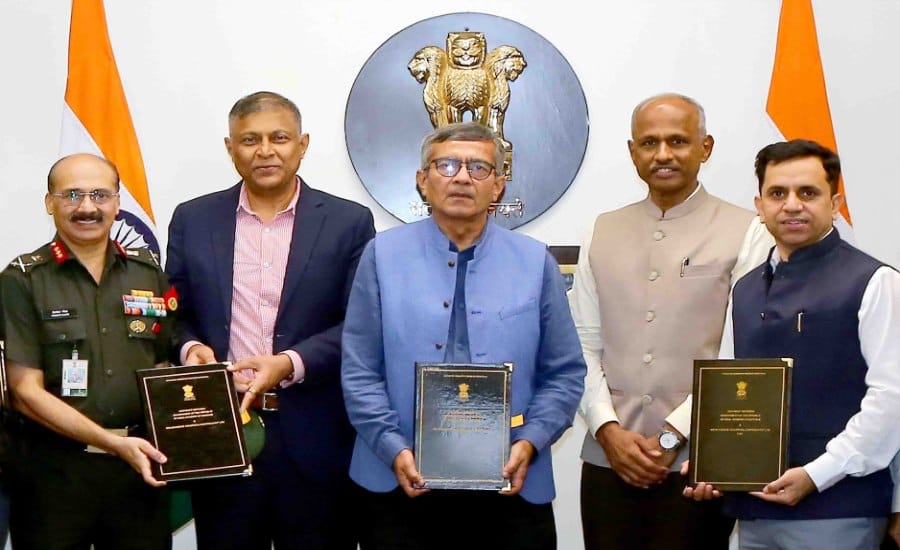
The contract was signed in New Delhi on September 21, 2026, in the presence of Defence Secretary Rajesh Kumar Singh.
2
The Defence Ministry said the procurement demonstrates the effectiveness of the Make-II mechanism in moving indigenous innovations from development into production and induction.
3
The deal was described as aligned with the government’s Viksit Bharat @2047 vision and as a milestone toward Aatmanirbharta in defence, including the creation of a resilient, self-reliant and globally competitive Indian defence industry.
4
The contract forms part of a broader push to expand domestic defence manufacturing: the government recently approved the transfer of technology for all conventional missile systems developed by DRDO to Indian companies for domestic production.
5
The ministry’s announcement followed recent deliveries by Hindustan Aeronautics Limited, including two Tejas Final Operational Clearance twin-seat trainers, three HTT-40 basic trainers and four Dhruv Next Generation helicopters to Pawan Hans.
India's Defence Ministry signed a ₹586 crore contract on September 21 to supply homemade Auxiliary Power Units for the Army's T-72 and T-90 tanks, News on Air reported. The deal with Accurate Industrial Controls Private Limited marks a major step toward replacing imported defense parts with Indian-made technology.
The APUs will power critical tank systems including fire control, firing circuits, and gun stabilization, Manufacturing Today India noted. The contract signals India's push to build a self-reliant defense industry and reduce dependence on foreign suppliers.
How Indigenous Power Units Strengthen Tank Operations
Auxiliary Power Units are backup electrical systems that keep tanks running when the main engine shuts down. Indian Masterminds explained that the new APUs solve a longstanding problem: India's tanks needed imported power systems that were expensive and unreliable. These locally developed units will improve tank readiness and reduce maintenance costs.
The APUs provide continuous power to fire-control computers, targeting systems, and gun-stabilization equipment. Equity Pandit reported that this upgrade has been costing the Army millions in lost operational efficiency. Domestic production now cuts both the price and the delivery time.
Make-II Framework Turns Lab Innovation Into Army Equipment
The contract was awarded under India's Make-II scheme, which partners the Defence Ministry with private industry to convert research into production. News on Air said Defence Secretary Rajesh Kumar Singh signed the deal in New Delhi. The mechanism has proven effective at moving homegrown defense technologies from development to operational service.
This approach marks a shift in how India builds its military. Instead of relying only on state-run companies, the government now funds private firms to manufacture critical components. The strategy aligns with Prime Minister's Viksit Bharat @2047 vision and supports India's broader Aatmanirbharta (self-reliance) goals.
Broader Push to Replace All Imported Defense Systems
The tank power-unit deal is part of a larger effort to eliminate foreign dependency across India's military arsenal. The government recently approved technology transfer for all conventional missile systems developed by DRDO to Indian private companies for domestic production. Jane's noted that India is systematically upgrading its armored fleet with locally made subsystems.
Recent weeks have seen steady progress on this front. Hindustan Aeronautics Limited delivered two Tejas trainers, three HTT-40 basic trainers, and four Dhruv helicopters to Pawan Hans, demonstrating that India can now produce advanced defense equipment domestically at scale.
Sentiment
Mostly PositiveNEGATIVENEUTRALPOSITIVE
Publishers
22
Articles
29
Reach
51
A
AnonymousAuthor


