New Polish Combat Vehicle
Poland Unveils New Heavy Infantry Vehicle Aimed at Production by 2029
Anonymous
Key Points
1
Unlike Poland’s amphibious Borsuk IFV, the CBWP was not designed to swim, allowing its designers to allocate more of the vehicle’s weight and volume to ballistic and mine protection.
2
The CBWP’s chassis is derived from the design used for Poland’s Krab self-propelled howitzer, and the 2023 framework agreement covers several hundred vehicles in multiple configurations, plus logistics and training support.
3
The ZSSW-30 turret incorporates a hunter-killer targeting arrangement: the commander can search for additional threats while the gunner engages an identified target. The turret is already used on Poland’s Rosomak and Borsuk vehicles and includes a coaxial 7.62 mm machine gun alongside its cannon and Spike-LR launchers.
4
CBWP protection options include STANAG-compliant ballistic and mine protection, mine-resistant seats intended to reduce blast effects beneath the hull, laser-warning equipment such as OBRA-3 linked to smoke grenade launchers, and an optional active protection system.
5
The Pegas concept is specified at about 8 meters long, 3.2 meters wide and 3.3 meters high, with a projected top speed of 70 kph and a 500-kilometer range. Its planned armor protection reaches NATO STANAG 4569 Level 6 at the front and at least Level 4 elsewhere, while additional armor is intended to improve protection against shaped-charge weapons such as RPG-7 grenades.
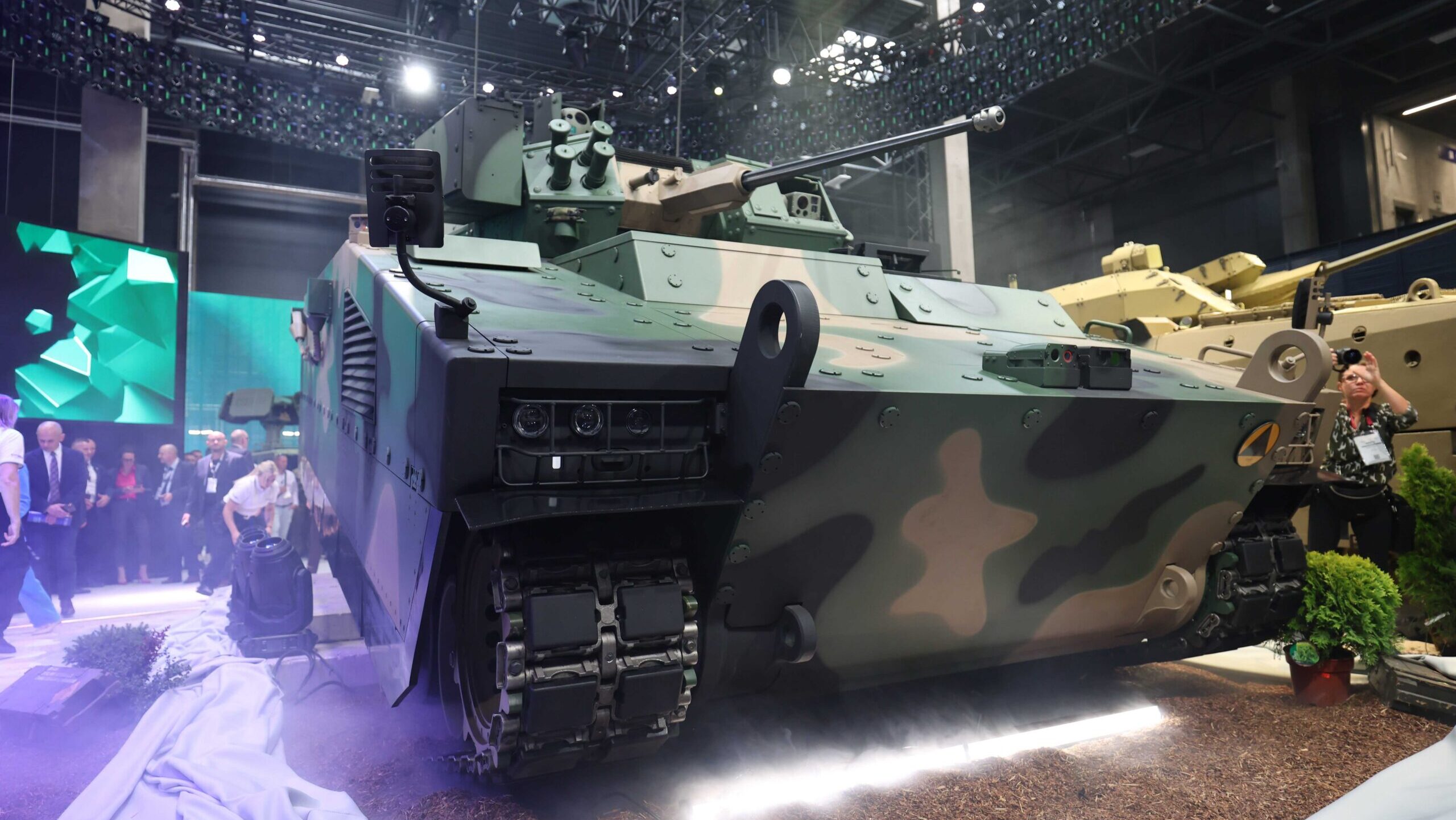
Poland unveiled a full-size demonstrator of its new CBWP heavy infantry fighting vehicle at MSPO 2026, signaling major progress toward serial production by 2029. Breaking Defense reports the 40-ton tracked platform, built by state-owned PGZ and Huta Stalowa Wola, carries a three-person crew plus eight infantry soldiers while packing a 30 mm cannon, anti-tank missiles, and modular armor designed for high-intensity combat.
Unlike Poland's earlier Borsuk amphibious vehicle, the CBWP was engineered specifically for protection over water capability, freeing up weight and space for stronger ballistic and mine defenses. The War Zone notes the design draws from Poland's proven Krab self-propelled howitzer platform, with a 2023 framework agreement already backing production of several hundred vehicles in multiple configurations.
Purpose-Built for Direct Combat Support
The CBWP fills a specific tactical role: moving infantry into contested zones while providing immediate firepower. Archynetys explains the vehicle transports a full squad of eight soldiers with a crew of three—commander, gunner, and driver—designed to operate alongside main battle tanks during intense fighting. The remotely operated turret means crew members stay protected inside the hull while targeting threats.
The turret's hunter-killer system lets the commander scan for new targets while the gunner stays locked on current threats, improving responsiveness in fast-moving battles. Defence Industry Europe confirms the ZSSW-30 turret combines a 30 mm cannon with Spike anti-tank missiles and a coaxial 7.62 mm machine gun, leveraging proven systems already used on Poland's Rosomak and Borsuk platforms.
Multi-Layer Defense Against Modern Threats
The CBWP's protection suite reflects lessons from Ukraine's ongoing conflict. The War Zone describes ballistic and mine protection meeting NATO STANAG standards, plus mine-resistant seats designed to absorb blast energy from explosions beneath the hull. The vehicle also includes laser-warning systems like the OBRA-3 that trigger automatic smoke-grenade launchers when targeted by laser-guided weapons.
An optional active protection system can intercept incoming anti-tank missiles before impact. Defence Industry Europe notes modular armor configurations allow different variants to match specific mission needs, whether protecting against shaped-charge weapons like RPGs or standing up to sustained direct fire in high-threat zones.
Ukraine Racing Forward With Pegas Rival Design
Poland is not alone in modernizing its infantry vehicles. Yahoo Finance reports Ukraine's Kharkiv Morozov Machine Building Design Bureau unveiled the Pegas concept at the same exhibition—a 35-ton IFV designed to replace aging Soviet-era BMP-1 and BMP-2 platforms. The Pegas reaches 70 kph top speed with a 500-kilometer range and features NATO-standard armor reaching Level 6 at the front.
The Pegas incorporates 8.3 meters of length, 3.2 meters width, and 3.3 meters height, with plans for a Ukrainian BM Topaz combat module and drone-focused electronic warfare capabilities. Yahoo Finance notes additional armor layers address shaped-charge threats like RPG-7 grenades, positioning Ukraine's concept as another modern answer to infantry fighting vehicle obsolescence across Eastern Europe.
Timeline and Export Ambitions Ahead
Poland's production roadmap targets 2029 for full-rate manufacturing to begin. Defence Industry Europe confirms the 2023 framework agreement covers not just vehicles but also logistics support and crew training, indicating commitment to operational deployment across Polish forces. The timing aligns with NATO's broader push to modernize armor fleets facing renewed Russian threats.
The unveiling at MSPO 2026 serves a dual purpose: demonstrating domestic capability while marketing the platform to allied nations. Archynetys observes the CBWP launch coincides with heightened threat perception from Russia and renewed efforts to export the design abroad, making Poland a weapons developer rather than just a buyer in Europe's evolving security landscape.
Sentiment
Mostly PositiveNEGATIVENEUTRALPOSITIVE
Publishers
13
Articles
9
Reach
22
A
AnonymousAuthor


