South China Sea Ruling Reaffirmed
US, UK, and Allies Reaffirm 2016 South China Sea Ruling Against China's Claims
Anonymous
Key Points
1
Joint statements explicitly state that there is 'no legal basis for China's expansive maritime claims in the South China Sea, including those based on "historic rights".'
2
The arbitral tribunal's ruling largely favored the Philippines, ruling under UNCLOS that there was no legal basis for China to claim historic rights to resources outside its regular entitlements; UNCLOS has been in force since 1994 and has been ratified by more than 170 countries.
3
The statements were issued to mark the 10th anniversary of the 2016 arbitral ruling and describe the award as 'final, legally binding and definitive'; the tribunal was established under Annex VII of UNCLOS.
4
The coalition reiterates opposition to any destabilising or unilateral actions, including by force or coercion, that threaten peace and stability in the region.
5
Several reports list additional allied countries beyond the US, UK and Australia as part of the coalition, including Canada, Germany, Italy, Estonia, Latvia, Lithuania, Romania and Slovenia.
Fourteen nations and the European Union jointly declared on Tuesday that China's sweeping claims in the South China Sea have "no legal basis," marking the 10th anniversary of a landmark international ruling. The statement, led by the United States, the United Kingdom, and Australia, called the 2016 arbitral award "final, legally binding and definitive" — and urged all parties to resolve disputes peacefully under international law. Star Tribune
China rejected the arbitration when it was issued in 2016 and continues to claim nearly the entire South China Sea. The sea carries an estimated $3 trillion in global trade each year and has been a frequent flashpoint for military confrontations. AJC
What the 2016 Ruling Actually Said
The tribunal was set up under Annex VII of the United Nations Convention on the Law of the Sea, known as UNCLOS. It ruled largely in favor of the Philippines. The judges found that China had no legal right to claim "historic rights" to resources beyond what international law already gives it. UNCLOS has been in force since 1994 and has been ratified by more than 170 countries. Head Topics
The joint statement this week said the ruling "definitively resolved" the legal question of China's maritime claims. The coalition stressed there is no legal basis for China to assert historic rights over the sea's vast resources — including fish, oil, and natural gas deposits. Cecil Daily
A Growing Coalition Pushes Back on Beijing
The joint declaration was not just a US-UK-Australia affair. Canada, Germany, Italy, Estonia, Latvia, Lithuania, Romania, Slovenia, New Zealand, Japan, and the Philippines all joined the statement. The Philippines has direct territorial disputes with China in the sea and has seen repeated confrontations with Chinese vessels in recent months. Star Tribune
The coalition said it opposes any "destabilizing or unilateral actions" — including those carried out by force or coercion — that threaten peace and stability in the region. The statement also reaffirmed support for freedom of navigation and overflight, two rights China has repeatedly challenged in practice. AJC
China Rejects the Ruling — Again
Beijing has never accepted the 2016 ruling and calls the arbitration illegitimate. China claims sovereignty over nearly the entire South China Sea using a boundary known as the "nine-dash line." That line overlaps with the exclusive economic zones of Vietnam, the Philippines, Malaysia, Brunei, and Indonesia. Head Topics
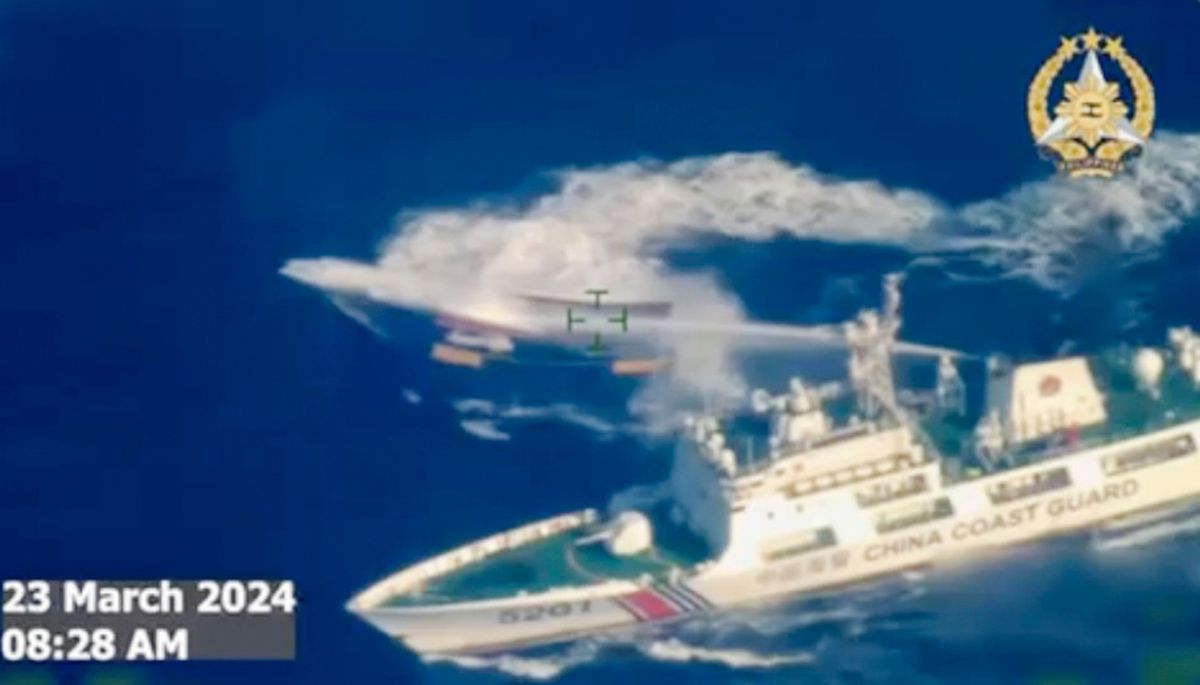
China has built artificial islands and military outposts on disputed reefs, and its coast guard has clashed repeatedly with Philippine vessels. The anniversary statement is a direct challenge to that posture. The coalition framed its message as a defense of a "free and open Indo-Pacific" governed by international rules. myMotherLode
Why This Moment Matters for the Indo-Pacific
The 10th anniversary statement signals that Western and allied nations are not letting the ruling fade into irrelevance. The joint declaration puts diplomatic pressure on Beijing without triggering direct military confrontation. It also gives the Philippines — a US treaty ally — political backing in an increasingly tense standoff. Cecil Daily
Analysts say the breadth of the coalition matters. When European nations like Germany and Italy sign on alongside Pacific allies, it is harder for China to frame the dispute as a purely American issue. The statement underlines that the UNCLOS framework — not unilateral force — should govern who controls one of the world's most important waterways. Star Tribune
Sentiment
Mostly NegativeNEGATIVENEUTRALPOSITIVE
Publishers
17
Articles
157
Reach
174
Topics
A
AnonymousAuthor


