South China Sea Tensions
Rubio Arrives in Manila as US Condemns China's Dangerous South China Sea Actions Amid Clash
Anonymous
Key Points
1
The Kremlin said it would welcome Rubio-Lavrov contacts at the ASEAN event in Manila, signaling broader international diplomacy interest around Rubio's visit.
2
Rubio has previously met Wang Yi on the sidelines of the ASEAN summit in Kuala Lumpur last year and again in Munich in February, indicating ongoing engagement with China’s top diplomat amid the Manila trip.
3
In a Philippine media op-ed, Rubio wrote: 'This freedom is by no means guaranteed. If these waters were to fall under the control of a power willing to weaponize trade as a geopolitical tool, both the United States and ASEAN states would face new, severe threats to their sovereignty, security, and economic future.'
4
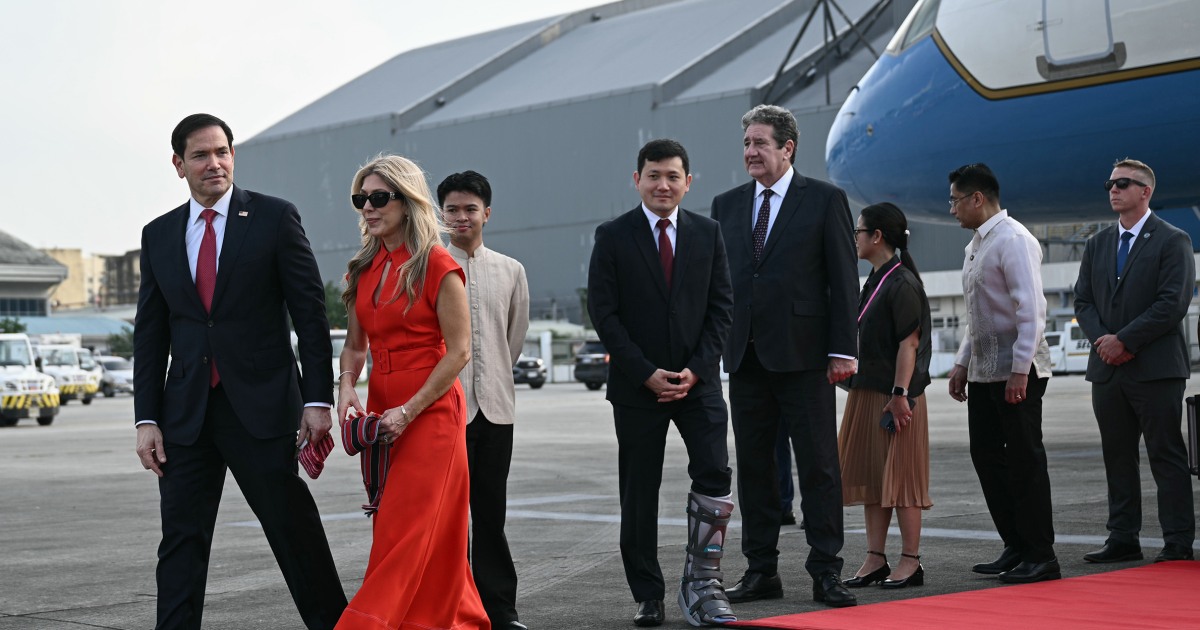
Rubio arrived in Manila for the ASEAN Foreign Ministers' Meeting accompanied by his wife, Jeanette Dousdebes Rubio.
5
China’s Coast Guard described Manila’s account of the incident as a 'complete reversal of the truth' amid accusations that a Filipino sailor was injured near a disputed outpost.
U.S. Secretary of State Marco Rubio arrived in Manila for ASEAN Foreign Ministers' talks as Washington sharply condemned China's "dangerous and aggressive" behavior in the South China Sea. The State Department said China's actions undermine regional peace and contradict its own pledges to resolve disputes peacefully, according to NBC News.
The condemnation followed a clash near Second Thomas Shoal in which a Filipino Navy officer was injured. China summoned the Philippine ambassador over the incident, calling Manila's account a "complete reversal of the truth," according to China Global South.
Filipino Sailor Injured in South China Sea Clash
A Philippine Navy officer suffered a serious head injury during a confrontation at Second Thomas Shoal, a disputed outpost in the South China Sea. The shoal sits inside waters that an international court ruled belong to the Philippines in 2016. China ignores that ruling and claims nearly the entire sea as its own, according to International Business Times.
Beijing fired back after Manila described the incident publicly. China's coast guard said the Philippine account was false. China also summoned the Philippine ambassador in a formal diplomatic protest, according to Fox 26. The back-and-forth signals deepening tension around the shoal, which has been a flashpoint for months.
Rubio Warns Against Weaponizing South China Sea Trade Routes
Rubio used a Philippine media op-ed to make the stakes clear. He wrote: "If these waters were to fall under the control of a power willing to weaponize trade as a geopolitical tool, both the United States and ASEAN states would face new, severe threats to their sovereignty, security, and economic future." The South China Sea carries trillions of dollars in global trade each year.
Rubio reaffirmed the U.S. commitment to freedom of navigation. He also stressed that the American security umbrella — meaning U.S. defense commitments to allies — remains in place. He arrived in Manila with his wife, Jeanette Dousdebes Rubio, according to NBC News.
Rubio Open to Meeting China's Wang Yi in Manila
Rubio said he was open to meeting Chinese Foreign Minister Wang Yi on the sidelines of the ASEAN summit. The two have met before — once at an ASEAN summit in Kuala Lumpur and again in Munich in February. Those talks show both sides are still willing to talk, even as tensions flare at sea, according to Newsbreak.
The Kremlin also said it would welcome contact between Rubio and Russian Foreign Minister Sergei Lavrov at the Manila event. That signals the ASEAN gathering has become a hub for broader global diplomacy, with the South China Sea dispute as its sharpest flashpoint, according to NBC News.
Middle East Crisis Clouds Southeast Asia Diplomacy
The South China Sea row was not the only crisis in the room. Renewed U.S.-Iran hostilities cast a shadow over the Manila meetings. Foreign ministers expressed deep concern over the conflict. The added uncertainty put pressure on ASEAN nations already navigating a tense rivalry between Washington and Beijing, according to NBC News.
Rubio's visit comes as the U.S. tries to reassure Southeast Asian partners that it remains committed to the region. His op-ed and public remarks were aimed directly at that audience. The message: America will push back against any power that tries to control vital sea lanes and use them as leverage.
Sentiment
Mostly NegativeNEGATIVENEUTRALPOSITIVE
Publishers
25
Articles
76
Reach
101
Topics
A
AnonymousAuthor


