F1 Underground
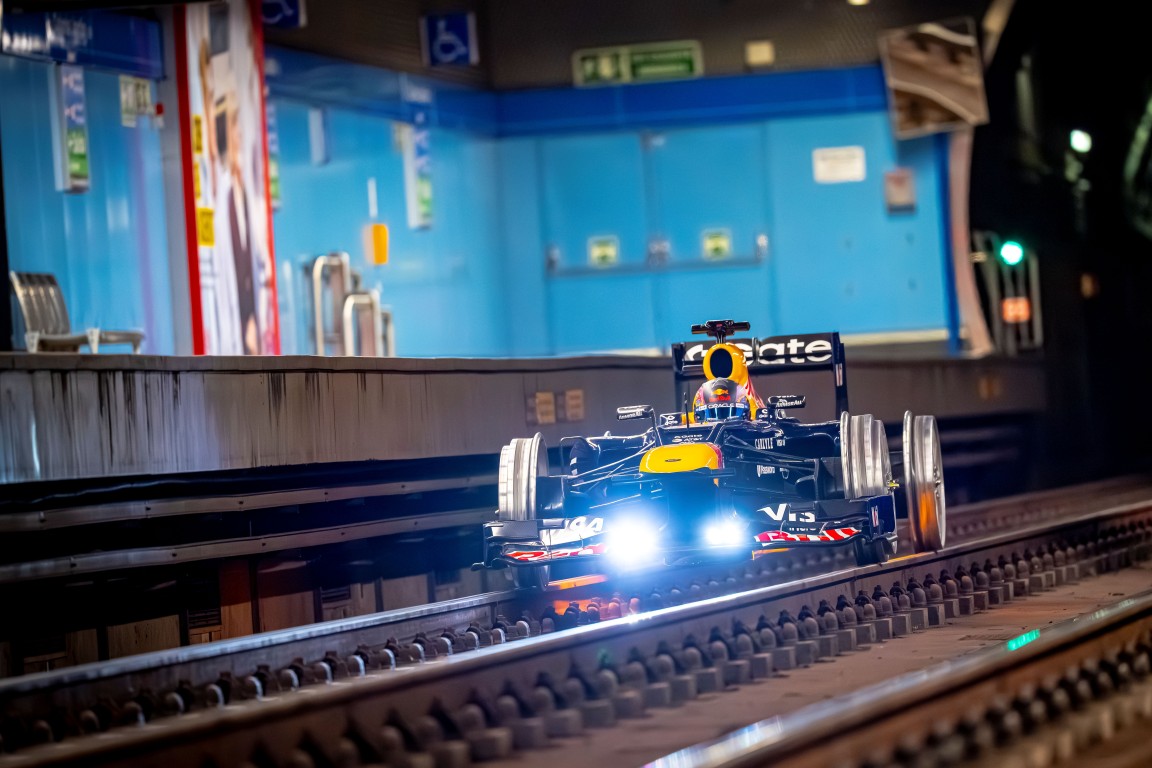
Red Bull drives a championship Formula One car through Madrid Metro tracks.
Anonymous
Key Points
1
Patrick Friesacher described the experience as “surreal,” adding, “It’s very cool to add Metro driver to the resume.”
2
The new Madring circuit is scheduled to host the Spanish Grand Prix through 2035.
3
Madrid’s previous Formula One race was the 1981 Jarama Grand Prix, won by Ferrari’s Gilles Villeneuve; Jacques Laffite finished second and John Watson third.
4
The RB8 was a double-title-winning car: Sebastian Vettel won the drivers’ championship and Red Bull Racing won the constructors’ championship with it in 2012.
5
The Madrid Metro run was part of a broader history of Red Bull showruns, which have previously taken Formula One cars to locations including the Himalayas, the Kitzbühel ski slope and the Dead Sea.
Red Bull Racing pulled off a stunt no Formula One team has attempted before: they drove Sebastian Vettel's 2012 championship-winning RB8 down the tracks of Madrid's Metro system. B&T The modified car ran through closed sections of the underground network, passing Estadio Metropolitano station and two major depots. The car had been fitted with custom metal wheels weighing 29.8 kilograms each — roughly twice as heavy as standard F1 wheels. The stunt marked a wild celebration ahead of Madrid hosting its first Spanish Grand Prix in 45 years at the new Madring circuit.
Former Minardi driver Patrick Friesacher operated the rail-bound RB8 through the underground tunnels. He described the experience as "surreal," saying, "It's very cool to add Metro driver to the resume." Trend Hunter Red Bull has a history of extreme showruns — the team has previously taken F1 cars to the Himalayas, down ski slopes in Kitzbühel, and to the Dead Sea.
Engineering the F1-to-Metro Conversion
Converting a high-speed race car into a subway vehicle required serious engineering work. Sports Cape Magazine Red Bull's team at the Canillejas workshop designed and installed the custom metal wheels that would grip the Metro tracks. The wheels were substantially heavier than F1's standard wheels — at 29.8 kilograms each, they doubled the typical weight. The engine, chassis, and aerodynamics all stayed intact; only the suspension and wheel assembly were modified to fit the rails.
A Historic Return for Madrid's Grand Prix
Madrid hadn't hosted a Formula One race since 1981, when Ferrari's Gilles Villeneuve won at Jarama. Verge Magazine Jacques Lafitte finished second and John Watson third. Now, after 45 years, the city is getting a new F1 venue. The Madring circuit is scheduled to host the Spanish Grand Prix annually through 2035, making this a long-term commitment to bringing top-tier motorsport back to the Spanish capital.
The RB8's Legacy as Red Bull's Defining Machine
The RB8 was no ordinary Formula One car. Grand Prix It won both the drivers' championship with Sebastian Vettel and the constructors' championship for Red Bull Racing in 2012. The car dominated that season and became one of the team's most iconic machines. Now, transformed into a Metro train, it's getting a second life celebrating the sport's return to Madrid.
Red Bull's Tradition of Pushing F1 Boundaries
This Madrid Metro run is just the latest in Red Bull's history of extreme motorsport stunts. The team has driven F1 cars up mountains in the Himalayas, down the legendary ski slope at Kitzbühel, and even to the Dead Sea. Each stunt showcases the car's capabilities while generating global buzz for the brand and the sport. The Madrid Metro run fits perfectly into that playbook — it's audacious, unexpected, and guarantees headlines.
Sentiment
Mostly PositiveNEGATIVENEUTRALPOSITIVE
Publishers
17
Articles
3
Reach
20
Topics
A
AnonymousAuthor


