4th of July Divisions
Nationwide 4th of July Celebrations Contrasted by Patriot Front Demonstrations in Washington D.C.
Anonymous
Key Points
1
In Bangor, Maine, George Hale was named the Grand Marshal of the 2026 Fourth of July Parade and was honored with a commemorative plaque; Hale is a U.S. Navy veteran and longtime WABI broadcaster with more than 60 years at WABI and 73 years in broadcasting.
2
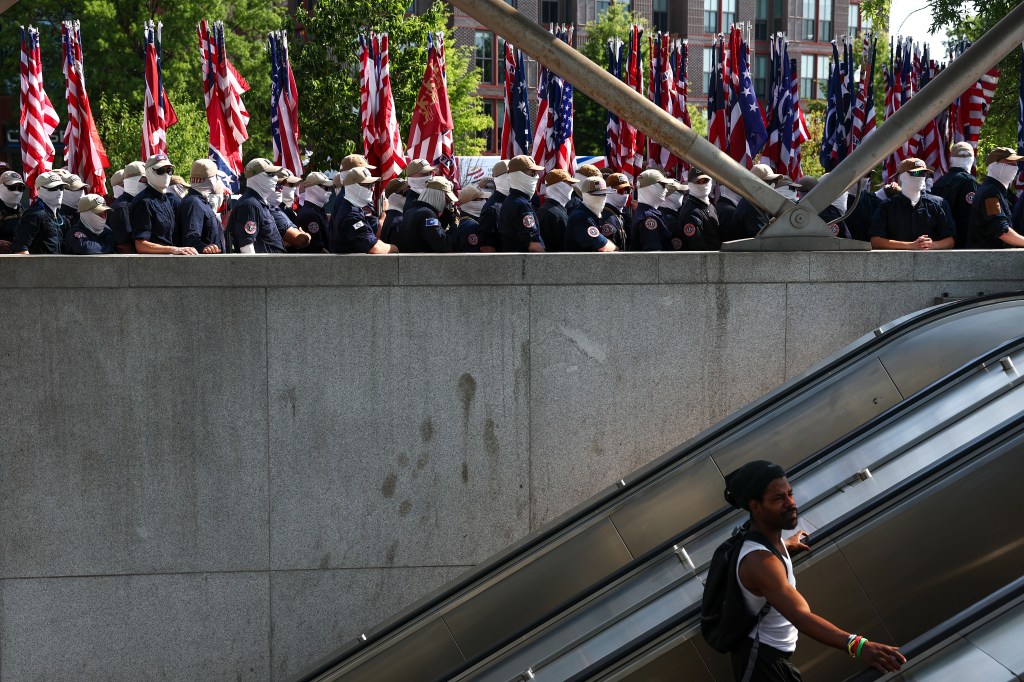
In Washington, D.C., about 400 Patriot Front members were documented wearing blue shirts, khaki pants and white masks, carrying American and Confederate flags as they marched and even boarded a subway car during the July 4 demonstrations.
3
A separate DC march by Patriot Front adherents featured several hundred participants in tan hats bearing the group's logo and carrying Confederate flags as they moved through neighborhoods near the Capitol; police said they recognize the right to peaceful expression while emphasizing public safety.
4
The nationwide 250th celebration included an RAF Red Arrows flyover over New York, a naval review with tall ships, and Times Square hosting a first-of-its-kind ball drop on July 4 (executed eight times to mark independence across time zones), with the Royal Marines Band performing in DC.
Hundreds of masked members of the white supremacist group Patriot Front marched through Washington, D.C. on July 4, turning the nation's 250th birthday into a flashpoint for extremism. About 400 members wore blue shirts, khaki pants, and white masks while carrying American and Confederate flags through the capital, according to The Guardian.
The march drew counterprotests and prompted police statements about balancing peaceful expression with public safety. The demonstration unfolded as millions of Americans celebrated the anniversary with parades, flyovers, and fireworks from coast to coast.
Masked Marchers Chant 'Reclaim America' in DC Streets
Patriot Front members moved through Washington neighborhoods near the Capitol in coordinated formation. They chanted "reclaim America!" as they marched, Charlotte Observer reported. The group carried both American and Confederate flags. At one point, members boarded a Washington subway car together, according to The Guardian.
Members wore tan hats bearing the group's logo alongside their matching uniforms. The masks hid their identities throughout the march. Police said they recognize the right to peaceful expression but stressed that public safety remained the top priority. No major violent incidents were reported during the demonstration.
Who Is Patriot Front and Why Were They There?
Patriot Front is a neo-fascist, white supremacist group founded in the United States. The organization chose July 4 deliberately, framing the 250th anniversary as a moment to push its nationalist message, The Guardian reported. The group's coordinated dress and large turnout of roughly 400 members showed careful planning.
The use of Confederate flags alongside American flags drew sharp attention from onlookers and counterprotesters. Critics called the march a direct attempt to hijack a national celebration. The group's presence highlighted ongoing concerns about organized extremist activity in the United States, according to Mahoning Matters.
250th Anniversary Draws Global Spectacle Across US Cities
Beyond Washington, the 250th independence milestone brought large-scale celebrations nationwide. The RAF Red Arrows flew over New York City. A naval review featuring tall ships took place on the water. The Royal Marines Band performed in Washington, D.C., marking rare international participation in the festivities.
Times Square hosted a first-of-its-kind event: the famous ball dropped eight times to mark midnight across every U.S. time zone. It was the first time the ball dropped on any day other than New Year's Eve. In Bangor, Maine, U.S. Navy veteran and 73-year broadcasting legend George Hale served as Grand Marshal of the local July 4 parade.
Security Tensions Shadow an Otherwise Festive Day
The Patriot Front march forced local authorities to weigh free speech rights against crowd safety. Police publicly acknowledged both concerns without taking action to stop the march. The group's size — several hundred strong — made it one of the most visible extremist demonstrations at a major U.S. holiday in recent memory, according to Charlotte Observer.
Counterprotesters gathered along the route to oppose the march. The split images — masked nationalists on one street, fireworks and celebrations on another — captured the tension running through the day. The 250th anniversary meant to unite the country instead revealed deep divisions still present in American public life.
Sentiment
Mostly NegativeNEGATIVENEUTRALPOSITIVE
Publishers
27
Articles
152
Reach
179
A
AnonymousAuthor


