Voting Law Upheld
Delaware Supreme Court Unanimously Upholds Permanent Absentee Voting Law
Anonymous
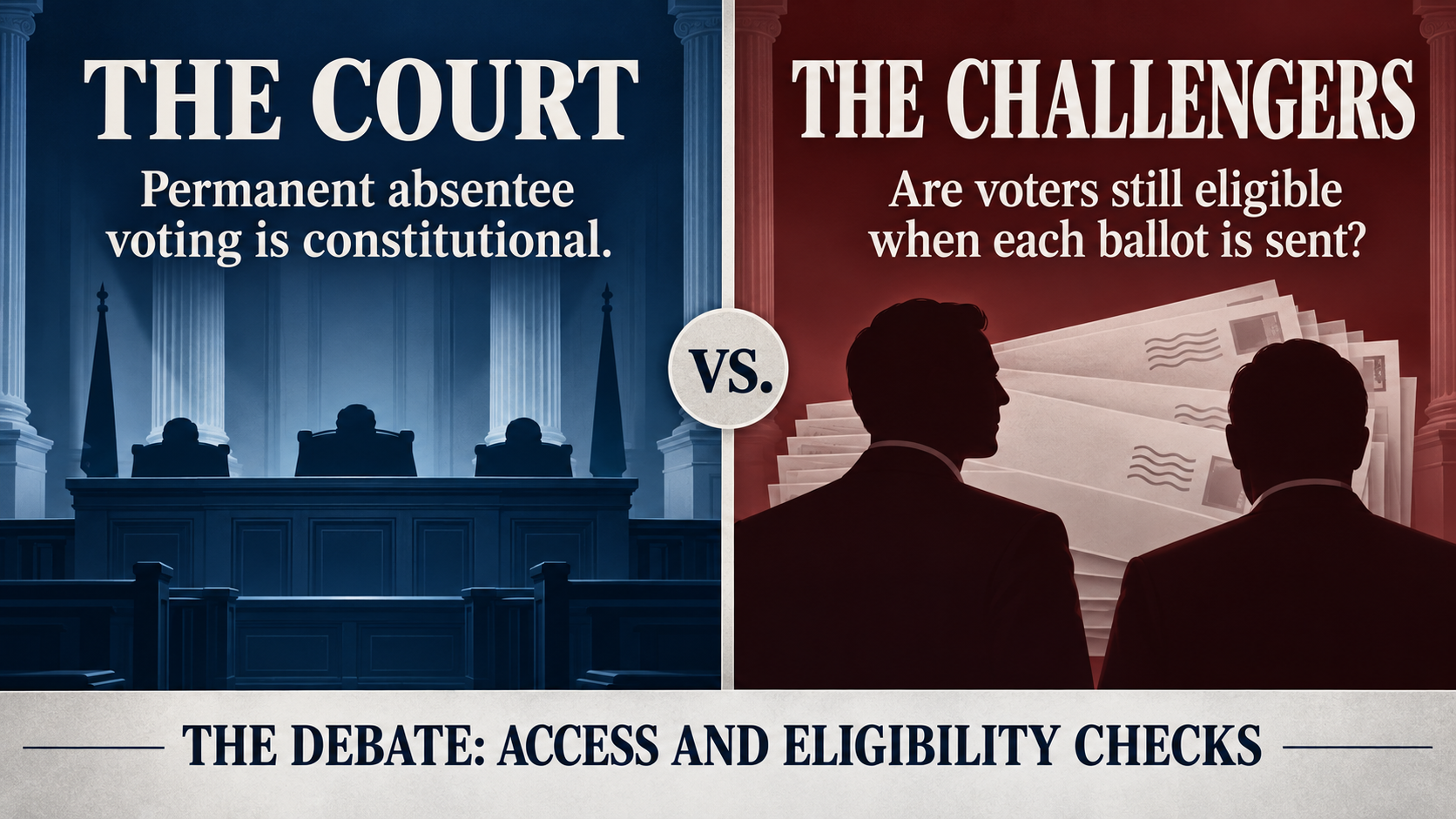
The Delaware Supreme Court unanimously upheld the state’s permanent absentee voting law, rejecting a second constitutional challenge led by state Sen. Gerald Hocker and another candidate. The court said the plaintiffs’ argument was based on a faulty premise and that the statute does not expand absentee voting beyond categories allowed by the Delaware Constitution. The ruling clears the way for the Department of Elections to begin sending permanent absentee ballots to eligible voters, including veterans, seniors, people with disabilities and caregivers. Attorney General Kathy Jennings called the decision a victory for voters who rely on the program, while criticizing the lawsuit as an attempt to suppress voting; opponents have raised concerns about election security and potential fraud. The state will continue offering early voting, Election Day voting and absentee voting for eligible voters.
Key Points
1
More than 38,000 Delaware voters used absentee ballots in the November 2024 election, according to Attorney General Kathy Jennings.
2
The challenge was brought by both State Sen. Gerald Hocker and Independent Party of Delaware Senate candidate Steven Washington, who argued that the law improperly expanded the categories of voters allowed to cast absentee ballots under the state Constitution.
3
Chief Justice Collins Seitz Jr. wrote that “at bottom, the plaintiffs have lost sight of the mountain they must climb to succeed on a facial constitutional challenge to legislation,” in a case that included claims that voter-fraud cases were not adequately policed.
4
Delaware voters may cast an absentee ballot by signing an affidavit stating that they will be out of town on Election Day; the report noted that the system has no enforcement mechanism for that affidavit.
5
The decision marked the second time the Delaware Supreme Court rejected a substantially similar challenge from Hocker; his earlier lawsuit was defeated in 2024, also in a unanimous ruling, while Republican opposition has separately blocked constitutional amendments that would authorize broader no-excuse mail voting.
Sentiment
Mostly NegativeNEGATIVENEUTRALPOSITIVE
Publishers
17
Articles
145
Reach
162
A
AnonymousAuthor