Bhote Koshi Flash Flood
Devastating flash flood along the Bhote Koshi River leaves hundreds missing in Nepal.
Anonymous
Key Points
1
China's leadership mobilized a cross-border response, with President Xi Jinping ordering 'all-out' search and rescue and Premier Li Qiang urging immediate verification of the number of missing and affected people.
2
Initial official tallies cited at least 31 deaths, and the Nepal Tourism Board reported 384 travellers missing (291 foreigners and 93 Nepali nationals).
3
India has opened emergency helplines for its nationals and kept the Indian Air Force on standby to assist, with about 105 Indians among the missing and additional security personnel unaccounted for.
4
The NTB preliminary list notes that 37 Non-Resident Indians (NRIs) are among those missing.
5
Authorities say the Bhote Koshi originates in Tibet and the flood reportedly entered Nepal from the Tibetan side, with a mudslide near Gyirong in Tibet fueling cross-border concerns.
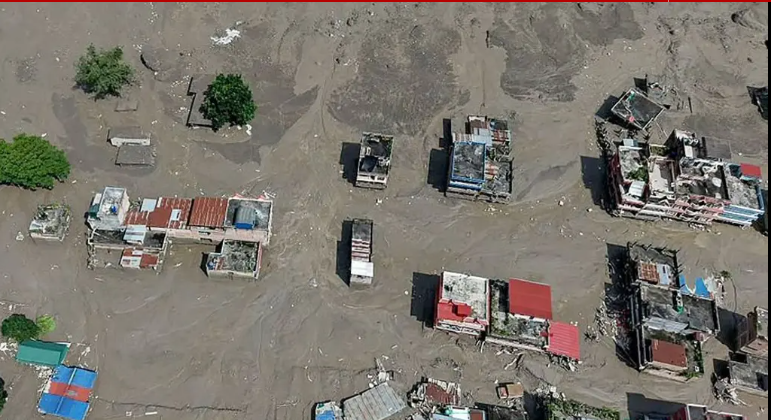
A massive flash flood swept through Nepal's Rasuwa district on August 26 after a magnitude 4.4 earthquake triggered an avalanche of ice and rock along the Bhote Koshi River near the Tibet border. Nepal Tourism Board lists 384 travelers as missing, including 291 foreigners and 93 Nepalese nationals. At least 31 confirmed deaths have been reported, though the toll is expected to rise as rescue teams continue searching.
The surge of mud, rock, and water destroyed bridges, roads, and hydropower infrastructure across both Nepal and Tibet. Indian authorities opened emergency helplines and placed the Indian Air Force on standby, with about 105 Indians among the missing. China's President Xi Jinping ordered an all-out search and rescue operation, while Nepal's Prime Minister Balendra Shah instructed teams to move people in lower areas to safety.
Earthquake Triggers Catastrophic Glacial Lake Outburst
The disaster began with a 4.4 magnitude earthquake at 8:23 AM local time. Nepal's Foreign Minister Shishir Khanal stated that the quake triggered an avalanche of glacial ice and rock upstream on the Tibetan side. This collapse unleashed a torrent that surged through Nepal's border region within minutes, destroying everything in its path.
According to disaster specialists, the warming Himalaya has destabilized glacial systems in the region. NPR quoted a risk reduction expert noting that early warning systems are critical in this changing landscape. The Bhote Koshi originates in Tibet before flowing into Nepal's Rasuwa district, making the river a transboundary hazard zone vulnerable to upstream collapses.
Infrastructure Damage Spans Bridges, Roads, and Power Plants
The floodwaters obliterated critical infrastructure across the region. Government estimates show 19 ground bridges were swept away and 40 kilometers of the main Betrawati–Rasuwagadhi highway suffered severe damage. Nepal's Foreign Minister reported that a large number of hydropower projects, government offices, and road facilities were destroyed, with around 13 to 14 hydropower projects disrupted. Over 200 trucks were also swept away.
The devastation extended to the critical Gyirong Port, Tibet's primary overland commercial gateway to Nepal. Land transit routes used for cross-border pilgrimage and trade—including paths to Mount Kailash—remain halted. The closure threatens bilateral commerce and isolates remote border communities still searching for survivors.
International Response Mobilizes Across Three Nations
India acted swiftly after learning that 105 of its nationals were missing. Indian authorities established emergency helplines and placed air support on standby. The government also reported that 37 Non-Resident Indians were on the missing list, with rescue efforts coordinated through Indian embassies in Kathmandu and Beijing.
China's leadership issued urgent directives within hours. President Xi Jinping ordered an all-out search operation, while Premier Li Qiang demanded immediate verification of casualty figures. Nepal's Prime Minister Balendra Shah instructed his teams to evacuate people from lower-lying areas and mobilized the Nepal Army and Police to lead rescue operations. Nepal's President Ramachandra Paudel expressed deep sorrow and called for intensified relief efforts.
Diverse Nationalities Among Missing Travelers Highlight Tourism Risk
The missing travelers represent at least 15 countries across continents. Beyond 105 Indians, the list includes 17 Malaysians, 12 British nationals, 4 South Africans, 3 Americans, and South Korean hydropower workers. An additional 111 travelers remain unconfirmed in nationality, reflecting the Bhote Koshi region's appeal to international trekkers and tourists.
Trek operators reported disrupted itineraries. Ram Kumar Adhikari, owner of Alpine Eco Trek, told Press Association that he had 12 British citizens scheduled to arrive that morning. The disaster underscores the vulnerability of popular Himalayan routes and the need for better cross-border coordination on natural hazard warnings and rescue protocols.
Sentiment
Mostly NegativeNEGATIVENEUTRALPOSITIVE
Publishers
105
Articles
187
Reach
292
A
AnonymousAuthor


