New Galactic Speed Record
Astronomers Discover Fastest Star Orbiting the Milky Way's Central Black Hole
Key Points
The discovery relied on ESO's Very Large Telescope Interferometer (VLTI), a high-precision instrument that enables resolving and tracking S301's rapid orbit around Sagittarius A*.
S301 is about 10 times closer to the Milky Way's central black hole than the previous record-holding star, increasing sensitivity to the black hole's rotation and spin effects.
Sagittarius A* is estimated to have a mass of roughly 4.3 million solar masses, highlighting the extreme gravity in which S301 moves.
The star S301 is extremely faint, which poses observational challenges but makes it a potentially powerful probe for testing general relativity in strong gravitational fields.
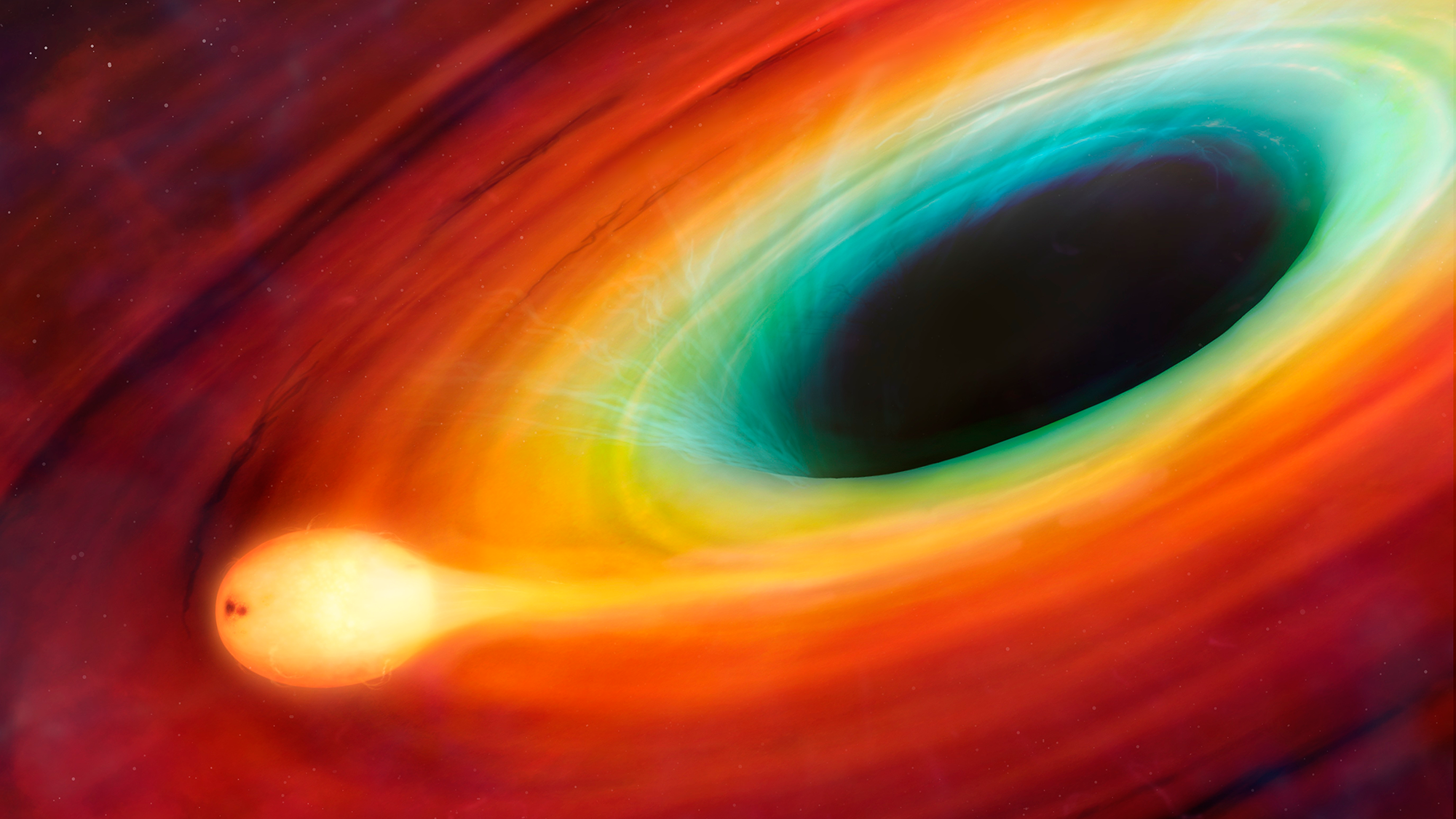
Astronomers have discovered S301, the fastest known star in the Milky Way, racing around the supermassive black hole Sagittarius A* at 25,000 kilometers per second hitechub. The star completes a full orbit in just 8.7 years and swings closer to the black hole than any star observed before — roughly 12 times the Earth-Sun distance at its nearest point voiceofemirates.
This close approach makes S301 a unique laboratory for testing Einstein's theory of gravity. Researchers expect the star to reveal the spin of Sagittarius A*, which has a mass of about 4.3 million suns, and could help confirm predictions about how spacetime warps near black holes geo.tv.
How S301 Orbits 10 Times Closer Than Previous Records
S301 approaches Sagittarius A* at a distance of 136 Schwarzschild radii — a measurement of black hole gravity geo.tv. The previous record-holding star orbited roughly 10 times farther away geo.tv. This dramatic leap means S301 experiences far stronger gravitational pull and rotational effects from the black hole.
The European Southern Observatory's Very Large Telescope Interferometer captured S301's rapid motion with unprecedented precision hitechub. Only such high-resolution instruments can track a star so faint and so close to the black hole's intense radiation and gravity.
Testing General Relativity in the Galaxy's Most Extreme Environment
The star serves as a natural probe of Einstein's general relativity. By watching how S301 orbits and bends near Sagittarius A*, scientists can test whether space and time truly warp the way Einstein predicted universetoday. Strong gravity near black holes is where these predictions face their toughest tests.
Researchers also aim to measure the black hole's spin — a fundamental property Einstein's theory predicts all black holes possess voiceofemirates. If successful, this would confirm the no-hair theorem, which states black holes have only three measurable properties: mass, charge, and spin voiceofemirates.
Scientists Expect Spin Measurements Within a Decade
The Max Planck Institute for Extraterrestrial Physics in Germany led the discovery of S301 us.headtopics. Continued observations over the coming years will refine measurements of the black hole's rotation and angular momentum with far greater accuracy than before.
S301 is extremely faint, which makes observing it challenging. But that same faintness suggests it could provide cleaner data about spacetime near the black hole, free from the glare of brighter objects universetoday. Within ten years, astronomers may finally pin down Sagittarius A*'s spin.
Sentiment
Mostly PositivePublishers
16
Articles
90
Reach
106


