China's Commercial Sea Launch Milestone
China's Orienspace Successfully Launches Gravity-1 from Sea, Deploying Nine Satellites
Anonymous
Key Points
1
Gravity-1 carried six Dongpo satellites for the Huantian constellation (Dongpo-13, 14 and 17–20), including two optical satellites with AI payloads for onboard target recognition and intelligent analysis, plus four SAR satellites with formation flying for millimeter‑level surface deformation monitoring, produced by MinoSpace under a $111 million contract awarded in 2025.
2
In addition to the Dongpo group, the flight included Xiguang-2 (01) hyperspectral satellite, Tianyi-49 from Spacety, and Zidingxiang-3 Lilac-3 from the Harbin Institute of Technology/Beijing Taikonlink Technology.
3
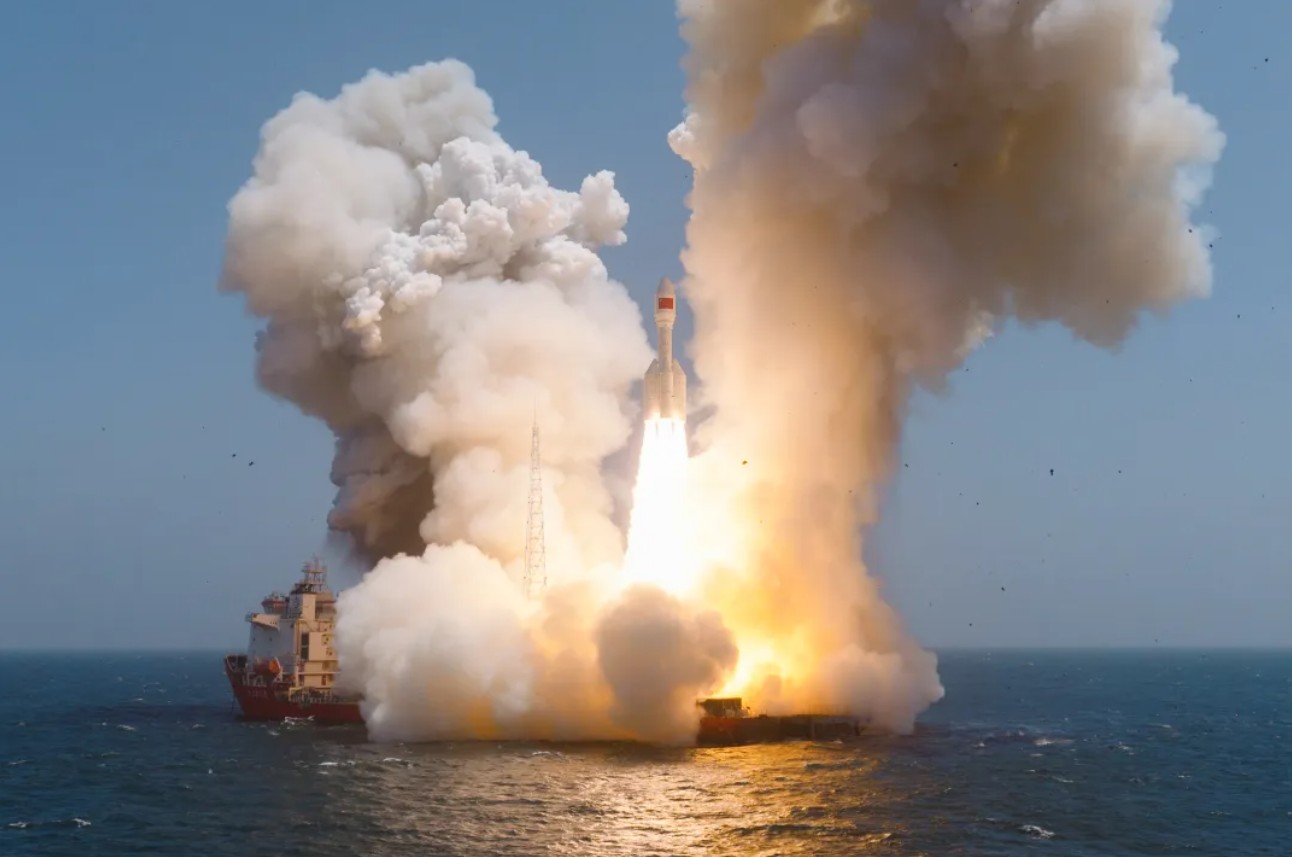
Gravity-1 marked China's first open-sea launch and its first commercial sea-based launch in the East China Sea off the Yangtze River Delta, utilizing a mobile launch platform to enable flexible site selection.
4
Gravity-1 has a payload capacity of about 6.5 tonnes to low-Earth orbit and can deliver roughly 4.2 tonnes to a 500-km sun-synchronous orbit, highlighting its suitability for multi-satellite deployments.
5
Orienspace is targeting Gravity-2, a two-stage reusable liquid‑propellant launcher, with readiness hoped for in Q4, signaling ongoing development beyond Gravity-1.
China's commercial launch firm Orienspace sent nine satellites into orbit on Wednesday, lifting off from the East China Sea off Shanghai aboard a Gravity-1 solid rocket. Xinhua reported that the Taiyuan Satellite Launch Center confirmed all nine satellites reached their designated orbits successfully.
It was Gravity-1's third flight and China's first open-sea, long-range commercial sea launch. The 30-meter-long rocket deployed a mix of Earth observation and remote sensing satellites, marking a new chapter for China's fast-growing private space sector. SpaceNews noted the launch took place from a service ship near Shanghai.
Nine Satellites Packed Into One Historic Flight
The payload included six Dongpo satellites for the Huantian constellation — Dongpo-13, 14, and 17 through 20. Two are optical satellites with AI systems for onboard target recognition. Four are SAR satellites, meaning they use radar to map the ground. Together, they can detect surface movement at millimeter-level precision. SpaceNews reported that MinoSpace built the Dongpo group under a $111 million contract awarded in 2025.
The other three satellites rounded out a diverse manifest. Xiguang-2 (01) is a hyperspectral imager, meaning it captures dozens of light wavelengths invisible to the human eye. Tianyi-49 came from Spacety. Zidingxiang-3, also called Lilac-3, was built by the Harbin Institute of Technology and Beijing Taikonlink Technology. Xinhua confirmed all nine reached orbit.
Sea Launch Platform Opens Up Flexible, Mobile Deployment
Launching from the ocean gives Orienspace a major advantage. A ship can move to different positions to reach different orbits more efficiently. This is especially useful for sun-synchronous orbits, which are popular for Earth observation satellites. Xinhua described this as China's first open-sea and long-range sea launch, set in the East China Sea near the Yangtze River Delta.
Gravity-1 can carry about 6.5 tonnes to low-Earth orbit. To a 500-km sun-synchronous orbit, it can deliver roughly 4.2 tonnes. That capacity makes it well-suited for multi-satellite deployments like this one. SpaceNews reported the rocket lifted off from a launch service ship, not a fixed ground pad.
Orienspace Eyes Reusable Gravity-2 Rocket by Year's End
Orienspace is not stopping with Gravity-1. The company is developing Gravity-2, a two-stage reusable rocket powered by liquid propellant. Reusable rockets can dramatically cut launch costs by flying the same hardware more than once. SpaceNews reported that Orienspace hopes Gravity-2 will be ready in the fourth quarter of this year.
The move fits a broader pattern in China's space industry. Private launch companies are racing to build bigger, cheaper, and reusable rockets — mirroring what SpaceX did in the United States. Gravity-1's third successful flight gives Orienspace real momentum as it pushes toward that next step. Xinhua called Wednesday's mission a successful flight test, underscoring that development work continues.
China's Commercial Space Sector Keeps Gaining Speed
Wednesday's launch is one piece of a much larger push. China is operating its Tiangong space station, planning crewed lunar missions, and building next-generation rockets. Private firms like Orienspace are now a key part of that ecosystem. They fill demand for affordable, flexible launches that state-owned providers do not always cover. Beijing News confirmed the launch marked a successful flight test mission for the Gravity-1 program.
The Huantian constellation, which received six new satellites on this flight, is designed to deliver high-frequency Earth imaging for commercial clients. AI-powered onboard processing means data can be analyzed in space before being sent to the ground. That reduces the time between observation and action — a key selling point for defense, agriculture, and disaster response customers.
Sentiment
Mostly PositiveNEGATIVENEUTRALPOSITIVE
Publishers
14
Articles
12
Reach
26
A
AnonymousAuthor


