Gold Reserve Legal Updates
Gold Reserve announces scheduled dates for critical litigation and arbitration proceedings
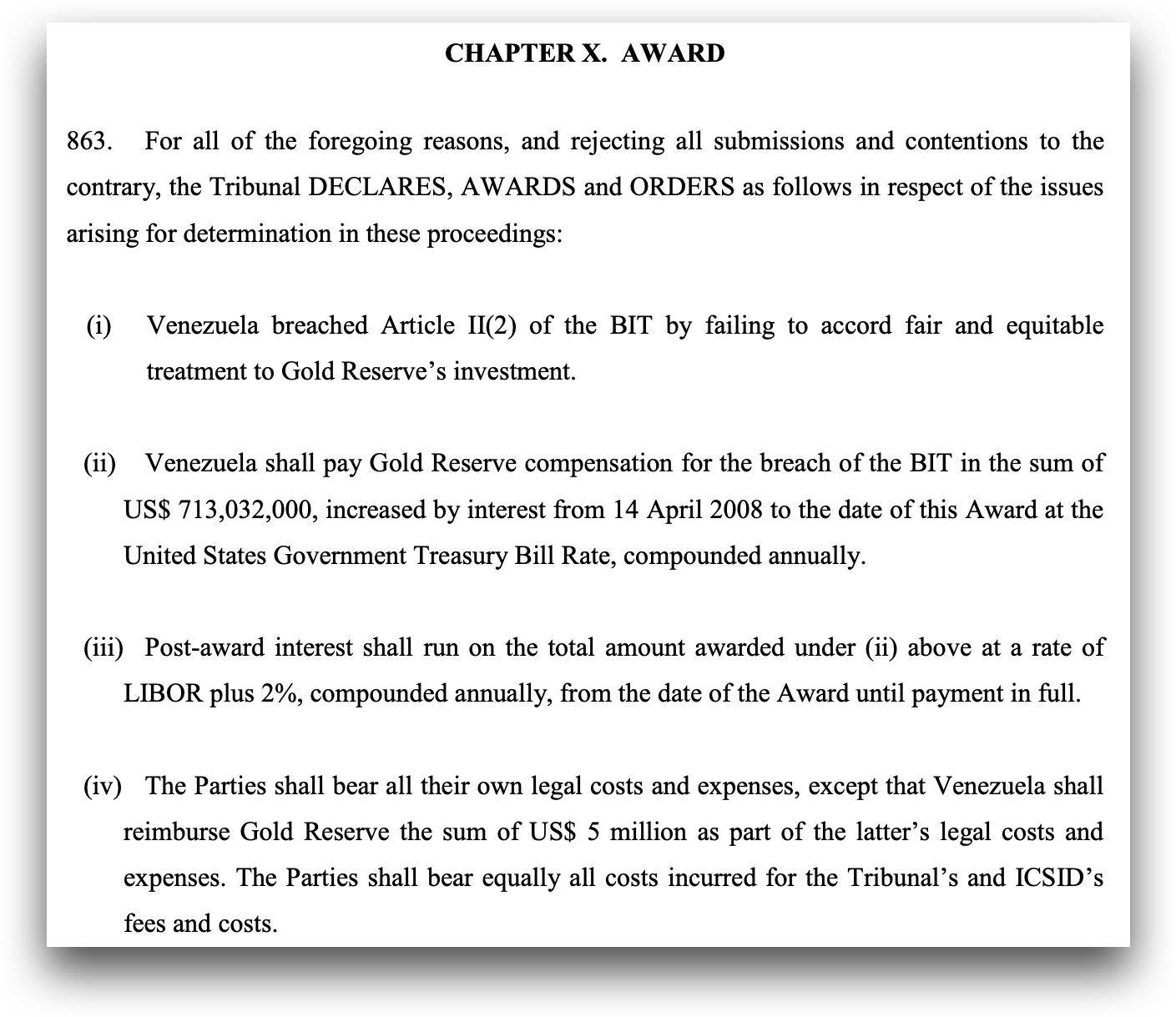
Gold Reserve Ltd. (TSX.V: GRZ) disclosed on August 14, 2026, that three critical legal deadlines are now approaching in its sprawling fight to recover billions from Venezuela. The Delaware Court of Chancery is expected to rule on August 17 on a motion to dismiss the company's lawsuit against former partner Rusoro Mining. Days later, a World Bank arbitration tribunal will hold its first procedural hearing. And on October 21, a federal appeals court will hear oral arguments on whether to void the $5.9 billion sale of Citgo's parent company to Elliott-backed Amber Energy, according to National Post.
The three proceedings together could determine whether Gold Reserve ever collects on a judgment now worth roughly $1.24 billion — or whether it has a shot at far more through a second arbitration claiming over $7 billion, Montreal Gazette reported.
Gold Reserve vs. Rusoro: A Broken Partnership Worth Billions
The two mining companies once tried to work together. In March 2025, Gold Reserve and Rusoro signed a Consortium Agreement to submit a joint credit bid for PDVH — the indirect parent of Citgo Petroleum. Each company held a massive unpaid arbitration award against Venezuela and planned to use those awards as currency in the bid. The partnership collapsed when the court-appointed Special Master instead chose Amber Energy's $5.892 billion cash offer, according to Edmonton Sun.
Gold Reserve alleges Rusoro secretly coordinated with the winning Amber/Elliott bid to secure its own private payout — roughly $1.04 billion in cash, convertible notes, and warrants. Rusoro denies wrongdoing and filed a motion to dismiss, arguing Gold Reserve suffered no irreparable injury. The Delaware Court of Chancery is expected to rule on that motion on August 17, Paris Star Online reported.
Third Circuit Oral Arguments Could Unwind the Citgo Deal
The biggest date on the calendar is October 21, when the U.S. Court of Appeals for the Third Circuit hears oral arguments on the appeal against the Citgo sale. Gold Reserve is one of several parties challenging the deal. In its filings, the company alleged the auction was "plagued with significant conflicts of interest," pointing to $170 million in fees paid to the Special Master's advisors by Elliott affiliates and bondholders, according to Brantford Expositor.
The stakes are enormous. Citgo posted a $936 million profit in Q2 2026 alone, driven by record diesel exports. Gold Reserve's own rejected bid stood at $7.9 billion — $2 billion more than what Amber Energy paid. If the Third Circuit overturns the sale, the entire process could restart, The Sudbury Star reported.
A $7 Billion Venezuela Arbitration Adds Another Front
Separately from the Citgo fight, Gold Reserve launched a second international arbitration in March 2025. The case — filed at the World Bank's International Centre for Settlement of Investment Disputes (ICSID) — claims more than $7 billion. The claim stems from Venezuela's 2022 revocation of mining rights for Siembra Minera, a joint venture formed to develop a massive gold deposit in Bolívar State holding an estimated 52 million troy ounces of gold, according to The Whig.
The newly formed ICSID tribunal will hold its first hearing on procedural matters before September 12, according to Recorder. With gold trading near $4,300 per ounce in 2026, the Siembra Minera deposit carries a potential value in the tens of billions. Gold Reserve said it will provide updates as each proceeding develops.
Gold Reserve Restructures to Navigate U.S. Sanctions on Venezuela
While the courtroom battles play out, Gold Reserve is also reshaping its corporate structure. In May 2026, the company announced plans to spin out its Venezuelan and Alaskan mining assets into a new Miami-based entity called American Heralds Mining Corp. The move is designed to align with U.S. critical mineral policy and avoid the sanctions complications that come with its current Bermuda domicile, Fort McMurray Today reported.
The restructuring signals that Gold Reserve is preparing for a scenario where it eventually returns to operating in Venezuela — not just litigating against it. Shifting U.S.-Venezuela relations and a new Venezuelan mining law have opened a narrow window for that possibility. Whether the company can exploit it depends heavily on what happens in Delaware and Washington over the next two months, Leader-Post reported.
Sentiment
NeutralPublishers
27
Articles
27
Reach
27


