Sports, Celebrity, and the Bronco Chase
OJ Simpson's Bronco Chase Marked a Shift in 1990s Sports Coverage and Celebrity Culture
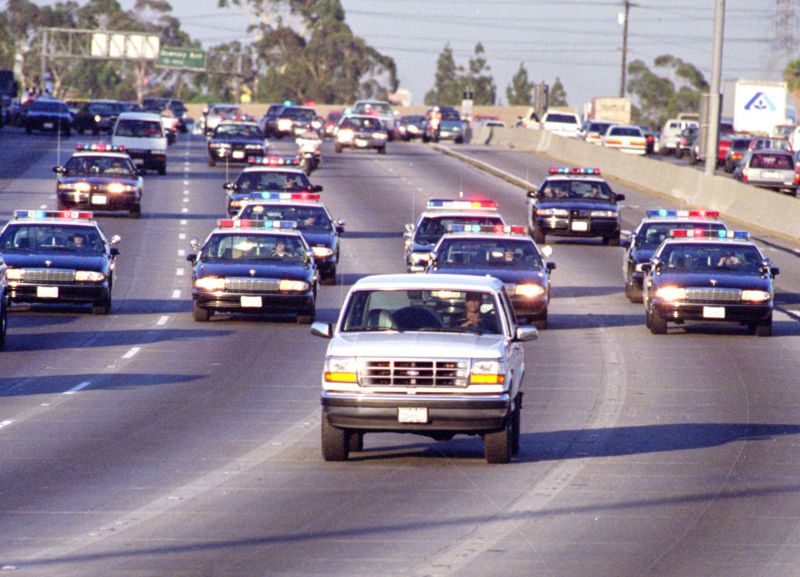
On June 17, 1994, millions of Americans tuned in to watch the New York Knicks play Game 5 of the NBA Finals — but the game was quickly forgotten. Networks cut away to broadcast a slow-speed police chase on a Los Angeles freeway, as former NFL star OJ Simpson fled in a white Ford Bronco driven by his ex-teammate Al Cowlings. The chase became one of the most-watched television events in American history, according to CNN.
That moment captured something bigger than a single scandal. The 1990s was a decade where sports, celebrity, and media collided in ways never seen before. And no one embodied that shift more than Simpson.
A Slow Chase That Stopped the Country
The Bronco chase unfolded live on national television for roughly 90 minutes. An estimated 95 million people watched, according to CNN. Networks interrupted their regular programming — including the NBA Finals — to carry the footage wall-to-wall. It was a preview of a media world where breaking news could swallow everything else whole.
Simpson had been a beloved figure for decades. He won the Heisman Trophy in 1968, rushed for over 11,000 yards in the NFL, and later became a TV pitchman and actor. His fame made the chase feel surreal. Here was one of America's most recognizable faces, wanted for questioning in the murders of his ex-wife Nicole Brown Simpson and her friend Ron Goldman.
The 1990s Blurred Sports and Celebrity Culture
The Simpson chase did not happen in a vacuum. The 1990s saw sports stars become mainstream celebrities in a way they never had before. Athletes like Michael Jordan and Magic Johnson were not just players — they were cultural icons with endorsement deals and movie roles, according to Local News 8.
This shift was driven in part by the explosion of 24-hour sports television. Channels like ESPN gave fans more access to athletes than ever before. That access made stars feel closer — but it also put their private lives under a much brighter spotlight. The line between what happened on the field and off it started to disappear.
Simpson Sat at the Center of Celebrity and Scandal
Few athletes captured the 1990s media moment like Simpson. He was not just a football legend. He had crossed over into Hollywood and advertising, appearing in Hertz rental car commercials and the "Naked Gun" film series. His face was everywhere, according to CNN. That fame made his fall from grace all the more dramatic and all the more watchable.
When Simpson was later acquitted of murder in October 1995, an estimated 150 million people watched the verdict live. The trial had run for nine months and dominated news coverage the entire time. It showed, in stark terms, how a sports scandal could consume an entire nation's attention for over a year.
How the Chase Changed Sports Media Forever
The Bronco chase set a template for the media era that followed. It proved that sports celebrities could drive news cycles far beyond the sports page. Scandal, fame, and live television were a powerful mix. Networks learned that audiences would stay glued to a screen for hours when a famous face was involved, according to Local News 8.
That lesson shaped how sports media covered athletes for the next three decades. Personal lives became fair game. Courtroom dramas became prime-time events. The chase lasted just 50 miles on a Los Angeles freeway, but its impact on American media stretched much further and lasted much longer.
Sentiment
NeutralPublishers
5
Articles
4
Reach
5


