Waste to Clean Hydrogen
Hyundai Motor Group Opens Korea's First Waste-to-Hydrogen Complex in Cheongju for Circular Economy
Key Points
Completion ceremony attendees included Hyundai Motor Group President Seo Gang-hyun, Climate, Energy and Environment Vice Minister Lee Ho-hyun, North Chungcheong Province Governor Shin Yong-han, and Cheongju Mayor Lee Jang-sub; Seo described HTWO ENERGY Cheongju as 'an example of a circular economy model based on local production and consumption,' and said Hyundai will help Cheongju become Korea's leading inland hydrogen city and expand the model to global markets.
The facility’s hydrogen production process involves upgrading biogas to high-purity biomethane by removing impurities such as hydrogen sulfide and moisture, then producing hydrogen via steam methane reforming, with carbon dioxide captured and liquefied for reuse or sale, and integrated hydrogen compression and storage.
The project is designed to convert local waste into hydrogen for regional use, underscoring a circular economy approach and Hyundai’s goal to build a self-sufficient hydrogen ecosystem that can be expanded to national and global markets.
Cheongju was selected as a final recipient of the Hydrogen City Development Project, with plans tied to building an integrated biogas facility for organic waste treatment, reinforcing government–industry collaboration to advance hydrogen mobility and local energy self-sufficiency.
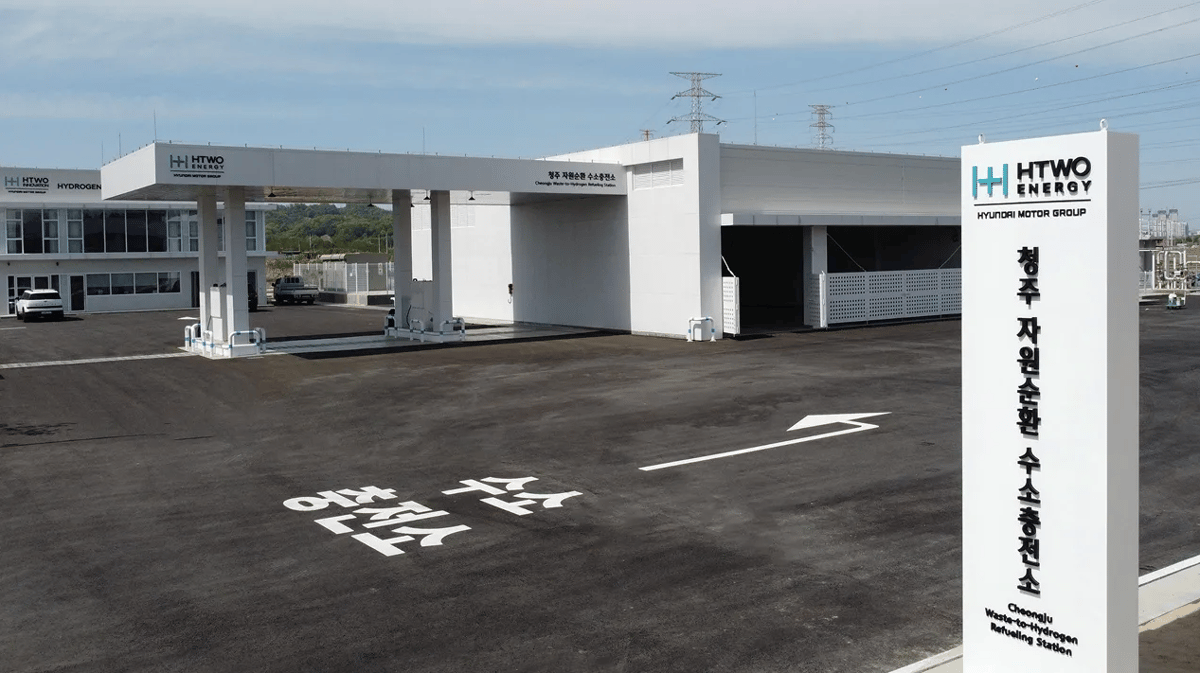
Hyundai Motor Group has opened South Korea's first waste-to-hydrogen complex, turning sewage sludge into clean fuel for local vehicles. The facility, called HTWO ENERGY Cheongju, sits on a 7,500-square-meter site at a public sewage treatment plant in Cheongju, North Chungcheong Province, according to Korea Herald.
The plant currently produces around 500 kilograms of hydrogen per day. Hyundai plans to scale that up to roughly 2 tons per day by 2030, according to Gasworld. Group President Seo Gang-hyun called it "an example of a circular economy model based on local production and consumption."
How Sewage Sludge Becomes Clean Hydrogen Fuel
The process starts with biogas collected from local sewage sludge. Workers first remove impurities like hydrogen sulfide and moisture. That upgrades the raw biogas into high-purity biomethane. The plant then runs the biomethane through steam methane reforming to extract hydrogen gas, according to Seoul Daily.
The facility also captures the carbon dioxide produced during that process. The CO2 is liquefied and can be reused or sold. The site includes hydrogen compression and storage units, plus a refueling station for fuel-cell vehicles and buses. Nothing goes to waste.
Local Production, Local Use — A Self-Sufficient Model
Cheongju was chosen as a recipient of South Korea's Hydrogen City Development Project. The city is building an integrated biogas facility to handle organic waste, reinforcing the local-loop approach. The goal is for Cheongju to become Korea's leading inland hydrogen city, Seoul Daily reported.
Hyundai describes the project as a "local production for local consumption" model. Hydrogen made from Cheongju's own waste stays in Cheongju to fuel its own vehicles. Seo said Hyundai plans to expand this model to national and then global markets.
Government Officials Join Hyundai at Opening Ceremony
The opening drew senior figures from both industry and government. Attendees included Climate, Energy and Environment Vice Minister Lee Ho-hyun, North Chungcheong Province Governor Shin Yong-han, and Cheongju Mayor Lee Jang-sub, according to Seoul Daily. Their presence signals strong state backing for hydrogen mobility in Korea.
The government-industry partnership reflects Korea's broader push for local energy self-sufficiency. Hydrogen city projects like Cheongju are part of a national strategy. Hyundai sees public sewage infrastructure as a ready-made network for scaling hydrogen production across the country.
Scaling Up: From 500 Kilograms to a National Blueprint
At full capacity in 2030, the plant's 2-ton daily output could fuel hundreds of hydrogen fuel-cell buses and cars. Right now at 500 kilograms per day, the facility is already supplying regional demand. Gasworld noted that the ramp-up plan is tied to growth in Cheongju's hydrogen vehicle fleet.
Hyundai's HTWO brand covers hydrogen production, storage, transportation, and mobility. The Cheongju plant pulls all those pieces together in one place. If it works here, Hyundai says it can copy the model in cities across Korea and eventually overseas, according to Seoul Daily.
Sentiment
Mostly PositivePublishers
13
Articles
7
Reach
20


