China's Asteroid Arrival
China's Tianwen-2 probe begins scientific exploration of asteroid 2016 HO3 after billion-kilometer journey
Anonymous
Key Points
1
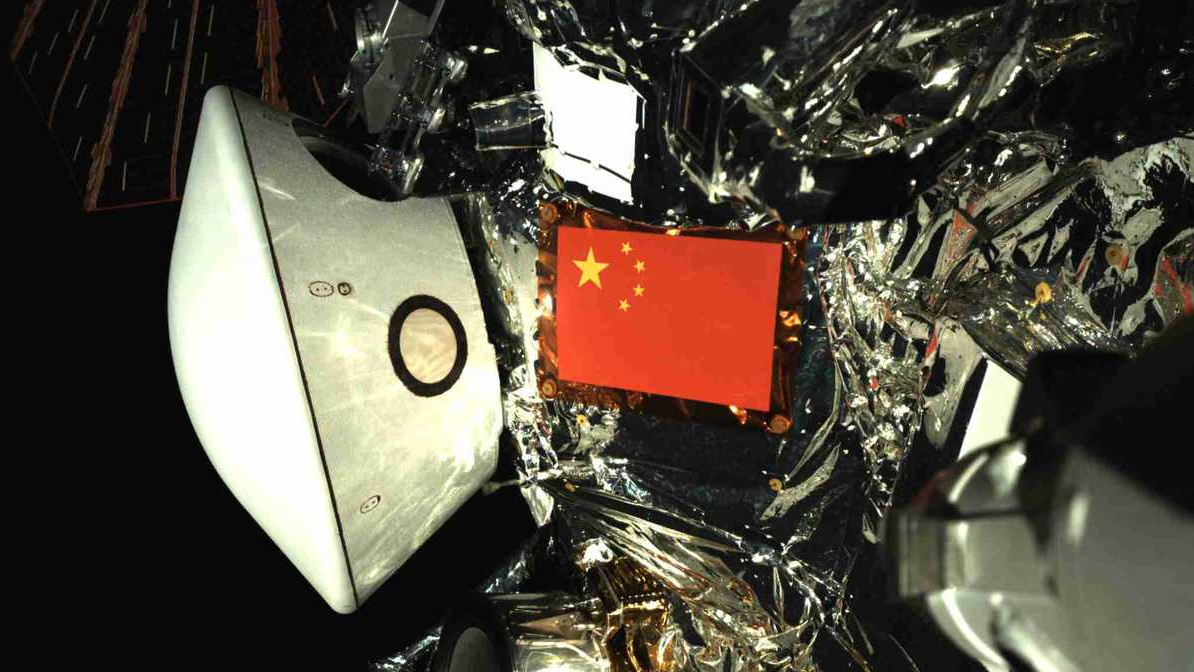
New image released by the CNSA shows 2016HO3 as captured by Tianwen-2 from roughly 20 kilometers away during its approach.
2
Tianwen-2 was launched on May 29, 2025, from the Xichang Satellite Launch Center, marking its start to a multi-year asteroid exploration program.
3
The mission’s decade-long scope includes not only asteroid 2016HO3 sampling but also the main-belt comet 311P, which lies farther from the Sun than Mars.
4
During its approach, Tianwen-2 captured imagery of 2016HO3 to support assessments of its morphology, material composition, and internal structure.
China's Tianwen-2 probe has arrived within 20 kilometers of asteroid 2016HO3, kicking off a detailed scientific exploration phase after a roughly 400-day, 1-billion-kilometer journey through deep space, according to Xinhua. The mission marks China's first attempt to collect samples from an asteroid and return them to Earth.
Global Times reported that China's National Space Administration released a new image of the asteroid — also known as Kamoʻoalewa — taken by Tianwen-2 from about 20 kilometers away. The probe is now gathering data on the asteroid's shape, surface materials, and internal structure to prepare for future sample collection.
A 400-Day Journey to a Tiny Near-Earth Asteroid
Tianwen-2 launched on May 29, 2025, from the Xichang Satellite Launch Center in southwest China. It traveled roughly 1 billion kilometers before reaching its target. The probe first spotted 2016HO3 on June 6, 2026. By June 7, it had entered a coplanar trajectory at 30,000 kilometers from the asteroid. It closed in to 2,000 kilometers by June 19, according to Xinhua.
The approach relied on deep-space engine burns and optical navigation — a system that uses onboard cameras to track the asteroid's position. Ground-based telescopes had placed the asteroid's location within a range of hundreds of kilometers. The onboard navigation narrowed that uncertainty down to the kilometer scale, Yahoo News reported.
Studying the Asteroid's Surface Before Touching It
Now that Tianwen-2 is just 20 kilometers away, scientists can study the asteroid up close. The probe is examining 2016HO3's morphology — meaning its shape and surface features — as well as its material composition and internal structure. This work is meant to find the safest and most scientifically valuable spot for a future sample grab, according to Xinhua.
2016HO3 is a small near-Earth asteroid that also orbits close to Earth's path around the Sun. It is sometimes called a "quasi-satellite" because it loops near Earth for long periods. Its small size and stable orbit made it a good first target for China's asteroid sampling program, Global Times noted.
A Decade-Long Mission With a Second, Distant Target
Tianwen-2's work does not stop at 2016HO3. After completing its study and sample collection at the asteroid, the probe will travel on to 311P — a main-belt comet that sits farther from the Sun than Mars. That second leg of the mission will take years, making Tianwen-2 a decade-long deep-space endeavor, according to Newsy Today.
Main-belt comets are rare objects that orbit in the asteroid belt but sometimes release gas and dust like a comet. Scientists believe studying 311P could offer clues about the early solar system and the origins of water on Earth. China's dual-target design puts Tianwen-2 among the most ambitious asteroid missions ever flown.
China's Growing Ambitions in Deep-Space Exploration
Tianwen-2 is the latest step in China's rapid push beyond the Moon. The country previously landed a rover on Mars with its Tianwen-1 mission in 2021. An asteroid sample-return mission puts China in rare company — only Japan's Hayabusa missions have successfully returned asteroid material to Earth, Yahoo News noted.
With Tianwen-2 now in exploration mode, the next major milestone will be identifying a landing zone on 2016HO3's surface. A successful sample return would give scientists pristine space rock to study in labs on Earth — material that has not changed since the solar system formed roughly 4.5 billion years ago.
Sentiment
Mostly PositiveNEGATIVENEUTRALPOSITIVE
Publishers
23
Articles
70
Reach
93
Topics
A
AnonymousAuthor


