Diamond Quantum Breakthrough
Fujitsu unveils breakthrough quantum computing prototype utilizing diamond-integrated tin-vacancy centers
Anonymous
Key Points
1
Fujitsu developed a heterogeneous bonding process to join tin-ion-implanted diamond with silicon substrates coated in alumina and oxide, and thinned the diamond from several hundred micrometers to several hundred nanometers for chip integration.
2
SnV centers have higher crystal symmetry than the nitrogen-vacancy centers traditionally used in diamond-spin systems, making them less vulnerable to environmental noise; Fujitsu cautioned that the roughly 10-times-brighter figure refers specifically to photon brightness, not overall qubit performance.
3
The partners’ earlier sub-0.1% gate-error result was supported by high-purity diamonds and carbon-13 isotope control at 0.01%, a technique used to reduce environmental noise; the result was published in a peer-reviewed journal in March 2025.
4
Fujitsu and its partners established the Fujitsu Advanced Computing Lab Delft in January 2024 to develop a blueprint for modular quantum computers capable of scaling beyond 1,000 qubits.
5
The prototype includes a control mechanism that translates quantum circuits into sequences using light, microwaves and radio-frequency waves, and Fujitsu CTO Vivek Mahajan said the approach could potentially be integrated with superconducting quantum computers.
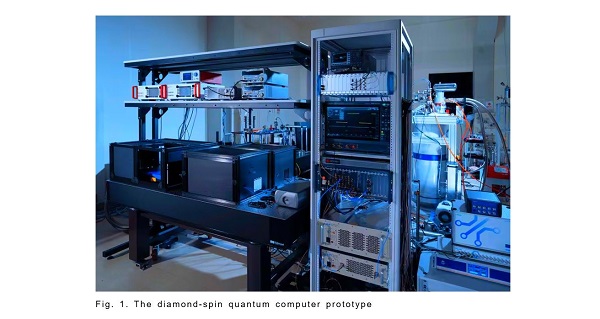
Fujitsu has built the world's first working quantum computer prototype that embeds tin-vacancy centers directly into diamond chips, operating at minus 271.6 degrees Celsius. Working with TU Delft and QuTech, the company created Semiconductor for You says a system where diamond-spin qubits connect through light, potentially unlocking a simpler path to scaling quantum machines beyond today's superconducting limits.
The breakthrough hinges on making tin-vacancy (SnV) centers roughly 10 times brighter than older nitrogen-vacancy alternatives, and achieving quantum gate errors below 0.1 percent. Semiconductor for You reports Fujitsu plans a multi-module prototype by 2027, with targets of 250 logical qubits by fiscal 2030 and 1,000 by fiscal 2035.
Why Diamond Chips Beat Traditional Quantum Approaches
Diamond-spin systems operate warmer than superconducting quantum computers, reducing cooling costs and complexity. Semiconductor for You explains that tin-vacancy centers have higher crystal symmetry than conventional nitrogen-vacancy centers, making them far less vulnerable to environmental noise—a major source of errors in quantum computing.
Fujitsu's heterogeneous bonding process fuses tin-implanted diamond with silicon substrates, then thins the diamond from hundreds of micrometers to hundreds of nanometers for seamless chip integration. This engineering allows multiple diamond modules to link optically, a design choice that could eventually scale the system to thousands of qubits.
How the Team Achieved Sub-0.1 Percent Error Rates
The partners used high-purity diamonds and carbon-13 isotope control at just 0.01 percent to suppress environmental noise and boost qubit stability. Semiconductor for You notes this technique has been validated in peer-reviewed research published in March 2025, proving the diamond-spin approach can rival superconducting systems on precision.
The prototype includes a control system that converts quantum circuits into command sequences using light, microwaves, and radio-frequency waves. Users access the system through Fujitsu's Hybrid Quantum Computing Platform without needing specialized quantum expertise—a key step toward practical adoption.
Fujitsu's Multi-Year Roadmap and Integration Plans
Fujitsu established the Fujitsu Advanced Computing Lab Delft in January 2024 to develop blueprints for modular quantum computers scaling beyond 1,000 qubits. The company aims to ship a multi-module prototype by 2027, demonstrating that optical linking of diamond chips can work in practice.
Fujitsu CTO Vivek Mahajan indicated the diamond-spin approach could integrate with superconducting quantum computers, creating hybrid systems that combine the strengths of both technologies. ITBrief reports the company is also testing quantum software on neutral-atom hardware with Japanese startup Yaqumo, hedging its bets across multiple quantum architectures.
Sentiment
Mostly PositiveNEGATIVENEUTRALPOSITIVE
Publishers
17
Articles
78
Reach
95
Topics
A
AnonymousAuthor


