Groq Fuels AI Expansion
Groq Secures Over $1 Billion Total Funding, Scales Global AI Inference Capacity with NVIDIA
Key Points
Groq currently serves more than six million developers, Fortune 500 enterprises and thousands of AI-native companies, underscoring its broad enterprise footprint.
The company’s data-center capacity is 54 megawatts today, with plans to scale to 200+ megawatts by 2027 to support larger NVIDIA-accelerated clusters.
Nvidia’s December 2025 licensing deal with Groq is valued at roughly $20 billion and has catalyzed a major leadership and talent shift toward Nvidia.
Groq has added new leadership as part of its rebuild, including COO Alan Rice (formerly of xAI and Meta), CTO Sinclair Schuller, and CPO Rakesh Malhotra.
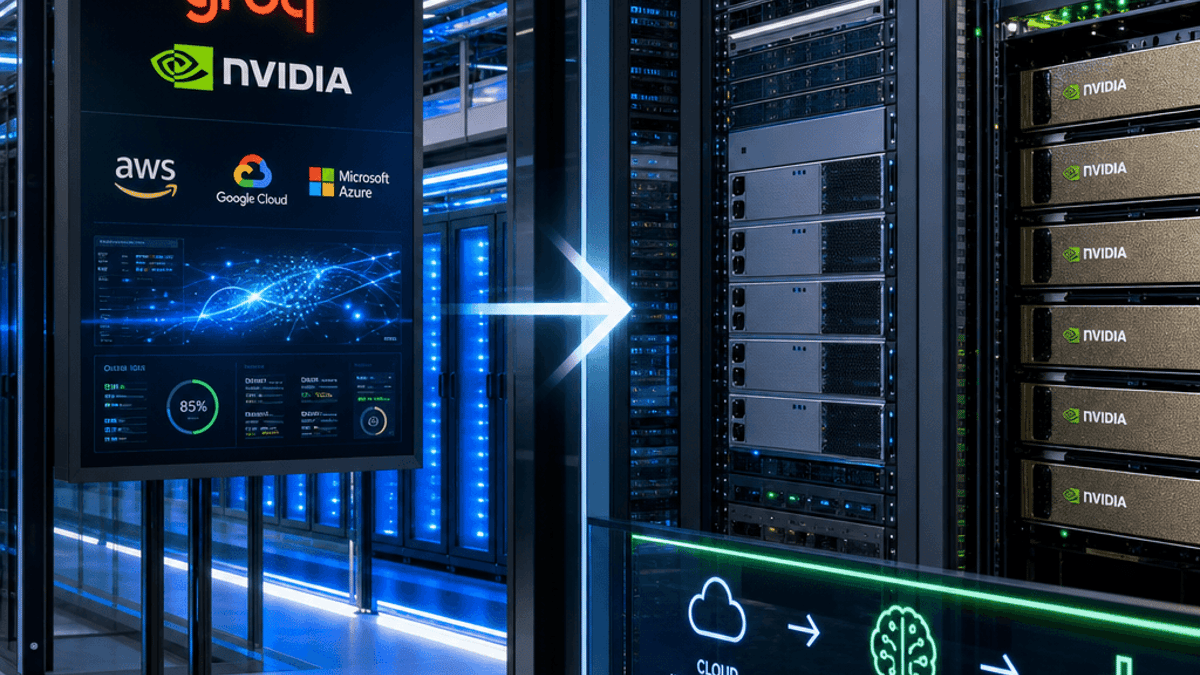
Nvidia’s LPX platform will be deployed within Groq’s data centers as part of the expansion, leveraging Groq’s Language Processing Unit (LPU) technology and integrating Nvidia’s LPX stack.
Groq has raised $350 million in a Series A round led by Disruptive, with Nvidia joining as a participant, at a valuation of $3.5 billion — half the $6.9 billion it commanded just last September, according to TechCrunch. The funding brings Groq's total capital raised to roughly $1 billion and marks a sharp pivot: the company is stepping away from making its own AI chips to become a "neocloud" provider offering GPU-powered infrastructure to enterprises.
The shift is dramatic. Groq built its name on its Language Processing Unit, a custom chip designed to run AI faster than Nvidia's GPUs. Now, according to The Next Web, it will deploy Nvidia's own hardware inside its data centers — and Nvidia's participation in the funding round signals a peace deal of sorts between former rivals.
Nvidia's $20 Billion Deal Reshapes Groq's Direction
The turning point came in December 2025. Nvidia struck a licensing deal with Groq worth roughly $20 billion, according to TechBuzz. The deal gave Nvidia access to Groq's LPU technology and set off a talent exodus. Groq founder and CEO Jonathan Ross and president Sunny Madra both left to join Nvidia following the agreement.
The departures forced a full leadership rebuild. Groq has since brought in Alan Rice as COO — previously at xAI and Meta — along with CTO Sinclair Schuller and CPO Rakesh Malhotra. The new team is tasked with steering Groq through its identity shift from chipmaker to cloud provider.
From AI Chip Startup to Neocloud Provider
Groq is now positioning itself as a "neocloud" — a newer kind of cloud company that rents out powerful AI compute to businesses. TechCrunch reports the company will support customers that need medium to large clusters of Nvidia-accelerated hardware for both training and running AI models. Nvidia's LPX platform will be deployed directly inside Groq's data centers.
The company already serves more than six million developers, thousands of AI-native startups, and Fortune 500 enterprises, according to Whalesbook. Its current data center capacity sits at 54 megawatts. Groq plans to grow that to more than 200 megawatts by 2027 — nearly four times its current size.
A Valuation Cut in Half — But Investors Stay In
Groq's new $3.5 billion valuation is a steep drop from the $6.9 billion it reached in September 2024, as The Next Web noted. That kind of markdown is unusual for a company still attracting major investors. It reflects the tough reality of the AI chip market, where competing with Nvidia head-on proved nearly impossible.
Still, the round drew serious backing. Disruptive, the Dallas-based firm, led the deal. Nvidia's participation adds strategic weight beyond the money. Yahoo Finance reports that the new capital will go toward expanding Groq's data center footprint and scaling its token-processing capabilities — the speed at which AI models generate outputs — on a global level.
What Groq's Pivot Means for the AI Infrastructure Race
Groq's move into neoclouds puts it alongside companies like CoreWeave and Lambda Labs — firms that rent Nvidia GPUs to AI developers at scale. The difference is that Groq brings its own LPU technology to the table. Even as it deploys Nvidia hardware, it retains proprietary inference tech that could give it an edge in speed and cost.
The company's bet is simple: enterprises need fast, affordable AI inference, and they need a lot of it. By owning 13 data centers across multiple regions and targeting 200+ megawatts of capacity, Groq is racing to become the go-to option for businesses that can't — or won't — build their own AI infrastructure, according to TechBuzz.
Sentiment
Mostly PositivePublishers
15
Articles
22
Reach
37


